
Crafting a Winning Project Plan Outline
Think of a project plan outline as the skeleton of your entire project. It's the strategic document that takes your big-picture goals and breaks them down into tangible, manageable pieces—things like the project scope, a realistic schedule, the budget you're working with, and exactly what you'll deliver at the end. It's truly the foundational blueprint for getting things done right, making sure everyone from the newest team member to the top stakeholder is on the same page from day one.
Why a Great Project Plan Outline Is Non-Negotiable
Let's be real—creating a project plan outline can feel like another box to check. But in practice, it's the very compass that steers a project toward success and away from chaos. A well-thought-out outline is your best defense against common project disasters, turning abstract ideas into a clear, actionable roadmap.
Without this structure, projects quickly become vulnerable to problems that kill budgets and morale. The most infamous of these is scope creep, where new requirements start piling on after the project has already started, inevitably leading to missed deadlines and blown budgets. Your outline is a bulwark against this, setting firm boundaries on what’s in and, just as importantly, what’s out.
Aligning Stakeholders and Exposing Risks
One of the most powerful things an outline does is get every single stakeholder aligned from the get-go. When the objectives, deliverables, and timelines are written down in black and white, there’s no room for guesswork. This shared clarity is the secret to smooth execution and is typically ironed out in early planning meetings. For a deep dive into structuring these critical conversations, our guide on crafting the perfect project kickoff meeting agenda is a great place to start.
This process also forces potential risks out into the open before they become full-blown emergencies. A good plan makes you think through dependencies, resource limitations, and other potential roadblocks. For instance, if you realize a lead developer has a vacation scheduled during a critical sprint, you can plan around it now instead of panicking later.
A project without a critical path is like a ship without a rudder. A great project plan outline doesn't just list tasks; it maps the most efficient route to your destination, anticipating storms and charting a clear course for the entire crew.
The massive growth of planning software shows just how vital this has become. The project management software market, valued at roughly USD 7.24 billion in 2025, is expected to surge to USD 12.02 billion by 2030. As you can see from these project management trends at thebusinessdive.com, this isn't just a passing fad. Structured planning has become a core survival tool for modern businesses, giving you the control and confidence needed to deliver successfully.
Defining the Core Components of Your Plan
Alright, now that we know why a project plan outline is so crucial, let's get into the nuts and bolts. This isn't about just filling in a template; each section is a vital part of your project's engine. When you get these pieces right, they work together to give you clarity, direction, and a solid defense against the chaos that can derail even the best-laid plans.
Think of the Executive Summary as your project’s elevator pitch. It’s often the only part a busy executive will actually read, so it has to be sharp. In just a paragraph or two, it needs to nail the "what" and "why" of the project, highlighting the main objective and the business value it delivers. Crafting a summary that gets you an instant "yes" is a real skill.
Next, every project needs a clear destination. That's where SMART Goals come in. Vague goals like "improve user experience" are a recipe for disaster because you can't measure them. SMART goals, on the other hand, leave zero room for interpretation.
- Specific: Instead of "launch a new website," get precise: "Launch a redesigned e-commerce website with a one-page checkout."
- Measurable: How will you know you've won? "Reduce cart abandonment by 15% within three months of launch."
- Achievable: Be honest. Can you actually hit this goal with the team and resources you have?
- Relevant: Does this project actually push the company’s bigger objectives forward?
- Time-bound: Give it a deadline. "Achieve the 15% reduction by the end of Q3."
Drawing Your Battle Lines with a Scope Statement
Once your goals are set, it's time to build a fence around them. That fence is the Scope Statement. This is where you define, in no uncertain terms, what's in and—just as critically—what's out. A solid scope statement is your best weapon against scope creep, that sneaky villain that adds "just one more feature" until your timeline and budget are toast.
For our website project, the scope would list all key features: product pages, the new checkout, and a blog. It would also explicitly state what’s out of scope, like "a customer forum" or "multi-language support." This clarity is everything. It's also the kind of documentation that makes your planning sessions incredibly effective. If you want to make those meetings even better, our guide on crafting a meeting agenda outline has some great templates and tips.
From Overwhelming Goals to Actionable Tasks
Okay, so your goals are defined and your scope is locked down. How do you actually get from here to there? You need a Work Breakdown Structure (WBS). This is a brilliant technique for taking a massive, intimidating project and chopping it up into smaller, bite-sized pieces. It organizes all the work into a hierarchy, starting with the major deliverables and breaking them down into individual tasks.
The Work Breakdown Structure doesn’t just list tasks; it creates a visual map of the entire project. It ensures that no work is forgotten and that every team member understands how their individual contribution fits into the larger picture.
Let's stick with our "new website launch" example. The top level of the WBS is the website itself. From there, you'd break it down into major deliverables:
- Design: This then splits into wireframes, mockups, and a style guide.
- Development: This gets broken down into front-end coding, back-end logic, and database setup.
- Content: This deliverable consists of copywriting, sourcing images, and creating videos.
- Testing & Deployment: This covers QA testing, user acceptance testing (UAT), and finally, pushing the site live.
You can keep breaking these down until you have a clear list of tasks that can be assigned, estimated, and tracked. Suddenly, that overwhelming goal becomes a straightforward series of steps.
Building Your Timeline and Allocating Resources
So you've defined your project's core components. Great. But an outline without a schedule and a clear idea of who's doing what is just a wish list. Now comes the part where we get real—adding the two elements that transform your plan from an idea into an actual strategy: time and resources. This is where we anchor your project to reality.
Nailing Down Your Project Timeline
Plotting a schedule is more than just picking a deadline out of thin air. It demands some thoughtful estimation work.
If you're tackling something small and familiar, a quick analogous estimate will probably do the trick. Think of it as a "we've done this before" approach. If your last blog post took about two weeks from start to finish, it's a safe bet the next one will take a similar amount of time. Simple.
But what about bigger, more complex projects where you're navigating a lot of unknowns? That's when you need a more robust method like PERT (Program Evaluation and Review Technique). PERT forces you to think through three different scenarios for each task—best-case (optimistic), worst-case (pessimistic), and the most likely outcome. This gives you a weighted average, a far more reliable forecast that embraces uncertainty instead of ignoring it.
A visual timeline is non-negotiable for keeping everyone on the same page. The classic tool here is a Gantt chart, which lays out your entire schedule in a simple, easy-to-read bar chart format.
This flowchart shows how everything from your executive summary and goals down to the individual tasks fits together. It's a top-down approach that ensures your nitty-gritty timeline details are always serving the big-picture strategy.
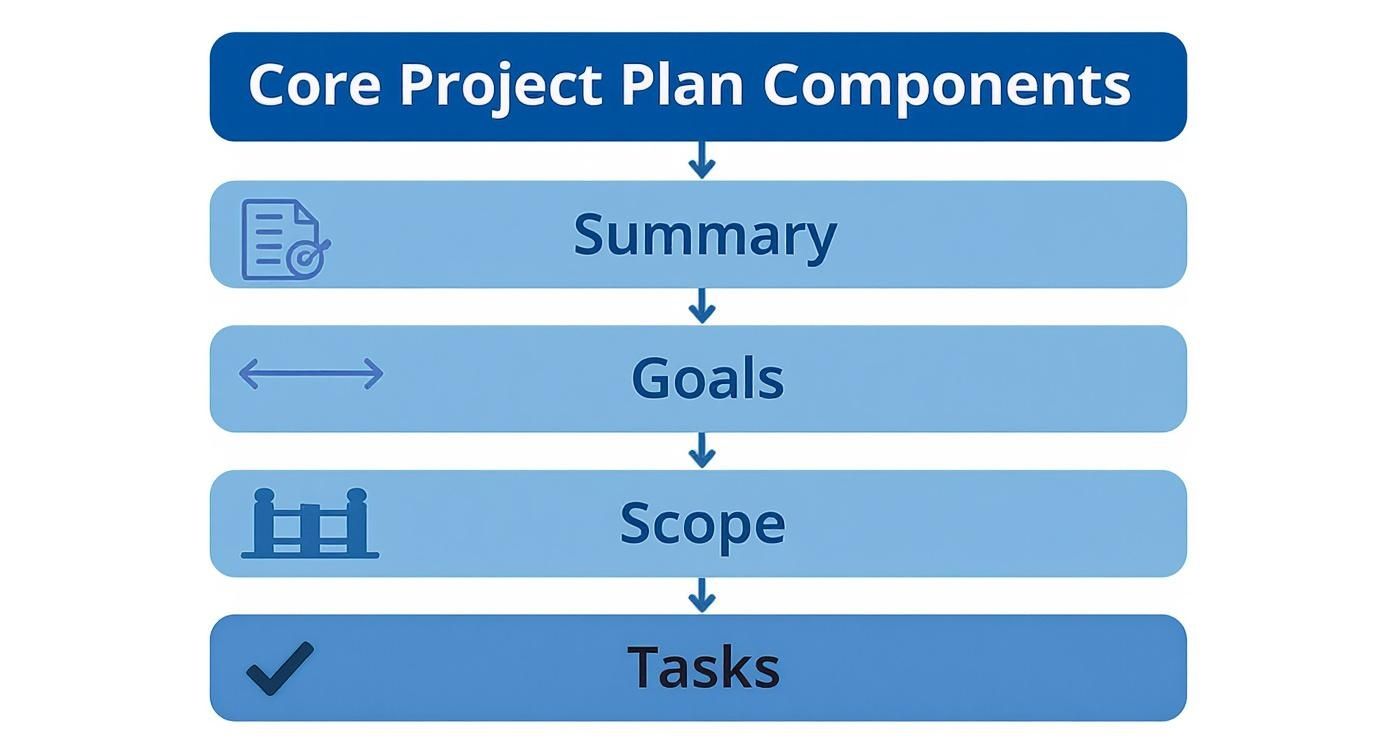
Imagine using a Gantt chart for a new marketing campaign. You’d map out everything from the initial brainstorming sessions to the final post-launch report. More importantly, it highlights which tasks can’t start until others are finished, helping you pinpoint the project's critical path—that all-important sequence of tasks that dictates your project's total length.
Mastering the Art of Resource Allocation
Now for the other half of the equation: resources. This isn't just about money. It’s about your team's time, their skills, and the tools they need to do their jobs. Get this wrong, and you're on a fast track to burnout, missed deadlines, and project failure.
Let's picture a small marketing team working on a new product launch. The project manager has to be a master juggler. They need to decide how much of the graphic designer’s time goes to social media visuals versus email templates. At the same time, they're managing the ad budget and making sure the content team has access to the right SEO tools.
This juggling act is the new normal. Research shows that a staggering 59% of project managers run between 2 to 5 projects simultaneously. Only 15% have the luxury of focusing on just one. You can dive deeper into this project management trend by checking out the full research at ravetree.com. With so much going on, a rock-solid project plan outline is the only thing standing between you and total chaos.
Good resource management isn't just about handing out assignments. It's about proactive bottleneck prevention. When you map out who does what and when, you can spot potential traffic jams weeks in advance and steer around them.
To make it all work, you have to:
- Pinpoint Dependencies: Get crystal clear on which tasks depend on others. You can't start writing ad copy until the target audience is locked in.
- Set Critical Milestones: Mark the major checkpoints in your timeline. Think "Final Ad Creatives Approved" or "Campaign Launch Day." These are your signposts of progress.
- Allocate Time Wisely: Be brutally realistic about what your team can handle, especially when they're stretched across multiple projects. Always build in a buffer for the inevitable curveballs.
Adapting Your Outline for Agile and Scrum Teams
If you're working with Agile or Scrum teams, you know that a traditional, top-down project plan just doesn't fit. The rigid structure of a classic plan feels out of place in a world of sprints, backlogs, and constant change. For these teams, a static document isn't a roadmap—it’s a relic.
This doesn't mean we throw planning out the window. It means we transform the classic project plan outline into a living, breathing set of artifacts that are built to handle change.
Instead of one massive, all-encompassing plan, the Agile approach uses a more dynamic hierarchy. The big-picture vision lives in a Product Roadmap, which lays out the major features and strategic goals over the long term. From there, we create a Release Plan, which bundles features into upcoming releases. Finally, the day-to-day work is managed in the Sprint Backlog, a focused list of tasks the team commits to finishing in the next short cycle.
This fundamental shift in structure also requires a new way of talking about and measuring work.
Embracing a New Planning Language
In an Agile world, the granular tasks you'd find in a Work Breakdown Structure are replaced with user stories. These are concise, plain-language descriptions of a feature, told from the perspective of the end-user. They typically follow a simple but powerful format: "As a [type of user], I want [some goal] so that [some reason]."
Estimating these stories also looks different. Instead of trying to guess hours or days, teams use story points—a relative unit of measure that captures effort, complexity, and risk all at once. This abstract metric helps a team figure out its velocity, or how much work it can realistically take on in a sprint. If you're new to this, mastering the art of story point estimation is a game-changer for making your sprints more predictable.
The heart of Agile planning is accepting that you don't know everything upfront. You plan in short cycles, see what happens, and then adjust your course based on real feedback. It's about responding to change, not following a rigid plan.
This is why the fixed-scope contracts common in Waterfall projects are a poor fit for Agile. The scope in an Agile project is intentionally flexible, allowing the team to pivot based on what they learn and what the customer truly needs. The timeline isn't one long marathon; it's a series of fixed-length sprints, usually lasting one to four weeks, creating a reliable rhythm for delivery and reflection.
To see just how different the two approaches are, it helps to compare their core planning components side-by-side.
Waterfall vs Agile Planning Elements
The table below breaks down the fundamental differences between how traditional and Agile teams handle key aspects of project planning.
| Planning Element | Waterfall Approach | Agile Approach |
|---|---|---|
| Scope | Defined upfront and fixed | Flexible and expected to evolve |
| Timeline | A single, long-term schedule | A series of short, fixed-length sprints |
| Deliverables | Large, infrequent releases at the end | Small, functional increments delivered each sprint |
| Planning Unit | Detailed tasks in a WBS | User stories in a backlog |
| Estimation | Hours or days | Story points or T-shirt sizes |
As you can see, the mindset is completely different. By adapting your project outline to an Agile model, you’re building a system that’s focused on delivering customer value, empowering your team, and being able to react quickly. It’s less about having a perfect plan from day one and more about embracing a process of continuous planning.
Avoiding Common Project Planning Pitfalls
Knowing what to include in your project plan is only half the battle. Just as important is knowing what traps to avoid. Even a meticulously detailed plan can crumble if it’s built on a shaky foundation. These common pitfalls aren't just minor cracks; they're project-ending sinkholes that can swallow your budget and timeline whole.
One of the biggest culprits I see is chronically optimistic timelines. It’s easy to map out a project where every task flows perfectly into the next, but reality rarely cooperates. You have to account for sick days, unexpected tech glitches, and dependencies that don't quite line up. Not building in that buffer is a classic recipe for stress and blown deadlines.
Another project killer? Vague objectives. A goal like "improve the user interface" is essentially meaningless because you can't measure it. Without a crisp, specific definition of success, the finish line keeps moving and your team never gets the satisfaction of knowing they’ve actually won.
Ignoring Stakeholders and Risks
Here’s a big one: treating stakeholder feedback as an afterthought. I once saw a software project get completely derailed just weeks before launch because a key department head wasn't looped in on a critical workflow. Their feedback was 100% valid, but it came way too late, forcing a costly and demoralizing rework.
Engaging stakeholders early and often isn't just about being polite—it's one of your best risk mitigation strategies. That brings me to the next major failure point: skipping a proper risk management plan.
Think of your project plan outline as more than just a map. It should also be a guide to the dragons, sea monsters, and treacherous terrain you might face. A solid risk management plan is your sword and shield for that journey.
If you don't take the time to brainstorm what could go wrong, you're left completely exposed when something inevitably does. A good risk assessment isn't about being negative; it's about being prepared.
Before you finalize your plan, give it a quick pressure test with this checklist:
- Are your goals actually SMART? Can every single objective be tied to a specific, measurable metric?
- Did you talk to the right people? Have all the key stakeholders signed off on the scope and deliverables that affect their teams?
- Is there breathing room in the schedule? Did you account for the unknown, or is every task scheduled back-to-back with zero margin for error?
- Have you identified your top 3-5 risks? More importantly, do you have a clear, actionable response ready for each one?
Answering these questions honestly helps you catch these common mistakes before they become your problem. It turns a simple project plan into a resilient, real-world tool that can handle a few punches.
Frequently Asked Questions
Even with the best guide in hand, some questions always pop up once you start putting theory into practice. Let's dig into a few of the most common ones I hear from teams who are building out their first project plan outlines.
How Detailed Should My Project Plan Outline Be?
This is the classic "it depends" question, but the real answer comes down to finding the right balance for your project and your team. There's no one-size-fits-all solution here.
If you're working on a high-stakes, heavily regulated project, you'll need to get granular. Every detail matters. But for a quick internal initiative, a leaner, more high-level outline is not just fine—it's usually better. A great rule of thumb is to include just enough detail for anyone on the team to understand their tasks, who they're waiting on, and when things are due.
The goal is clarity, not a hundred-page document that no one will ever read. Start with the big rocks—your major milestones and key deliverables—and then flesh out the details only where you genuinely need them.
The best project plan outline provides clarity without being rigid. It should be a guide that empowers your team, not a straitjacket that restricts their ability to adapt and solve problems.
Remember, the plan has to survive contact with reality. If it’s too rigid, it’ll shatter the first time you hit an unexpected snag.
What Is the Difference Between a Project Plan and a Project Charter?
This is a fantastic question because these two get mixed up all the time, but they play very different roles.
Here’s the simplest way I can put it:
A Project Charter is the project's official birth certificate. It's a short, high-level document that formally says, "This project exists." It names the project manager, spells out the main goals, and gets the blessing from key sponsors. It answers the big "what" and "why."
A Project Plan is the detailed instruction manual that follows. Once the charter is signed off, the plan explains exactly how you're going to get from A to B. It’s the tactical roadmap answering the crucial "how" and "when," diving into tasks, timelines, resources, and all the nitty-gritty details.
So, the charter gives you the green light to start the journey. The plan is the map you'll use to navigate it.
How Often Should I Update My Project Plan?
Your project plan should be a living, breathing document—not a relic you create once and then file away. How often you update it really hinges on your project's methodology.
If you're running an Agile project, your plan is constantly evolving. You're likely reviewing and tweaking it at the end of every single sprint, which is typically every 1 to 4 weeks. For more traditional waterfall projects, you'll definitely want to review it at each major milestone. I'd also recommend a regular weekly or bi-weekly check-in just to make sure you're tracking against your baseline.
The bottom line? Any significant change—to scope, resources, or the timeline—should trigger an immediate update. That's how you keep everyone on the same page and stop the plan from becoming a work of fiction.
Ready to make your planning sessions more efficient and accurate? At Scrum Planning Poker, we offer a free, simple-to-use tool that helps your team run seamless agile estimations. Get started in seconds with no signup required and bring clarity to your next project. Try it now at onlineplanningpoker.com.