Your Next Meeting Agenda Outline for Real Productivity
A meeting agenda outline is really just a game plan for your meeting. It's the blueprint that lays out the who, what, and why, turning what could easily become a chaotic free-for-all into a focused and productive session. Without one, you're essentially just hoping for the best.
Why Most Meetings Fail and How an Agenda Fixes It
We’ve all been there, right? Stuck in a meeting that seems to drag on forever, veering wildly off-topic with no clear purpose or end in sight. It’s easy to blame meetings themselves, but the real culprit is a lack of planning. A meeting without a clear path is almost destined to go nowhere.
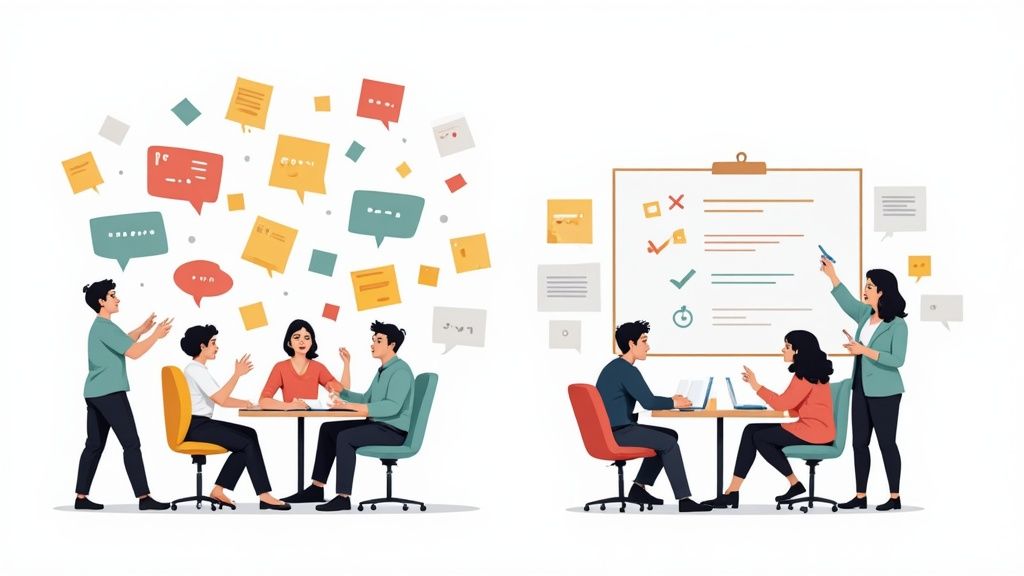
This isn't just a hunch; the numbers are pretty jarring. It turns out that only about 37% of workplace meetings actually use an agenda. This disorganization contributes to a staggering $37 billion lost every year in the U.S. alone due to unproductive meetings. If you're curious about the data behind this, you can dig into more meeting statistics from Notta.ai to see the full scope of the problem.
The Power of a Simple Plan
Your meeting agenda outline is your single best weapon against this kind of inefficiency. It's so much more than a simple to-do list; it's a framework that builds focus, drives accountability, and shows respect for everyone's time.
A solid outline makes a world of difference:
- Clarity of Purpose: Everyone walks in knowing exactly why they're there and what you all need to achieve together.
- Participant Preparation: When attendees know the topics beforehand, they can actually prepare their thoughts and contributions, which makes for much richer discussions.
- Focused Conversation: The structure acts as a guardrail, keeping the conversation on track and preventing those time-wasting tangents we all dread.
- Clear Next Steps: It provides a natural place to capture action items, assign owners, and set deadlines, ensuring the work continues long after the meeting ends.
Think of it like this: You wouldn't start building a house without a blueprint. A meeting agenda outline serves the same function—it provides the essential structure you need to build something valuable with your team's time.
Key Elements of an Effective Meeting Agenda Outline
A quick look at the core components every effective meeting agenda outline needs to ensure clarity and purpose from the start.
| Element | Purpose |
|---|---|
| Meeting Objective | A single sentence explaining the primary goal or decision to be made. |
| Topics & Time Allotment | A list of discussion items, each with a specific time limit to maintain pace. |
| Topic Owners | Assigning a leader for each item to ensure accountability and preparation. |
| Required Pre-Work | Any documents or data attendees must review beforehand. |
These are the non-negotiables that form the foundation of any productive meeting, no matter how big or small. Getting these basics right sets the stage for success before anyone even joins the call.
Building the Foundation Before You Write the Agenda
I've seen it a hundred times: people jump straight into listing agenda topics without a second thought. That's a recipe for a meeting that meanders and ultimately goes nowhere. A truly effective meeting agenda outline is built on a solid foundation, and that work happens long before you ever type a single word.
Think of it as the prep work that separates a focused, productive session from a chaotic time-waster. It all starts with getting crystal clear on one thing.

Before anything else, you have to ask yourself this critical question: "If we only accomplish one thing in this meeting, what does it absolutely have to be?" Forget about a laundry list of nice-to-haves. Nailing down that single, non-negotiable goal is what brings instant focus to the entire plan.
Define Your Core Objective
This primary objective becomes your north star. It dictates who needs to be in the room, what information they'll need, and how you’ll know if you were successful. Vague goals like "Discuss Q4 strategy" just don't cut it. A powerful objective is specific, and it's built around action.
Let’s look at the difference:
Weak Objective: "Review the marketing campaign."
Strong Objective: "Decide on the final budget and launch date for the 'Project Titan' marketing campaign."
Weak Objective: "Talk about the new feature."
Strong Objective: "Approve the final UI mockups for the new user dashboard feature."
This single sentence is now your filter. As you consider adding topics to the agenda, ask if they directly help achieve that specific objective. If not, they probably belong in a different meeting or an email.
Curate the Guest List Ruthlessly
Once you know exactly what you need to achieve, figuring out who to invite gets a whole lot easier. The question is no longer, "Who might want to be here?" Instead, it's, "Who is absolutely essential to hitting our goal?" Over-inviting is one of the most common meeting sins—it kills momentum and slows decision-making to a crawl.
I'm a big fan of the "two-pizza rule," famously used by Amazon's Jeff Bezos. If you can't feed everyone in the meeting with two large pizzas, you've invited too many people. A smaller, more focused group almost always leads to better discussions and faster outcomes.
Be ruthless. Every single person in that room should have a clear purpose for being there. They are either providing critical data, lending their expertise, or making a final call. If their only role is to "stay in the loop," send them the meeting notes afterward.
Even with a perfectly curated list, it helps to get everyone engaged from the start. A quick team-building exercise or a well-chosen icebreaker for work can build rapport before you dive into the heavy lifting.
Equip Your Team with Pre-Work
The final piece of the foundation is making sure your attendees show up ready to contribute. This means sending out any pre-reading, data reports, or crucial documents with the agenda.
Giving people this context at least 24 hours in advance is non-negotiable. It’s what turns a meeting from a passive lecture into an active problem-solving session. When everyone arrives prepared, you can skip the long-winded background briefings and get right down to business, making every minute count.
How to Structure Your Agenda for Flow and Focus
The way you order your agenda items has a massive impact on the meeting's energy and outcome. A random list of topics can kill focus and lead to conversations that go nowhere. But a well-thought-out sequence? That creates momentum and keeps everyone locked in. The real goal is to design a meeting agenda outline that builds focus, hits the hard stuff at the right moment, and wraps up with total clarity.
This is more than just making a list; you're essentially crafting a story for your meeting. You’re guiding your team’s attention from a quick warm-up, through the main event, and into a clear, actionable conclusion.
Start with Momentum Builders
Always kick things off with quick wins or simple updates. This isn't just fluffy small talk; it's a strategic play to get everyone talking and contributing right out of the gate. Starting with low-stakes items, like a quick project update or celebrating a small success, injects positive energy from the very beginning.
- Quick Wins: Maybe share a great piece of customer feedback or a milestone someone just hit.
- Simple Updates: Cover straightforward announcements that don't need a deep dive.
- Check-ins: A quick go-around on what everyone’s working on can get every voice in the room early.
This approach effectively warms up the group, making them much more ready and willing to dive into the tougher topics you have lined up.
Put Your Most Important Topic in the Middle
Once you've built that initial momentum, it's time to tackle the beast. Your most challenging or important topic—the one that requires the most brainpower—should go right in the middle of the agenda. At this point, people are fully engaged but haven't hit that late-meeting wall yet.
This is your peak-focus window, and it's perfect for:
- Tough Problem-Solving: Hashing out a complex technical issue.
- Big Decisions: Getting final approval on a budget or project roadmap.
- Creative Brainstorming: Generating ideas for a new campaign or feature.
Placing your main event here guarantees it gets the full, undivided attention it needs. It sounds simple, but this structural choice is huge. Think about it: millions of meetings happen every day, yet a staggering 70% of people feel meetings stop them from getting their actual work done. A well-built agenda is the antidote. In fact, 79% of workers agree that meetings with a clear agenda are way more productive. You can dig into more numbers like these by checking out these meeting statistics from Flowtrace.co.
A great agenda doesn't just list what you'll discuss; it guides the energy in the room. It’s the difference between a meeting that feels like a slog and one that feels like a focused, productive workshop.
Use Timeboxing and Assign Clear Roles
Two of the most effective tools for keeping a meeting on track are timeboxing and assigning roles. Timeboxing is simply putting a strict time limit on each agenda item. This creates a healthy sense of urgency and prevents one topic from eating up the entire hour. If a discussion needs more time, the group can consciously decide to extend it or, better yet, schedule a follow-up.
Just as critical is assigning roles right on the agenda itself. This simple act creates a sense of shared ownership and helps the meeting run itself.
| Role | Responsibility |
|---|---|
| Facilitator | Guides the discussion, keeps it on track, and makes sure everyone is heard. |
| Note-Taker | Documents key decisions, action items, and important points. |
| Timekeeper | Keeps an eye on the clock and gives a heads-up when time for an item is nearly up. |
When everyone knows their job, the facilitator isn't the only person responsible for the meeting's success. It becomes a true team effort, which naturally leads to more accountability and much better outcomes. This turns your agenda from a simple list into a powerful plan for getting things done together.
Agenda Outline Examples You Can Steal and Use Today
Knowing the theory behind a good agenda is one thing, but having a few solid, reusable outlines in your back pocket is what really makes a difference. Instead of staring at a blank document, you can grab a proven structure and tweak it for your team's needs.
Let's walk through a few real-world examples. We'll start with a classic weekly team meeting outline, then look at two common agile ceremonies that are essential for any product or software team. Each one includes recommended time slots to help you get started right away.
The best agendas tend to follow a simple, three-part flow: start with alignment, dive into the core work, and end with clear actions.
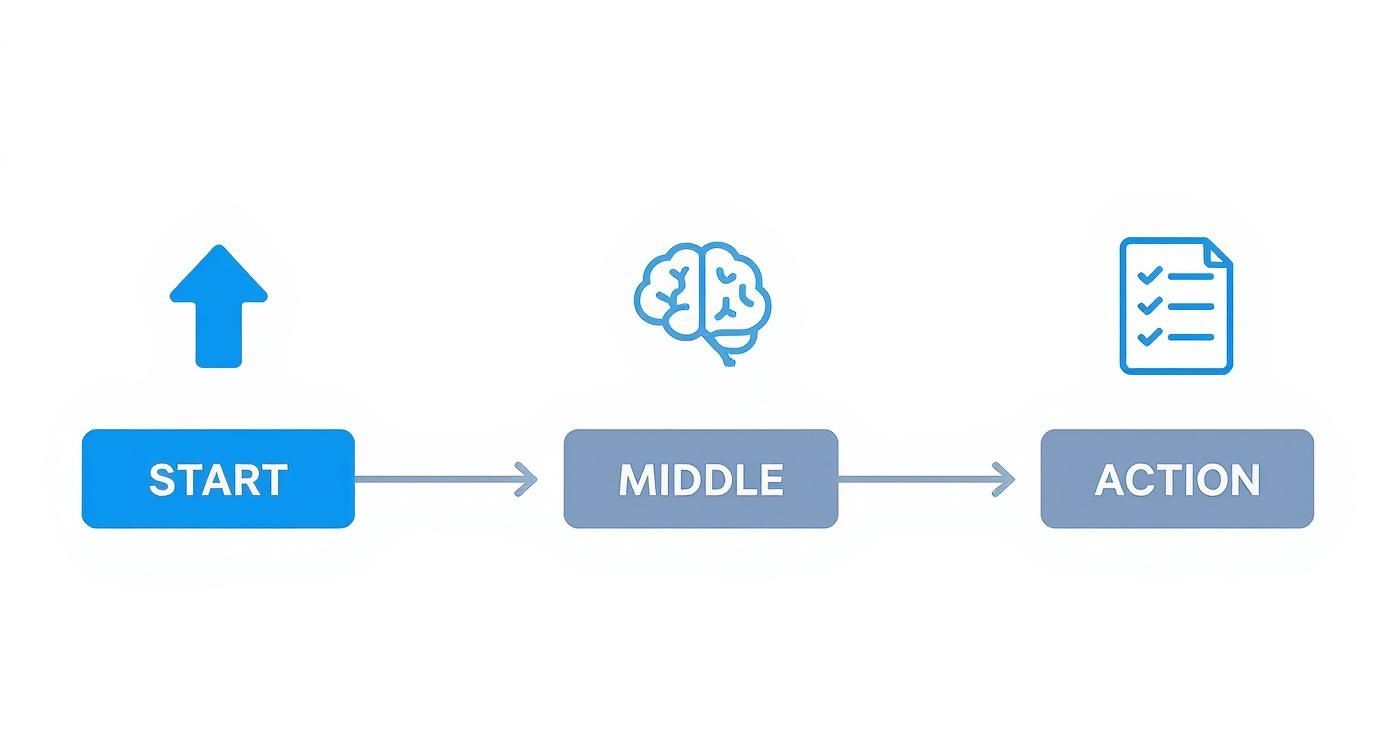
This progression helps build momentum before you tackle the tough stuff, ensuring you wrap up with everyone knowing exactly what they need to do next.
A Classic Weekly Team Meeting Outline
This is the bread and butter of meeting agendas, perfect for a standard 60-minute team sync. The whole point is to get aligned on progress, call out any blockers, and agree on priorities for the coming week. It's a simple framework, but it's incredibly effective at keeping everyone on the same page without letting the meeting drag on.
It's amazing how many teams just "wing it." Research shows that nearly 64% of recurring meetings don't have a formal agenda, which is a major reason they so often run late. On the flip side, teams that consistently use a clear agenda report way higher productivity. For more ideas, Zoom has a great blog post covering different meeting agenda examples.
Here’s a structure that just works:
- Check-in & Wins (5 mins): Kick things off on a positive note. Ask everyone to share one small win from the past week.
- Review Last Week's Action Items (10 mins): This is all about accountability. Go through the list—what got done? What’s still pending?
- Key Project Updates & KPIs (20 mins): The main event. Each person gives a quick update on their core projects and metrics.
- Roadblocks & Help Needed (15 mins): Create a dedicated space for people to say, "I'm stuck." This is where the real teamwork happens.
- Priorities for This Week (5 mins): Before you break, align on the top 1-3 goals for the week ahead.
- Action Item Recap (5 mins): Have the note-taker read back every new action item, who owns it, and when it’s due. No ambiguity.
This outline deliberately shifts the meeting from being a passive status report to an active problem-solving session. By carving out specific time for roadblocks and priorities, you're not just talking about what happened—you're shaping what happens next.
Agile Sprint Planning Meeting Agenda
For teams running on agile, sprint planning is a non-negotiable ceremony. This is where you decide what the team can realistically deliver in the next sprint and how you'll get it done. A messy planning session can throw an entire two-week cycle off track before it even starts.
It's important not to confuse this with a project kickoff meeting agenda, which is a much higher-level meeting for setting the stage on a brand new initiative.
An effective Sprint Planning agenda for a 2-hour session (typical for a two-week sprint) looks something like this:
- Set the Stage (10 mins): The Product Owner presents the proposed sprint goal. The team also quickly reviews its capacity for the upcoming sprint.
- Backlog Discussion & Selection (45 mins): The team pulls up the product backlog and discusses the top-priority user stories. Are they ready? Does everyone understand the "why"?
- Task Breakdown (45 mins): For each story the team agrees to take on, the developers break it down into smaller, concrete technical tasks.
- Commitment & Sprint Backlog Creation (15 mins): The team formally commits to the sprint goal and the selected user stories. This collection of work officially becomes the sprint backlog.
- Final Questions & Close (5 mins): One last chance to clear up any confusion before everyone dives into the work.
Planning Poker Agenda Outline
Planning Poker is a fantastic, collaborative way for agile teams to estimate work. Instead of one person pulling a number out of thin air, the whole team weighs in, leading to more accurate and reliable forecasts. A session to estimate a handful of stories shouldn't take more than 30-45 minutes.
The goal isn't just to get an estimate; it's to make sure everyone on the team has a shared understanding of what the work actually involves. When estimates are wildly different, it usually means people are interpreting the requirements differently—a critical insight to gain before work begins. For a great free tool, check out Online Planning Poker.
Here’s how to structure it:
- Introduction to Stories (5 mins): The Product Owner briefly explains the 3-5 user stories up for estimation. Just the highlights.
- Story 1: Q&A (5 mins): The team asks clarifying questions about the first story. What are the acceptance criteria? Any hidden complexities?
- Story 1: Estimation Round (5 mins): Everyone privately selects their estimate, then reveals it at the same time. Discuss any major differences and re-vote if needed.
- Repeat for Remaining Stories (15 mins): Run through the Q&A and estimation rounds for the other stories.
- Recap & Confirmation (5 mins): Quickly review the final estimates for all stories and make sure they are documented in your project management tool, like Jira or Trello.
Sprint Planning vs Daily Stand-up Agenda Comparison
It's easy to see how different agile meetings require very different agendas. Sprint Planning is a deep, strategic session, while the Daily Stand-up is a quick tactical check-in. Mixing up their purpose or structure is a recipe for wasted time.
This table breaks down the key differences between the two:
| Agenda Component | Sprint Planning Meeting | Daily Stand-up Meeting |
|---|---|---|
| Primary Goal | Define the upcoming sprint's work and goal | Daily sync on progress and blockers |
| Participants | Entire Scrum Team (Devs, PO, Scrum Master) | Primarily the Development Team |
| Typical Duration | 2-4 hours (for a 2-week sprint) | 15 minutes (max) |
| Key Topics | Backlog selection, task breakdown, capacity | What I did yesterday, what I'll do today, blockers |
| Output | A committed Sprint Backlog and Sprint Goal | A shared understanding of the day's plan |
| Focus | Forward-looking (the next 1-2 weeks) | Immediate-term (the next 24 hours) |
As you can see, each meeting has a distinct cadence and objective. Using the right agenda ensures you're having the right conversation at the right time.
Driving Action During and After the Meeting
A perfectly crafted agenda is a great start, but it's just a map. The real journey begins when the meeting starts. As the facilitator, your job is to use that map to navigate the actual discussion, keeping one eye on the conversation and the other on the clock. You’re there to make sure the meeting actually lands at its destination.
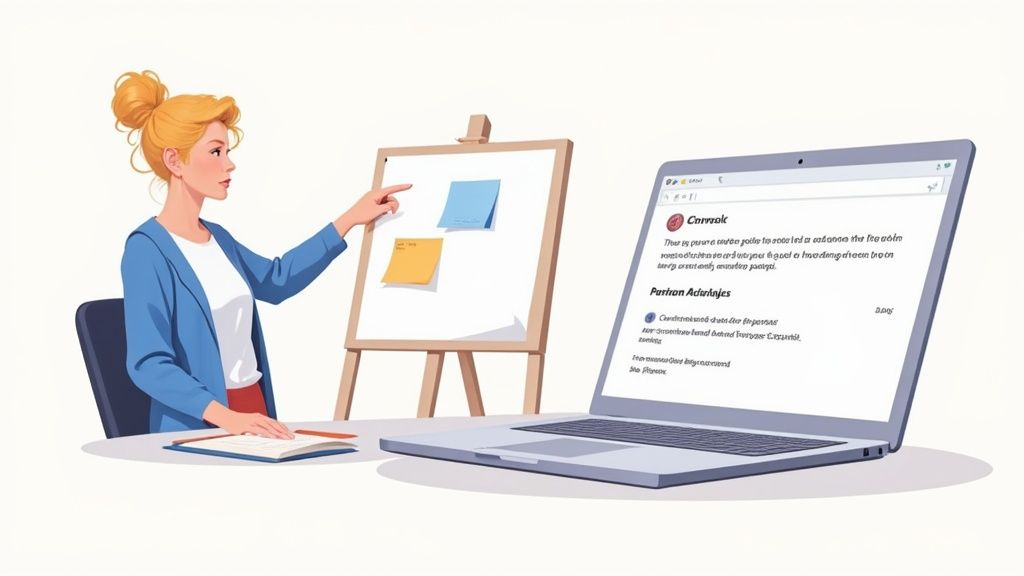
It’s almost a guarantee that conversations will drift. When a great but off-topic idea pops up, don’t just shut it down—that kills morale. But don’t let it derail your momentum, either. This is where the "parking lot" technique comes in handy.
Acknowledge the point and jot it down on a separate list, like a virtual whiteboard or a dedicated section in your notes. Try saying something like, "That's a fantastic point, but it's a bit outside our scope for today. I'm adding it to our parking lot so we don't lose it and can tackle it later." This respects the person's contribution without sacrificing the meeting's focus.
Where Progress Actually Happens: The Follow-Up
The work isn’t over when the video call ends. Honestly, the most important part happens next. The follow-up is where good intentions become real progress and you start building a culture of accountability. Without this crucial step, even the most productive meeting can just fade into a fuzzy memory.
Your goal is to close the loop fast. Don't wait a few days to send out a summary. Get it into everyone’s inbox within 24 hours, while the discussion and agreements are still fresh in everyone’s mind.
A meeting without a clear summary of decisions and action items is often just a conversation. The follow-up email is the bridge between discussion and execution, holding the team accountable for what was agreed upon.
Crafting the Perfect Summary Email
This summary doesn't need to be an essay. Keep it short, scannable, and focused entirely on the outcomes. Your follow-up should always include these core components:
- Key Decisions Made: A simple, bulleted list of the final calls that were made.
- Action Items: A clear table or list outlining each specific task.
- Owners: The name of the person responsible for each action item. No ambiguity!
- Deadlines: The exact date each task is due.
This simple act of documenting everything kills any confusion and ensures everyone walks away with the same understanding of what’s next. It proves the meeting was valuable and sets the team up for success.
For teams who really want to sharpen their process, looking into a retrospective format like the one detailed in this guide on the Start Stop Continue method can be a great way to get feedback and make future meetings even better.
Common Questions About Meeting Agendas
Even with the best templates, things get messy in the real world. Let's tackle some of the questions I hear all the time about putting meeting agendas into practice.
How Far in Advance Should I Send a Meeting Agenda?
My rule of thumb is to send the agenda at least 24 hours in advance. This gives people a fair chance to read it, get their heads in the right space, and handle any pre-work you’ve assigned.
But for the bigger, more complex meetings—think project kickoffs or a quarterly strategy deep-dive—you’ll want to give everyone more breathing room. For those, I aim for 48-72 hours. You want people showing up ready to dig in and contribute, not just passively listen.
What Is the Best Format for a Meeting Agenda Outline?
The best format is whatever is simplest and easiest to scan. It doesn't really matter if you're using a shared doc, a calendar invite, or an app like Asana. What matters are the building blocks.
A solid format almost always includes:
- Clear headings that announce each topic.
- Bullet points to break down talking points or questions.
- Specifics like the time allotted, who's leading the discussion, and what you need to achieve by the end of it.
Never forget that your goal is clarity and accessibility.
Your agenda isn't just a document; it's a communication tool. The easier it is for people to understand the plan in 30 seconds, the more effective your meeting will be from the very start.
What Should I Do If the Meeting Goes Off Topic?
It's your job as the facilitator to gently guide the conversation back on track. One of the most effective ways I've found to do this is to use a "parking lot." It’s simply a running list of important but off-topic items you can address later.
You could say something like, “That’s a great point, and I want to make sure we don't lose it. I'm adding it to our parking lot to discuss later. For now, let’s get back to our current topic.”
This little trick works wonders. It validates the person's contribution without letting the entire meeting get derailed.
Stop letting your agile estimations drift. With Scrum Planning Poker, you can run focused, fast, and free planning sessions right in your browser. Start your first session in seconds and bring clarity to your team’s estimates at https://onlineplanningpoker.com.