10 Effective Icebreaker for Work Activities (2025 Guide)
Starting a meeting or workshop with a generic 'let's go around the room' can drain energy before you even begin. A well-chosen icebreaker for work, however, does the opposite. It sparks engagement, builds psychological safety, and sets a collaborative tone for the entire session. This isn't about forced fun; it’s a strategic tool for warming up creative muscles, connecting distributed team members, and turning a group of individuals into a cohesive unit ready to tackle complex challenges. A great icebreaker primes the team for open communication and effective problem-solving, which is critical for everything from daily stand-ups to sprint retrospectives.
This guide moves beyond the cliché, offering a curated roundup of practical, effective activities designed for modern, agile workplaces. You'll find a structured collection of icebreakers tailored for various scenarios, including quick 5-minute openers, engaging remote-friendly options, and even estimation-themed games that align with Scrum practices. We provide clear, actionable instructions for each activity, complete with facilitation scripts, timing guidance, and specific adaptations for distributed teams. Forget awkward introductions; this list is your playbook for starting every meeting with focus, energy, and genuine connection.
1. Two Truths and a Lie
A classic for a reason, this icebreaker for work encourages participants to share unique personal facts in a playful, low-pressure format. Each person prepares three statements about themselves: two that are true and one that is a lie. They share these statements with the group, and the others must work together to guess which one is the falsehood.
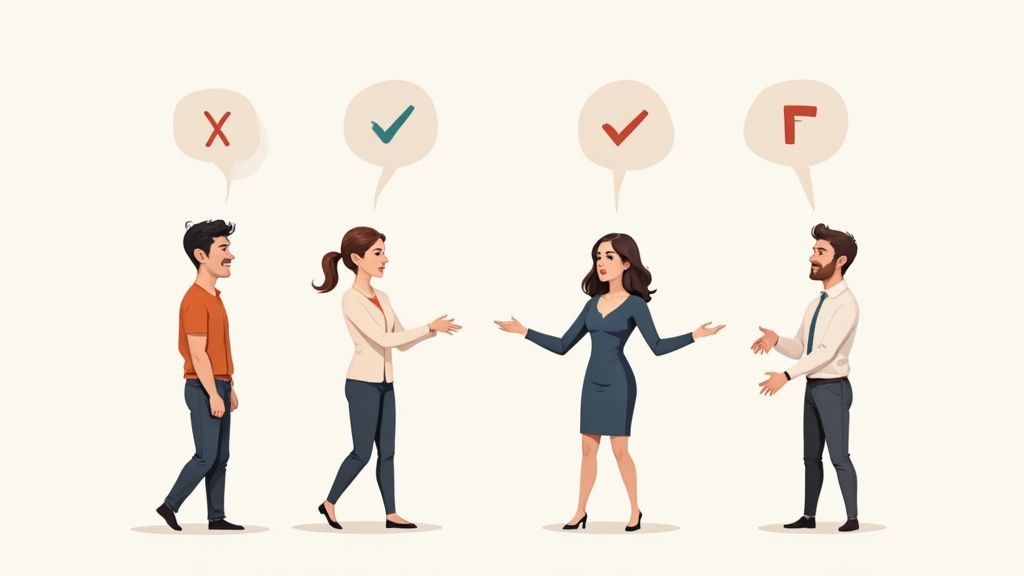
This activity excels at revealing surprising dimensions of colleagues' personalities and past experiences, sparking conversations that go beyond typical work topics. It's an effective tool for building psychological safety, as it requires a small degree of vulnerability in a structured and fun way.
How to Facilitate
To run this icebreaker effectively, provide clear instructions and model the behavior you want to see.
- Set the Stage: Announce the activity and give everyone 2-3 minutes to quietly prepare their three statements. Remind them to make the lie plausible and the truths surprising to make the game more challenging.
- Model the Way: As the facilitator, go first. This demonstrates the desired tone and gives others a concrete example to follow.
- Share and Guess: Have each person share their three statements. To boost engagement, ask the group to vote on the lie. For remote teams, using the chat or a poll feature in Zoom or Microsoft Teams works perfectly.
- Reveal and Rotate: After the group guesses, the person reveals the lie and may share a brief story behind one of the truths.
Facilitator Tip: Encourage people to think beyond work achievements. Statements about unique hobbies, hidden talents, or unusual life experiences often generate the most memorable moments and connections. This is a great icebreaker for work meetings where you want to foster personal rapport.
2. Human Bingo
This energetic icebreaker gets people moving and interacting right away, making it perfect for larger groups or new team kickoffs. Participants receive a bingo card where each square contains a specific characteristic or experience, such as "Find someone who has been to Asia" or "Find someone who speaks more than two languages." The goal is to mingle, find colleagues who match the descriptions, and get their signature in the corresponding square.
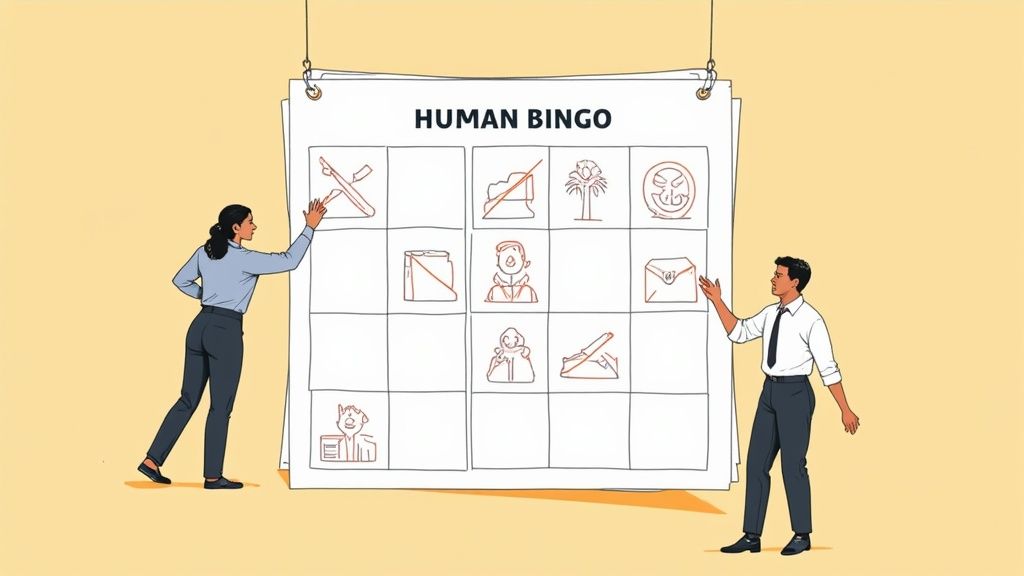
Human Bingo is excellent for breaking down silos and encouraging cross-departmental conversation. By giving participants a clear "mission," it removes the social anxiety that can come with open-ended networking. This icebreaker for work is especially effective during onboarding sessions, workshops, or company-wide events where many people don't know each other.
How to Facilitate
A little preparation ensures this game runs smoothly and achieves its goal of creating connections.
- Prepare the Cards: Create bingo cards with a 4x4 or 5x5 grid. Fill the squares with a mix of work-related and personal prompts (e.g., "is on the same project team," "has a pet other than a cat or dog").
- Explain the Rules: Clearly state the objective: get a line (horizontal, vertical, or diagonal) or a full card. Announce the time limit, typically 10-15 minutes.
- Encourage Mingling: Set the expectation that people should move around the room and talk to as many different individuals as possible. A common rule is that one person can only sign one square on any given card.
- Announce the Winner: When time is up or someone shouts "Bingo!", have them introduce the people who signed their winning squares.
Facilitator Tip: For remote or hybrid teams, use a digital whiteboard tool like Miro or a shared Google Sheet. Participants can "sign" squares by typing their names into the cells, making it an inclusive and effective icebreaker for work in any setting.
3. Would You Rather
This simple yet effective icebreaker for work prompts participants to choose between two hypothetical scenarios, revealing personality traits and sparking lighthearted debate. A facilitator poses a "Would you rather..." question, and team members select their preference, briefly explaining their reasoning. It's a fantastic way to stimulate quick thinking and encourage creative justification in a low-stakes environment.
The game's strength lies in its simplicity and adaptability. It can be as silly or as thought-provoking as the facilitator desires, making it suitable for any team dynamic. Companies like Netflix and Apple have used this activity in team meetings to quickly build rapport and energize participants before diving into more serious topics.
How to Facilitate
Success with this icebreaker depends on well-chosen questions and a brisk pace to maintain energy.
- Prepare Questions: Create a list of 5-10 questions in advance. Mix fun, imaginative questions (e.g., "Would you rather have the ability to fly or be invisible?") with more practical ones.
- Pose and Poll: Present one question to the group. For remote teams, a poll feature in Zoom or a Slack channel is perfect for instant visualization of the results.
- Share Justifications: Ask a few volunteers from each side to briefly (30 seconds max) explain their choice. This is where the real connection and humor emerge.
- Keep it Moving: Don't dwell on one question for too long. The goal is a quick, dynamic exchange. Move to the next question to keep the momentum going.
Facilitator Tip: Start with lighter, fun questions to warm the group up. Avoid controversial topics related to politics or religion. The goal is to find common ground and share a laugh, making it an ideal icebreaker for work meetings where you need to quickly establish a positive and open atmosphere.
4. Speed Networking/Speed Dating Format
Inspired by its social counterpart, this high-energy icebreaker for work maximizes introductions by having participants rotate partners every few minutes for structured, one-on-one conversations. This format is incredibly efficient for large groups or events where the primary goal is cross-team connection, ensuring everyone interacts with multiple new people in a short amount of time.
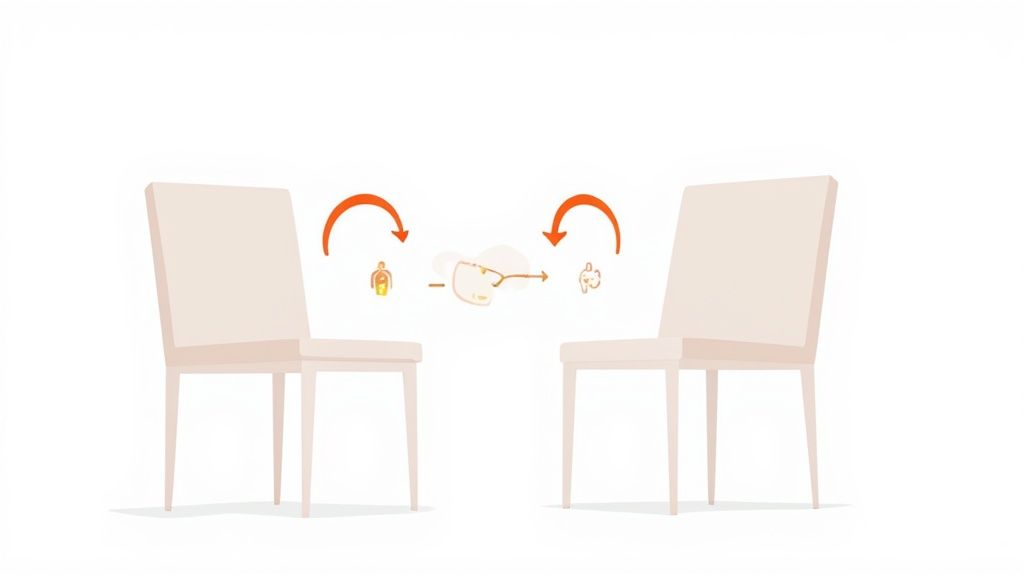
This method breaks down silos and encourages rapid rapport-building, making it a favorite at large company off-sites, conferences, and new-hire orientations. By providing specific prompt questions for each round, it removes the awkwardness of initiating small talk and focuses conversations on meaningful or fun topics, much like a well-structured retrospective. For more on structuring team feedback, you can explore the Start, Stop, Continue framework.
How to Facilitate
Careful orchestration is key to a smooth and effective speed networking session. Clear timing and organized rotations prevent chaos and maximize engagement.
- Set the Stage: Arrange chairs in two rows facing each other or in small pairs around the room. Explain that participants will have 2-3 minutes per "round" to chat with their partner before one row rotates.
- Provide Prompts: Display a unique, simple conversation prompt for each round. Start with light questions (e.g., "What's a favorite recent movie or book?") and gradually move to slightly deeper ones ("What's a skill you'd like to master?").
- Manage Rotations: Use a loud timer and a bell or distinct sound to signal the end of each round. Clearly instruct one line of participants to move one seat to their left or right, ensuring they meet a new person each time.
- Virtual Adaptation: For remote teams, this works seamlessly with breakout rooms. Automatically assign pairs to rooms for 2-3 minutes, then bring everyone back to the main session before re-shuffling and sending them out again with a new prompt.
Facilitator Tip: For in-person events, create two lines of people facing each other. Have one line remain stationary while the other line shifts one person over at each rotation. This is the simplest way to manage the movement and ensure everyone gets a new partner.
5. Show and Tell/Bring an Object
This nostalgic icebreaker for work revives a childhood favorite to create surprisingly deep connections among colleagues. Participants are asked to bring a personal item to the meeting, either physically or as an image, and share a brief story about its significance. This activity offers a tangible, authentic glimpse into what people value outside of their professional roles.

This method is powerful because it grounds personal stories in a physical object, making them more memorable and relatable. By sharing items related to hobbies, travel, or family, team members reveal unique facets of their identity, fostering empathy and building stronger interpersonal bonds. It's a simple yet profound way to see coworkers as whole people.
How to Facilitate
Proper setup is key to making this a meaningful experience rather than a rushed or awkward one.
- Provide Advance Notice: Give participants at least a few days of notice so they have time to select a meaningful object. This avoids putting people on the spot.
- Set Clear Guidelines: Define the scope of appropriate items (e.g., "an object from your desk," "something that represents a hobby") and a time limit, typically 2-3 minutes per person, to keep the meeting on track.
- Create a Sharing Order: Establish a clear order for sharing. For remote teams, you can go alphabetically or let people volunteer in the chat to ensure a smooth flow.
- Encourage Active Listening: After each person shares, allow for a brief moment for one or two colleagues to ask a question or share a positive comment. This promotes genuine engagement.
Facilitator Tip: For virtual meetings, have a backup plan. Ask participants to also have a photo of their item ready in case of camera issues. This simple icebreaker for work can be incredibly effective for humanizing remote and distributed teams.
6. Commonalities Challenge
This collaborative icebreaker for work sends small groups on a quest to discover shared experiences, moving beyond surface-level traits. Teams of 4-6 people race against the clock to compile a list of things they all have in common, from the obvious (e.g., favorite food) to the delightfully obscure (e.g., all have visited the same city).
The Commonalities Challenge is exceptionally effective at building rapport quickly and highlighting the diverse yet shared human experiences within a team. By focusing on what connects them, participants naturally build a foundation of mutual understanding. It’s a popular exercise used during onboarding at companies like HubSpot and Salesforce to accelerate new hire bonding.
How to Facilitate
A clear structure and a sense of urgency are key to making this activity a success. Your role is to set the stage for discovery.
- Divide and Conquer: Before starting, break the larger group into smaller teams of 4-6 people. This size is ideal for ensuring everyone can contribute.
- Set the Mission: Clearly state the objective: "Find and list as many unique things as you have in common as a group in the next 10 minutes." Encourage them to dig deeper than superficial similarities.
- Encourage Sharing: Once the time is up, ask a spokesperson from each group to share a few of the most surprising or interesting commonalities they discovered. This cross-pollination of stories often sparks wider group conversations.
- Capture the Connections: Record the shared findings on a whiteboard or in a shared digital document. This visual record reinforces the new connections made.
Facilitator Tip: Challenge teams to find at least one commonality that doesn't involve work and one that involves a shared experience rather than just a preference. This framing pushes them toward more meaningful and memorable discoveries, making it a powerful icebreaker for work retreats and team-building sessions.
7. Role/Character Introduction
This imaginative icebreaker for work invites participants to step outside themselves and introduce themselves as a character. Whether it's a superhero, a historical figure, or a favorite fictional persona, this creative approach reduces self-consciousness and encourages people to share different facets of their personalities in a fun, low-stakes environment.
This activity is particularly effective for creative teams or workshops focused on brainstorming and innovation, as it immediately sets an energetic and playful tone. It allows individuals to express themselves through a creative lens, revealing their interests, values, and sense of humor without the pressure of a standard personal introduction.
How to Facilitate
A little structure helps creativity flourish. Guide your team through the process with clear steps and enthusiastic modeling.
- Set the Stage: Explain the activity and give everyone 3-5 minutes to choose a character and think about how they would introduce themselves. You can provide a list of examples (e.g., Sherlock Holmes, Wonder Woman, Yoda) to spark ideas.
- Model the Way: As the facilitator, go first to demonstrate the desired energy and format. "Hello everyone, I'm Captain Picard. I'm here to explore strange new worlds, seek out new life and new civilizations, and ensure this project launch goes boldly."
- Share and Connect: Go around the room (or virtual room) and have each person give their character introduction. Encourage a brief explanation of why they chose that character.
- Keep it Light: Celebrate all attempts, focusing on participation and creativity rather than performance quality. For virtual teams, encourage the use of props, virtual backgrounds, or filters to enhance the experience.
Facilitator Tip: Tie the characters back to the meeting's goal or team roles if possible. For example, "Who is the 'Hulk' who will smash through obstacles?" This turns a fun icebreaker for work into a powerful metaphor for collaboration and problem-solving.
8. Question Ball/Conversation Ball Toss
This energetic icebreaker combines light physical activity with conversation to boost engagement and break up meeting monotony. A soft ball, often pre-printed with various questions, is tossed around the group. The person who catches it answers the question found under their right thumb, creating a spontaneous and fun way to learn about colleagues.
The Question Ball is excellent for getting people moving and raising the energy level, making it ideal for post-lunch sessions or long workshops. It encourages quick, candid responses and builds connections through shared, simple personal facts. This activity is frequently used during team-building events, onboarding sessions, and company offsites to foster a dynamic and interactive atmosphere.
How to Facilitate
A smooth and lively flow is key to making this icebreaker for work a success. Your role is to maintain momentum while ensuring everyone feels comfortable.
- Set the Stage: Arrange the group in a circle, either standing or seated, with enough space to safely toss the ball. Explain the simple rule: "When you catch the ball, read and answer the question under your right thumb."
- Start the Toss: Begin by gently tossing the ball to a participant. After they answer, they toss it to someone else who hasn't had a turn yet.
- Maintain Momentum: Keep the pace brisk but not rushed. Encourage quick answers to maintain energy. If someone is uncomfortable with their question, allow them a single "pass" or a "re-toss" for a new question.
- Virtual Adaptation: For remote teams, use a random name generator or a "virtual wheel" to select the next person. The facilitator can then read a question from a pre-prepared list for the chosen individual to answer.
Facilitator Tip: Curate your questions carefully. A good mix of lighthearted prompts ('What's your favorite season?') and slightly more reflective ones ('What's a skill you'd like to develop this year?') keeps the game interesting. This approach makes it a versatile tool, even for focused sessions where you want to gather team insights, similar to techniques found in a sprint retrospective template.
9. Personality Assessment Icebreaker (Myers-Briggs, DISC, StrengthsFinder)
This evidence-based icebreaker for work moves beyond simple games to foster a deeper understanding of team dynamics. Participants take a personality or strengths assessment like Myers-Briggs, DISC, or Gallup's CliftonStrengths (StrengthsFinder) and then discuss their results, helping colleagues appreciate diverse work styles, communication preferences, and hidden talents.
This activity provides a shared, neutral language for discussing interpersonal dynamics, which can improve collaboration and reduce conflict. It's particularly effective for new teams or groups looking to enhance their collective performance by understanding how individual strengths contribute to shared goals, much like how diverse perspectives strengthen agile estimation techniques.
How to Facilitate
A successful session requires thoughtful preparation and expert guidance to ensure a positive, constructive experience.
- Choose & Distribute: Select a reputable assessment tool that aligns with your team's goals. Send instructions and links to the team well in advance, asking them to complete the assessment before the meeting.
- Expert Interpretation: Consider hiring a certified facilitator to interpret the results. They can provide valuable context, answer questions, and guide the conversation away from stereotypes.
- Small Group Discussion: Break the team into smaller, diverse groups. Provide them with prompts like, "What in your results surprised you?" or "How does your communication style show up at work?"
- Share Back & Apply: Bring the whole group back together to share key insights. Focus the conversation on how the team can use this new understanding to work together more effectively.
Facilitator Tip: Frame the entire exercise around the appreciation of differences and the power of complementary strengths. Emphasize that there are no "good" or "bad" types, only different approaches. The goal is to build empathy, not to label people.
10. Scavenger Hunt Team Challenge
This high-energy icebreaker for work transforms a simple list into a collaborative adventure, sending teams on a quest to find items or complete tasks against the clock. Participants work together to solve clues, take creative photos, or track down specific objects, encouraging communication, problem-solving, and a healthy dose of competition.
The activity is exceptionally effective for breaking down silos and getting people moving, making it ideal for team-building days, new-hire orientations, or corporate retreats. It fosters rapid bonding as team members must rely on each other's diverse knowledge and skills to complete the list successfully.
How to Facilitate
A successful scavenger hunt hinges on clear rules and a well-designed list of challenges.
- Set the Stage: Divide the group into small teams of 3-5 people. Distribute the scavenger hunt list and clearly explain the rules, boundaries, and time limit.
- Create the List: Design a list with a mix of challenges. Include items to find (e.g., "something from another continent"), photos to take (e.g., "the whole team re-creating a famous movie poster"), and tasks to complete (e.g., "get a business card from another department").
- Launch and Monitor: Start a timer and send the teams on their way. As the facilitator, be available to answer questions or clarify rules. Capturing photos of the teams in action is a great way to document the fun.
- Debrief and Reward: Once time is up, gather everyone to share their finds and experiences. Announce the winning team and award fun, low-cost prizes.
Facilitator Tip: For remote or hybrid teams, adapt this into a digital scavenger hunt. Have participants find specific items in their home office or search for information on the company's website or intranet. This makes it a versatile icebreaker for work in any setting.
Top 10 Workplace Icebreakers Comparison
| Activity | Implementation complexity | Resource requirements | Expected outcomes | Ideal use cases | Key advantages |
|---|---|---|---|---|---|
| Two Truths and a Lie | Low — minimal facilitation | Minimal — no materials, works virtual | Light rapport, humor, quick personal insights | Small–medium groups, quick icebreakers, remote meetings | Easy, low-prep, inclusive |
| Human Bingo | Medium — design cards and manage flow | Moderate — printed/digital cards, space for mingling | Increased networking, conversation starters, circulation | Large in-person events, onboarding, conferences | Promotes mingling and discovery |
| Would You Rather | Low — prepare questions, simple facilitation | Minimal — questions or poll tool for virtual | Quick personality cues, humor, inclusive participation | Team check-ins, remote syncs, casual meetings | Low-pressure, adaptable, engaging |
| Speed Networking / Speed Dating | Medium — scheduling, timing and rotation | Moderate — space/timers/prompts or breakout rooms | Broad introductions, many brief connections | Large groups, cross-team bonding, conferences | Ensures equal airtime, maximizes introductions |
| Show and Tell / Bring an Object | Medium — require advance notice and time management | Minimal — personal items, camera for virtual | Deeper personal connection, empathy, memorable stories | Small teams, remote onboarding, creative groups | Authentic sharing, builds empathy |
| Commonalities Challenge | Low — assign groups and prompts | Minimal — paper optional, small-group space | Reveals shared experiences, strengthens team cohesion | Small-group team-building, retreats, workshops | Inclusive, reveals unexpected connections |
| Role / Character Introduction | Low–Medium — set tone and allow prep time | Minimal — prompts, optional costumes/props | Creativity, lowered self-consciousness, memorable moments | Creative teams, energizing sessions, icebreakers | Encourages play, fosters psychological safety |
| Question Ball / Conversation Ball Toss | Low — set rules; one prop | Minimal — ball and space (hard to virtualize) | High energy, spontaneous sharing, engagement | Mid-size in-person groups, energizers after sessions | Combines movement with conversation |
| Personality Assessment Icebreaker | High — choose tool and skilled facilitation | Moderate–High — assessments (possible cost), time to administer | Deeper, evidence-based understanding of work styles | Teams seeking long-term dynamics, leadership workshops | Validated insights and common language for teams |
| Scavenger Hunt Team Challenge | High — significant planning and logistics | High — space, props, coordinators, potential costs | Strong teamwork, collaboration, high engagement | Offsites, retreats, large-group events | Highly engaging, builds collaboration and competition |
Choosing and Facilitating the Perfect Icebreaker
Navigating the landscape of team dynamics can be complex, but as we've explored, the right icebreaker for work is more than just a fun opening act. It's a strategic tool for dismantling barriers, fostering psychological safety, and setting a collaborative tone for any meeting, workshop, or sprint. From the quick, high-energy rounds of 'Would You Rather' to the deeper connections built during a 'Show and Tell', each activity serves a unique purpose in transforming a group of individuals into a cohesive, high-performing team.
The true art of facilitation lies not in memorizing dozens of games, but in the thoughtful process of selection and execution. The most successful icebreakers are those chosen with clear intention, aligning perfectly with the session's goals and the team's specific context.
From Activity to Impact: Key Takeaways
Remember that the ultimate goal is to make the transition from social warm-up to focused work feel natural and seamless. The right icebreaker primes the team for collaboration, making them more open to sharing ideas, offering constructive feedback, and tackling challenges together.
To ensure your efforts land effectively, always keep these core principles in mind:
- Define Your "Why": Before you choose an activity, clarify your objective. Are you trying to energize a tired team, introduce new members, or encourage creative thinking? Your goal should dictate your choice.
- Context is King: Consider the practical constraints. A remote team requires digitally native options, while a large in-person group might benefit from activities that break them into smaller, more intimate pods. Always factor in time, group size, and physical or virtual space.
- Read the Room: Pay attention to your team's energy and comfort levels. Some groups thrive on competition and humor, while others prefer more reflective, low-pressure interactions. Be prepared to adapt or even switch activities if your initial choice isn’t resonating.
- Facilitate with Purpose: Your role as a facilitator is to create a safe and inclusive environment. Model vulnerability, explain the rules clearly, and ensure every voice has an opportunity to be heard. Your enthusiasm and guidance are what turn a simple game into a powerful team-building moment.
Your Next Steps to Mastering Team Engagement
The journey to becoming a skilled facilitator is one of continuous practice and refinement. Don't be afraid to experiment with different icebreakers to discover what works best for your unique team culture. The activities in this guide are a starting point; the real magic happens when you adapt them to your specific needs.
By thoughtfully selecting and facilitating an icebreaker for work, you are not just filling time; you are actively investing in your team's trust, communication, and overall effectiveness. This initial connection creates a powerful ripple effect, improving the quality of collaboration long after the meeting has ended. It’s a small investment that yields significant returns in team morale, productivity, and innovation.
Ready to bring a new level of engagement to your Agile ceremonies? Many of the estimation-themed games we discussed can be run seamlessly using a digital tool. Scrum Planning Poker provides an interactive and fun platform that not only streamlines sprint planning but can also be adapted for engaging estimation icebreakers. Try our free and easy-to-use tool to make your next team session more collaborative and effective at Scrum Planning Poker.