
9 Agile Estimation Techniques to Master in 2025
In the fast-paced world of agile development, accurate estimation is the bedrock of predictable delivery and stakeholder trust. Yet, it remains one of the most challenging aspects of sprint planning. Teams often fall into the trap of confusing estimates with commitments, leading to missed deadlines, burnout, and friction between product and engineering. The problem isn't a lack of effort; it's a lack of the right tools for the job.
Effective estimation isn't about predicting the future with perfect accuracy. It's about creating a shared understanding of complexity, effort, and uncertainty across the entire team. When done correctly, estimation becomes a powerful catalyst for collaboration, uncovering hidden dependencies and aligning everyone on the scope of work. It transforms abstract requirements into a tangible forecast, enabling better planning, risk management, and ultimately, more reliable delivery cycles.
This guide moves beyond theory to provide a comprehensive roundup of 9 powerful agile estimation techniques. For each method, you'll find actionable steps, clear pros and cons, and real-world scenarios to help you choose the best approach for your team's specific context. Whether you're a Scrum Master refining a large backlog, a Product Owner trying to forecast a release, or an engineering team committing to sprint work, mastering these methods will empower your team to build realistic roadmaps, foster productive discussions, and deliver value more consistently. Forget crystal balls; it’s time to equip your team with proven frameworks for navigating complexity and delivering on their promises.
1. Planning Poker: The Gold Standard for Collaborative Estimation
Planning Poker is a consensus-based, gamified technique where team members use numbered cards to estimate work items privately, then reveal them simultaneously. This simple act of simultaneous reveal is crucial as it prevents the "anchoring bias," where the first spoken estimate influences subsequent ones. It’s designed to foster rich discussion and expose different perspectives on complexity and risk.
When estimates diverge significantly, the team members with the highest and lowest estimates explain their reasoning. This dialogue uncovers hidden assumptions, overlooked dependencies, or differing levels of expertise, leading to a shared understanding and a more accurate, collectively-agreed-upon value. This iterative process combines individual expertise with group intelligence, making it one of the most popular and effective agile estimation techniques for sprint-level planning.
How It Works: A Step-by-Step Guide
Distribute Cards: Each team member receives a deck of cards, typically following the Fibonacci sequence (0, 1, 2, 3, 5, 8, 13, 21...).
Present the Item: The Product Owner or facilitator presents a user story or work item, clarifying requirements and answering questions.
Private Estimation: Each participant privately selects a card that represents their estimate of the effort involved.
Simultaneous Reveal: On the facilitator's count, everyone reveals their card at the same time.
Discuss and Re-vote: If estimates vary widely, the team discusses the reasoning behind the highest and lowest votes. After the discussion, the team re-votes until a consensus is reached.
When to Use It
Planning Poker is ideal for detailed sprint planning sessions where the team needs to commit to a specific amount of work. It excels when you need to gain a deep, shared understanding of individual user stories before starting development. It is particularly effective for teams new to agile, as it provides a structured format for estimation conversations.
Remote Team Adaptations
For distributed teams, digital tools are essential. Platforms like Scrum Planning Poker offer virtual card decks, automated facilitation, and integration with project management software like Jira. These tools ensure remote participants remain engaged and the process stays efficient, preserving the core benefits of this powerful agile estimation technique.
2. T-Shirt Sizing: Quick and Intuitive Relative Estimation
T-Shirt Sizing is a popular, high-level estimation technique that groups work items into relative size categories, just like clothing sizes: XS, S, M, L, XL. Instead of assigning precise numerical values, teams quickly assess items based on their perceived effort, complexity, and risk compared to one another. This approach avoids the false precision of early-stage numerical estimates and focuses the conversation on relative scale, making it one of the most efficient agile estimation techniques for initial planning.
By abstracting effort into familiar categories, T-Shirt Sizing facilitates rapid sorting of large backlogs and long-term release planning. Teams at companies like Netflix and Microsoft use it to prioritize features and align on scope before committing to detailed sprint-level analysis. It's a quick gut-check that helps identify epics or stories that are too large (XL, XXL) and need to be broken down further.

How It Works: A Step-by-Step Guide
Define the Sizes: The team establishes a shared understanding of what each size (e.g., XS, S, M, L, XL) represents in terms of relative effort and complexity.
Establish a Baseline: Select a small, well-understood work item and collectively agree to label it as a "Small" or "Medium" to serve as a reference point.
Present an Item: The Product Owner or facilitator describes a user story or epic.
Size the Item: Team members discuss the item relative to the baseline and other sized items, then collectively agree on a T-shirt size. For example, "Is this bigger or smaller than our reference 'Medium' story?"
Group and Review: Items are grouped by their assigned size, allowing for a quick visual overview of the backlog's composition.
When to Use It
T-Shirt Sizing is ideal for early-stage backlog grooming, release planning, or when you need to quickly estimate a large number of items without getting bogged down in details. It works best for epics or features where requirements are not yet fully defined. It’s often used as a preliminary step before using more granular techniques like Planning Poker. For a deeper look at how these methods compare, explore this comparison of T-Shirt Sizing and other techniques.
Remote Team Adaptations
For distributed teams, digital whiteboarding tools like Miro or Mural are perfect for this technique. Create columns for each T-shirt size and use digital sticky notes for work items. Team members can drag and drop items into the appropriate columns as they discuss them. This visual and interactive approach keeps remote participants engaged and ensures the estimation session is both collaborative and productive.
3. Story Points: The Abstract Unit of Agile Effort
Story Points are a relative unit of measure used in agile development to represent the overall effort required to fully implement a product backlog item. Unlike time-based estimates (hours or days), story points account for a combination of factors: the complexity of the work, the amount of work to be done, and the inherent uncertainty or risk. This abstraction decouples estimation from specific individuals and calendar time, focusing the team on a shared understanding of size and difficulty.
By using a relative scale, teams can estimate items against each other rather than in a vacuum. A user story estimated at 5 points is understood to be roughly half the effort of a 10-point story and significantly more complex than a 2-point story. This approach, foundational to many agile estimation techniques, allows teams to calculate a reliable velocity (the number of story points completed per sprint), which becomes a powerful tool for forecasting future work and managing stakeholder expectations without the false precision of time-based commitments.
How It Works: A Step-by-Step Guide
Establish a Baseline: The team selects a small, well-understood user story and assigns it a value, often 2 or 3 points. This becomes the reference point.
Relative Sizing: For each new item, the team discusses its effort relative to the baseline story and other previously estimated items. "Is this bigger or smaller than our reference story?"
Assign Points: Using a scale (commonly the Fibonacci sequence), the team assigns a point value that reflects the consensus on its relative size.
Calculate Velocity: After a few sprints, the team averages the number of story points completed per sprint to establish their historical velocity.
Forecast Future Sprints: The team uses its average velocity to forecast how many sprints will be required to complete the remaining backlog.
When to Use It
Story Points are ideal for any Scrum or agile team looking to create a sustainable and predictable delivery pace over the long term. They are most effective when a team has worked together for several sprints and can establish a stable velocity. This technique is particularly useful for release planning and for communicating progress to stakeholders without getting bogged down in hour-by-hour tracking.
Remote Team Adaptations
For distributed teams, maintaining a shared understanding of what a story point represents is key. Regular calibration exercises using a digital whiteboard or a dedicated tool are crucial. You can learn more about how remote teams master story point estimation to keep everyone aligned. Virtual tools within platforms like Jira or Scrum Planning Poker ensure that the assignment of points remains a collaborative and transparent process, no matter where team members are located.
4. Ideal Days (Ideal Hours): Focusing on Pure Effort
Ideal Days (or Ideal Hours) is a technique that estimates the amount of time a task would take if a developer could work on it without any interruptions. It separates the estimate of pure effort from the realities of meetings, emails, and other daily distractions, providing a clear measure of a work item's complexity. The core idea is to estimate in "perfect" time and then apply a load factor or velocity to translate that into calendar time for planning purposes.
This distinction between ideal time and calendar time is crucial. For instance, a task estimated at two ideal days might actually take a full calendar week to complete once meetings, context-switching, and administrative overhead are factored in. This approach, popularized by the Extreme Programming (XP) community, helps teams understand their true capacity and provides a more realistic basis for long-term forecasting than story points alone. It’s one of the more direct time-based agile estimation techniques.
How It Works: A Step-by-Step Guide
Define "Ideal Time": The team agrees on what constitutes an "ideal day" or "ideal hour" - typically a period of completely focused, uninterrupted work.
Estimate the Item: For a given user story, team members estimate how many ideal days or hours it would take to complete from start to finish.
Discuss and Agree: Similar to other methods, the team discusses any significant variances in estimates to reach a consensus on the ideal time required.
Apply a Load Factor: The team uses historical data to determine its "load factor" - the ratio of ideal time to calendar time. For example, if a team consistently completes 20 ideal hours of work in a 40-hour week, its load factor is 50%.
Calculate Calendar Time: The ideal time estimate is divided by the load factor to forecast the actual calendar time the work will likely take.
When to Use It
Ideal Days is highly effective for teams transitioning from traditional project management, as it bridges the gap between time-based estimates and agile principles. It is also valuable for capacity planning and for teams, like those in hardware-software hybrids, that need to track effort against specific time budgets. It shines when you need a clear, C-level-friendly forecast without abandoning the focus on effort and complexity.
Remote Team Adaptations
For remote teams, tracking interruptions and focus time is even more critical. Tools like Clockify or Harvest can help individuals measure their personal ideal-to-calendar time ratio. The team can then aggregate this data to establish a realistic remote load factor. Asynchronous communication tools help preserve focus blocks, making ideal time estimates more achievable and the entire agile estimation technique more accurate for a distributed workforce.
5. Three-Point Estimation: Accounting for Uncertainty
Three-Point Estimation is a powerful analytical technique that confronts uncertainty head-on by creating a weighted estimate based on three distinct scenarios: optimistic, pessimistic, and most likely. Derived from the Program Evaluation and Review Technique (PERT), it provides a more realistic range rather than a single, often misleading, number. This approach acknowledges that unforeseen events can and do happen, giving teams a way to quantify and manage risk.
The core of the technique lies in a formula that gives more weight to the most likely outcome while still considering the extremes: (Optimistic + 4×Most Likely + Pessimistic) ÷ 6. By factoring in best-case and worst-case scenarios, this method moves beyond simple guesswork and produces a more defensible estimate. This makes it one of the most valuable agile estimation techniques for projects where risk and ambiguity are high.
How It Works: A Step-by-Step Guide
Identify Three Points: For a given work item, the team determines three estimates:
Optimistic (O): The best-case scenario, assuming everything goes perfectly with no impediments.
Most Likely (M): The most realistic estimate, assuming a normal number of small issues.
Pessimistic (P): The worst-case scenario, accounting for significant risks and potential roadblocks.
Apply the Formula: The team calculates the weighted average using the standard PERT formula: (O + 4M + P) / 6.
Calculate the Standard Deviation: To understand the level of uncertainty, calculate the standard deviation: (P - O) / 6. A higher number indicates greater uncertainty.
Establish the Estimate: The result from the formula becomes the official estimate for the work item, with the standard deviation providing context on its reliability.
When to Use It
Three-Point Estimation is ideal for large, high-risk user stories or epics where uncertainty is a major factor. It is particularly useful in the early stages of a project or when tackling a feature with many unknown dependencies. Financial services firms and large-scale agile programs often use it to create more predictable release forecasts where managing risk is critical.
Remote Team Adaptations
For remote teams, this technique works well in shared documents or digital whiteboards where the three points can be documented and discussed. Tools that support spreadsheet functions, like Google Sheets or Microsoft Excel, can automate the calculations. For more advanced needs, project management software like Jira can be configured with custom fields to track the optimistic, most likely, and pessimistic values for each work item, making this powerful agile estimation technique accessible to any distributed team.
6. Dot Voting / Affinity Estimation
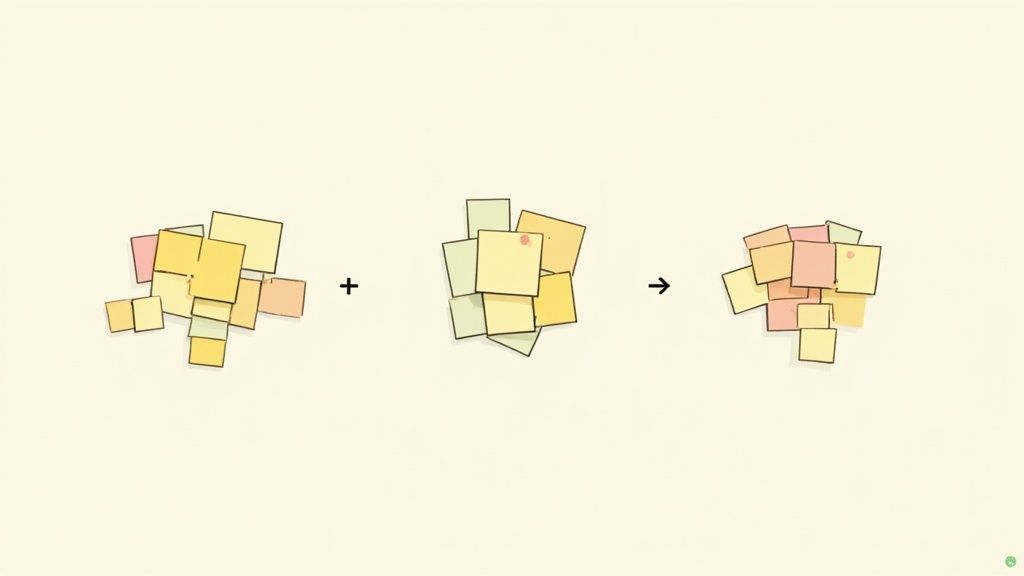
Dot Voting, often used interchangeably with Affinity Estimation, is a highly visual and collaborative technique for quickly grouping work items by relative size. Instead of assigning precise numerical values, the team uses dots (or stickers) to vote on the perceived effort of each item, allowing clusters of similar complexity to form organically. This method is fast, intuitive, and bypasses lengthy debates over exact point values.
It is a powerful tool for high-level backlog refinement or initial release planning where the goal is to establish relative sizing rather than precise commitments. The visual nature of the process makes it easy to spot consensus and outliers, fostering a shared understanding of the work ahead. This makes it one of the most efficient agile estimation techniques for handling large backlogs.
How It Works: A Step-by-Step Guide
Display Items: All work items (e.g., user stories on sticky notes) are placed randomly on a physical wall or digital whiteboard.
Distribute Votes: Each team member is given a set number of dots (e.g., 3-5 dots).
Silent Voting: Participants place their dots on the items they believe are the largest or most complex, without discussion. A team member can place multiple dots on a single item to indicate significant perceived effort.
Group by Affinity: The facilitator and team then rearrange the items on a horizontal scale (e.g., Smaller to Larger) based on the number of dots received. Items with a similar number of dots are clustered together.
Discuss and Finalize: The team discusses the resulting groups, making any final adjustments to item placement. These clusters can then be assigned a relative size, like T-shirt sizes (S, M, L) or story points.
When to Use It
Dot Voting is excellent for quickly estimating a large number of items, such as during initial backlog creation, release planning, or when a new team needs to quickly understand a product's scope. It's also ideal for feature prioritization, as seen in many startup workshops and design thinking sessions. It is less suited for detailed sprint planning where precise commitments are required.
Remote Team Adaptations
For remote teams, digital whiteboarding tools like Miro or Mural are perfect replacements for a physical wall. These platforms offer built-in dot voting features, timers, and infinite canvas space, allowing distributed members to participate just as effectively as they would in person. This preserves the interactive and visual core of one of the most adaptable agile estimation techniques.
7. Wideband Delphi: Structured Expert Consensus
Wideband Delphi is a structured, consensus-building technique that leverages anonymous expert judgment and iterative refinement to arrive at a reliable estimate. Unlike more informal methods, it formalizes the process of gathering and synthesizing input from multiple experts, significantly reducing the impact of cognitive biases like groupthink and anchoring. The core idea is to collect individual estimates anonymously and then use the reasoning behind the outliers to inform subsequent rounds of estimation.
This iterative process was famously used by organizations like NASA for mission planning and is a cornerstone of rigorous project estimation in defense and aerospace. By anonymizing initial feedback and facilitating a structured discussion around the data, Wideband Delphi combines the precision of individual expert analysis with the power of collective intelligence. It stands out among agile estimation techniques for its focus on documentation and rationale, making it ideal for high-stakes, complex projects where accuracy is paramount.
How It Works: A Step-by-Step Guide
Select the Team: A facilitator chooses a panel of experts with diverse perspectives (technical, business, etc.) and a moderator.
Kickoff Meeting: The facilitator presents the work item and its specifications, ensuring everyone has a shared understanding and can ask clarifying questions.
Individual Preparation (Round 1): Experts independently and privately create their initial estimates and document all assumptions and rationale. This is submitted to the facilitator.
Anonymized Summary: The facilitator strips all identifying information from the estimates and rationales, then compiles them into a summary document that highlights the range of estimates and the reasoning behind them, especially the outliers.
Iterative Estimation (Round 2+): The facilitator shares the anonymous summary. The team discusses the findings, and experts then revise their estimates privately based on the new information. This cycle repeats for 2-4 rounds until the estimates converge.
When to Use It
Wideband Delphi is best suited for estimating large, complex, or high-risk initiatives, such as a major feature, an epic, or an entire project. It is most valuable when you need a highly defensible and accurate estimate that requires input from a cross-functional group of specialists who may not work together day-to-day. Use it for your highest-uncertainty and highest-impact items.
Remote Team Adaptations
This technique is naturally suited for distributed teams, as much of the work is asynchronous and anonymous. Digital tools like shared documents (Google Docs, Confluence) can be used for the kickoff and to submit private estimates. The facilitator can use survey tools (e.g., SurveyMonkey) to collect estimates and then share the anonymized summary via email or a collaboration platform like Slack, making it an effective remote agile estimation technique.
8. Bucket System: Streamlining Large-Scale Estimation
The Bucket System is a relative estimation technique designed for speed and efficiency, particularly when dealing with a large backlog of work items. Instead of assigning a precise number to each item, the team sorts them into predefined "buckets," each representing a specific size or complexity range (e.g., Small, Medium, Large, or story point values like 1-2, 3-5, 8-13). This method accelerates the process by focusing on grouping similarly sized items rather than debating exact figures.
This technique is excellent for high-level planning, like Program Increment (PI) planning in the Scaled Agile Framework (SAFe), where hundreds of items need to be estimated quickly. By placing items into buckets, teams can rapidly create a high-level forecast without getting bogged down in the minutiae of individual stories. This makes the Bucket System one of the most practical agile estimation techniques for large-scale product roadmap and release planning.
How It Works: A Step-by-Step Guide
Define Buckets: The team establishes a set of buckets with clear, defined sizes. A common approach is to use a Fibonacci-like sequence (0, 1, 2, 3, 5, 8, 13, 20, 40, 100).
Create a Reference Item: For each bucket, identify a well-understood reference story that exemplifies that level of effort.
Place Items: The facilitator presents a work item, and the team discusses it briefly before collectively deciding which bucket it belongs in by comparing it to the reference items.
Iterate and Refine: The team quickly works through the entire backlog, placing each item. It’s common to do a second pass to review the buckets and ensure the items within each are truly comparable in size.
Assign Values: Once all items are sorted, the numerical value of the bucket is assigned to every item within it.
When to Use It
The Bucket System is ideal for initial backlog grooming, release planning, or any scenario where you need to estimate a large number of items quickly. It’s particularly effective for large, enterprise-level agile programs or when a team needs a rough order of magnitude for a new project or epic. It provides a "good enough" estimate that enables long-term forecasting without the time investment required by techniques like Planning Poker.
Remote Team Adaptations
For distributed teams, digital whiteboarding tools like Miro or Mural are perfect for creating virtual buckets. Team members can use digital sticky notes to represent work items and drag them into the appropriate columns. Many project management tools, including Jira with certain plugins, also offer features that can simulate a Kanban-style board to facilitate this powerful agile estimation technique in a remote setting.
9. Relative Estimation: Leveraging Comparison for Accuracy
Relative Estimation shifts the focus from asking "how long will this take?" to "is this bigger or smaller than that?" It's a powerful approach that leverages the human brain's natural strength in comparison over absolute quantification. Instead of assigning hours or days, teams compare new work items to a set of well-understood "reference stories," establishing a consistent scale of effort based on relative complexity, uncertainty, and volume of work.
This technique is foundational to most story point-based agile estimation techniques. By anchoring all estimates to a common baseline, teams create a more reliable and less emotionally charged estimation process. A small, well-defined story might be a "2," so when a new item is presented, the team simply decides if it’s smaller, larger, or about the same size as that reference point, which is far more intuitive than guessing at a precise number of hours.
How It Works: A Step-by-Step Guide
Establish Reference Stories: The team identifies and agrees upon several baseline user stories that represent different levels of effort (e.g., a small "2," a medium "5," and a large "13"). These should be well-documented and easily accessible.
Present the New Item: The Product Owner describes the new user story or work item to be estimated.
Compare and Contrast: The team discusses the new item in relation to the reference stories. They ask questions like, "Is this more or less complex than our reference '5'?"
Assign a Value: Based on the comparison, the team assigns a story point value. This is often done using a structured method like Planning Poker to achieve consensus.
Periodically Review References: The team should revisit and potentially update the reference stories if the team's composition, technology, or understanding of the domain changes significantly.
When to Use It
Relative Estimation is ideal for any team using story points, especially those moving away from time-based estimates. It excels at maintaining estimation consistency across sprints and even across different teams if they share similar reference points. It is particularly effective for backlog refinement sessions where the goal is to quickly size a large number of items without getting bogged down in detailed, absolute time calculations.
Remote Team Adaptations
For distributed teams, digital whiteboards like Miro or Mural are perfect for visually mapping items against reference stories. You can create columns for each reference point (e.g., 2, 5, 8) and have team members drag and drop new items into the column they feel is most appropriate. This visual exercise sparks discussion and helps remote teams align quickly. This approach pairs well with the scales used in poker-style estimation, which are often based on a relative sequence. To understand the most common scale used, you can learn more about the Fibonacci sequence in Planning Poker.
Agile Estimation: 9-Method Comparison
| Method | 🔄 Complexity | ⚡ Resource / Speed | ⭐ Expected outcome | 📊 Ideal use cases | 💡 Key advantage / tip |
|---|---|---|---|---|---|
| Planning Poker | Medium — facilitator-led rounds, real-time discussion | Moderate — synchronous whole-team sessions | Reliable consensus estimates for small–medium items | Sprint planning, story-level estimation, remote teams | Prevent anchoring with simultaneous reveal; use Fibonacci; timebox discussions |
| T-Shirt Sizing | Low — simple categorical scale | High — very fast, lightweight | Low precision but good for rough prioritization | Early discovery, release planning, epic decomposition | Define clear size definitions and reference examples |
| Story Points | Medium–High — needs calibration and velocity tracking | Moderate — requires historical data for accuracy | Good for forecasting and capacity planning over time | Scrum/Kanban teams, sprint planning, long-term forecasting | Use reference stories; avoid converting points to hours |
| Ideal Days (Ideal Hours) | Low–Medium — conceptually simple but needs productivity factors | Moderate — quick to estimate but requires conversion to calendar time | Clearer correlation to effort; can be misleading if idealized | Technical tasks, capacity planning where time correlation is needed | Track productivity factor and apply multiplier to convert to calendar time |
| Three-Point Estimation | High — three scenarios + weighted calculation (PERT) | Low — more time-consuming per item | Explicit uncertainty and probabilistic estimates | High-risk or high-uncertainty items, major projects | Calibrate scenarios with historical data; document assumptions |
| Dot Voting / Affinity Estimation | Low — visual grouping, minimal rules | High — very quick for many items | Coarse consensus categories; good for clustering | Large backlogs, workshops, design prioritization | Give equal dots, start with random placement, use digital boards for remote teams |
| Wideband Delphi | High — multi-round anonymous expert process with facilitation | Low — time- and resource-intensive | High accuracy and well-documented rationale | Complex, high-impact projects requiring expert input | Limit rounds (3–4), anonymize feedback, document outlier reasoning |
| Bucket System | Low–Medium — predefined buckets, mass placement | High — extremely efficient for bulk estimation | Sufficient precision for planning; less granular | Very large backlogs, program increments, enterprise planning | Create 5–7 clear buckets and reference items; run rough then refinement pass |
| Relative Estimation / Comparing to Reference | Medium — depends on quality/maintenance of reference items | Moderate — efficient once references are established | Consistently accurate relative estimates | Teams transitioning to points, diverse teams, comparative sizing | Maintain 2–3 reference stories and refresh as team/context changes |
Choosing the Right Technique for Your Team's Context
We've explored a comprehensive toolkit of agile estimation techniques, from the structured consensus of Planning Poker to the high-level grouping of T-Shirt Sizing and the collaborative speed of Affinity Estimation. The journey through these methods reveals a fundamental truth: there is no single "best" technique. The most effective approach is rarely a single, dogmatic choice but rather a dynamic, context-driven strategy.
The real power lies in understanding that these techniques are not mutually exclusive. A highly mature agile team might fluidly switch between them based on the task at hand. They might use T-Shirt Sizing for quarterly roadmap planning, shift to the Bucket System for release backlog grooming, and then zero in on Planning Poker for the high-priority, well-defined stories being pulled into the next sprint. The goal isn't to find a silver bullet but to build a versatile toolkit.
From Numbers to Conversations
A recurring theme across all these agile estimation techniques is the shift in focus from precision to understanding. The ultimate goal of estimation is not to generate a perfectly accurate number or a fixed deadline. Instead, the true value emerges from the conversations these techniques facilitate.
The most valuable output of any estimation session is not the estimate itself, but the shared understanding, uncovered assumptions, and identified risks that emerge from the team's dialogue.
When a developer and a tester provide wildly different estimates during a Planning Poker session, that discrepancy is a signal. It prompts a critical conversation about complexity, dependencies, or hidden requirements that might have otherwise been missed. This collaborative discovery is the engine that drives better planning and reduces future surprises.
Creating Your Team's Estimation Playbook
So, how do you move from theory to practice? The key is to experiment, inspect, and adapt. Don't be afraid to try a new technique and honestly assess its effectiveness during your team retrospectives. Your path to mastering estimation might look something like this:
Assess Your Needs: Are you planning a new epic, grooming a backlog, or committing to sprint work? The granularity of the task dictates the appropriate tool. High-level planning calls for methods like T-Shirt Sizing, while sprint-level detail benefits from the rigor of Story Points and Planning Poker.
Start Simple: If your team is new to formal estimation, start with a straightforward method like the Bucket System or Dot Voting. These techniques introduce the core concept of relative sizing without the initial overhead of more structured approaches.
Combine and Conquer: Create a hybrid model. Use a reference story (a baseline "5-point" story, for example) as a foundation for all relative sizing exercises, whether you're using Affinity Estimation or Planning Poker. This creates consistency across different estimation activities.
Iterate and Refine: Discuss what's working and what isn't in your retrospectives. Is Planning Poker taking too long? Perhaps try asynchronous estimation for some items. Are T-shirt sizes too vague? Try defining what "M" or "L" means for your specific team context.
By consciously selecting and refining your approach, you transform estimation from a dreaded administrative chore into a strategic activity. It becomes a powerful mechanism for building team alignment, fostering collective ownership, and creating a more predictable and sustainable pace of delivery. The journey to mastering agile estimation techniques is an investment in your team's communication, collaboration, and ultimate success.
Ready to put these principles into action? Elevate your sprint planning sessions with a tool designed for seamless collaboration. Scrum Planning Poker provides the structure your team needs for effective, engaging, and accurate estimation, whether you're in the same room or distributed across the globe.
Start your free estimation session with Scrum Planning Poker today!