
A Better Project Kickoff Meeting Agenda for Success
A project kickoff meeting agenda is more than just a list of topics; it's the strategic blueprint for your project's first official gathering. It’s the tool you use to align everyone involved, spell out the project’s purpose, define who’s doing what, and build the momentum you need to get started on the right foot.
Frankly, a great agenda turns what could be just another meeting into the project's very first win.
Why a Great Kickoff Agenda Is Your First Project Win
I’ve seen it time and again: the fate of a project is often sealed long before the first line of code is written or the first deliverable is designed. A carefully crafted kickoff agenda isn't just a formality—it's your most critical tool for starting strong. It’s what elevates the meeting from a simple checklist review to a session that genuinely syncs up everyone's expectations from day one.
Think of it as the foundational document for success. A clear agenda is your best defense against scope creep because it forces you to define what's in—and just as importantly, what's out. It helps create a sense of shared ownership that motivates your team and gives clients confidence, paving the way for open communication and real forward motion.
Fostering Alignment and Preventing Misunderstandings
We've all been in kickoff meetings that wander off-track and end without clear next steps. It's not just annoying; it's a real risk to the project. Research backs this up. A study from the University of North Carolina revealed that 71% of senior managers see meetings as unproductive, and 62% feel they don’t even bring teams closer together.
A strong agenda is the direct solution to this problem. It forces you to get specific on the things that matter most:
- A Shared Vision: It makes sure every single person in the room—from the lead developer to the client stakeholder—understands the "why" behind the project and what a successful outcome looks like.
- Role Clarity: It answers the simple but vital question: "Who is responsible for what?" This alone can prevent countless headaches and dropped balls down the line.
- Risk Identification: A good agenda carves out dedicated time to talk about potential roadblocks before they become full-blown emergencies.
Building Team Cohesion and Psychological Safety
The kickoff is also your first, best chance to shape the team's culture. When a meeting is run well, people feel heard, their input is valued, and they feel genuinely connected to the mission. It’s the perfect time to break the ice and build some rapport. Starting with a quick icebreaker for work can work wonders to get everyone comfortable and engaged.
A project kickoff meeting isn't just about conveying information; it's about building a coalition. The agenda is your script for creating a unified team ready to tackle challenges together.
Ultimately, this document is what transforms your first meeting from a potential source of confusion into a powerful launchpad for the entire project.
Laying the Groundwork for a Flawless Kickoff

A great project kickoff meeting doesn't just happen. It's the result of some smart, deliberate prep work that turns a potential hour of confusion into a laser-focused launchpad for your project. Before you even think about sending a calendar invite, you need to nail down the meeting’s core mission.
Your first move is to set sharp, actionable objectives. I don't mean just listing topics to cover. Frame them as questions that demand answers or decisions that need to be locked in.
- What's the single most important thing we need to achieve in this meeting?
- What are the three key decisions we absolutely must make before we wrap up?
- What critical information does every single person need to walk away with?
Thinking through these questions forces you to build an agenda with a real purpose. It stops the meeting from becoming a simple information dump and transforms it into a genuine working session.
Assembling the Right Team
Once you have those clear objectives, figuring out who to invite becomes a much more strategic exercise. The trick is to get all the key decision-makers and contributors in the room without bloating the guest list, which is a surefire way to kill conversation and grind decisions to a halt.
Think about who is absolutely essential for hitting your meeting goals. This usually means the project sponsor, key client stakeholders, the core delivery team (like your lead dev and designer), and the product owner. Be ruthless with that invite list and respect everyone's time. If someone only needs to weigh in on a specific 10-minute topic, consider just bringing them in for that part of the meeting.
A crowded meeting is an unproductive one. Every single person invited should have a clear reason for being there—either to provide critical input or to make a key decision. If you can't define their role in a sentence, they probably don't need the invite.
Equipping Attendees for Success
Okay, so your A-team is assembled. Now, your job is to make sure they show up ready to hit the ground running. This is where sending out pre-read materials and the agenda ahead of time is completely non-negotiable. A concise project brief, a summary of the scope, or a list of known risks can work wonders.
This isn't just about saving time during the meeting; it's about elevating the entire conversation. When people have the context beforehand, the kickoff can jump straight into alignment and problem-solving instead of getting bogged down in basic discovery. A good rule of thumb is to distribute the final project kickoff meeting agenda at least 48 hours in advance. This gives everyone a chance to review, jot down questions, and show up ready to contribute.
You can also get a head start on a few other things. Giving people a chance to review the plan can lead to early thoughts on effort, which is a core part of how agile teams operate—something you can explore in our guide to story point estimation. It’s this kind of prep work that ensures your kickoff builds momentum from the very first minute.
The Anatomy of an Effective Kickoff Agenda
Think of your project kickoff agenda as less of a checklist and more of a script for a really productive conversation. Each item isn’t just a topic to cover; it’s a deliberate step designed to build clarity, alignment, and momentum. This is what separates a forgettable, "could-have-been-an-email" meeting from one that truly launches a project with purpose.
A killer agenda moves beyond a simple list of topics. It builds a narrative, guiding everyone from initial introductions to concrete next steps in a way that feels natural and engaging.
Setting the Stage: Introductions and Vision
Starting with introductions is standard, but you can do better than just a round-robin of names and titles. Frame it as a way to build instant rapport. Ask each person to share their role, of course, but also ask them to mention one thing they're genuinely excited to contribute. This simple twist frames everyone's involvement around positive action right from the get-go.
From there, you pivot immediately to the "why." This is where the project sponsor or product owner needs to tell the story behind the work. It’s not a dry reading of the project charter; it's the narrative—the customer problem we're solving, the business value it creates, and what a huge success looks like for everyone involved. A compelling vision is what gets a team to do more than just complete tasks; it gets them to solve problems creatively.
The real goal of a kickoff is to transform a group of individuals into a unified team with a shared mission. Your agenda is the map that makes that happen.
Defining the Playing Field: Scope and Responsibilities
Once everyone is inspired by the vision, it’s time to draw the lines. This is where you get brutally specific about the project scope. Clearly lay out the key deliverables, features, and target outcomes. But just as important—maybe even more important—is to explicitly state what is out of scope. This one simple act is your single best defense against the dreaded scope creep that can derail even the best projects.
With the "what" firmly established, you have to nail down the "who." This section of the agenda is all about making roles and responsibilities crystal clear.
- Project Sponsor: Who is the ultimate champion with final authority?
- Product Owner: Who owns the backlog and makes the final call on priorities?
- Key Stakeholders: Whose feedback and input are absolutely critical?
- Core Delivery Team: Who are the developers, designers, and testers actually building this thing?
Getting this on paper (or on the screen) eliminates so much confusion down the road. Everyone knows exactly who to talk to for specific decisions.
Charting the Course: Timelines and Risks
Next, your agenda needs to bring the project back down to earth with a high-level timeline. No one is expecting a minute-by-minute Gantt chart here, but you absolutely need to present the key phases and major milestones. This gives the team a sense of the project's rhythm and when the big deadlines are coming.
For teams running on Agile, this is the perfect time to talk about the proposed sprint length and cadence. Getting on the same page early prevents a lot of friction later. If you're new to this, it's worth understanding the fundamentals of agile sprint planning.
Finally, you have to talk about what could go wrong. A dedicated block of time for a "pre-mortem" or risk brainstorming session is non-negotiable. Pose the question to the room: "If this project were to fail six months from now, what would be the most likely cause?" Getting potential risks—technical, logistical, or resource-related—out in the open allows the team to start thinking about how to get ahead of them.
A well-structured kickoff agenda has to cover certain ground to be effective. The table below breaks down the essential items, why they matter, and the core questions you need to answer for each one.
Essential Project Kickoff Agenda Items
| Agenda Item | Purpose | Key Questions to Address |
|---|---|---|
| Welcome & Introductions | To build rapport and establish a collaborative tone from the start. | Who is on the team? What is each person's role and expertise? |
| Project Vision & Goals | To align everyone on the "why" behind the project and define success. | What problem are we solving? What does success look like? |
| Scope & Deliverables | To create a shared understanding of what is (and is not) being built. | What are the key features and deliverables? What is explicitly out of scope? |
| Roles & Responsibilities | To clarify who is accountable for what and streamline decision-making. | Who is the sponsor? Who is the product owner? Who are the key stakeholders? |
| Timeline & Milestones | To set realistic expectations for timing and major deadlines. | What are the major phases of the project? When are the key milestones? |
| Risks & Mitigation | To proactively identify and plan for potential roadblocks. | What are the biggest threats to our success? How can we get ahead of them? |
| Communication Plan | To establish how the team will stay in sync. | How often will we meet? What tools will we use? Who needs to be informed? |
| Next Steps & Q&A | To ensure everyone leaves with clear, actionable tasks. | What are the immediate next steps? Who is responsible for them? |
This structured approach ensures you hit every critical point before a single line of code is written or design is mocked up.
With agile methods now used by 71% of organizations according to recent project management trends on clickup.com, the need for this kind of upfront alignment is more critical than ever. A great kickoff agenda is the foundation for a successful, collaborative project.
Agenda Templates for Different Project Realities
A generic, one-size-fits-all agenda for a project kickoff is a recipe for a dull, unproductive meeting. Let's be real: the needs of a massive, client-facing software launch are worlds apart from a quick internal website update.
You wouldn't use a sledgehammer to hang a picture frame, so don't bring a 20-page agenda to a two-week project. To make your kickoff truly effective, you have to tailor your plan to the project's scale and context. Below are three practical templates I've used for different project scenarios.
Lean Agenda for Small Internal Projects
When you're working on smaller, internal projects, speed and clarity are your best friends. The whole point is to get everyone aligned and moving forward fast, without getting bogged down in unnecessary formalities. This agenda is designed to be punchy, effective, and done in under an hour.
- Quick Intros & Project Goal (10 mins): Go around the virtual room. Everyone states their name, role, and one key thing they're contributing. Then, the project lead nails down the primary objective in just a couple of sentences.
- Scope "In & Out" (15 mins): This is a great time for a whiteboard (physical or digital). Quickly list everything that's in scope. More importantly, be ruthless about what's out of scope. This single activity prevents so much scope creep down the line.
- Roles & Key Tasks (10 mins): Settle two things: who is the final decision-maker, and who owns the very first set of tasks?
- Next Steps & Blockers (10 mins): Before you wrap, identify the immediate next steps. Then, give everyone a chance to flag any potential roadblocks they see coming.
This stripped-down approach keeps the energy high and ensures the team walks away with a shared understanding of what to do next. No fluff, all action.
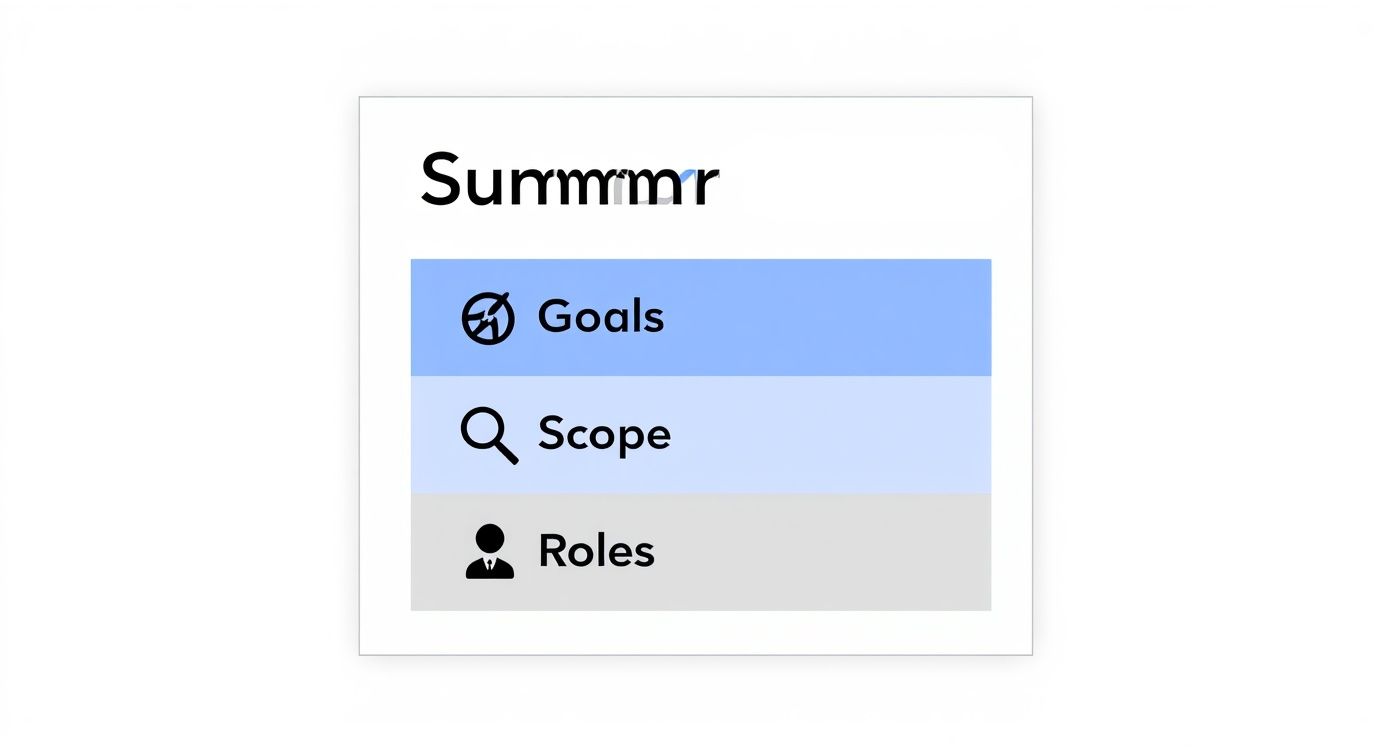
No matter the project size, these three pillars—Goals, Scope, and Roles—are the foundation. Nailing them down ensures everyone is working from the same playbook from day one.
Comprehensive Agenda for Large Client-Facing Projects
When the stakes are higher—think external clients, big budgets, and multiple teams—your agenda needs more structure and detail. The goal here is to build client confidence and leave no stone unturned. This is about being thorough and professional.
- Formal Introductions & Client Vision (20 mins): Go beyond names. Introduce each team member and their specific role. Then, hand the floor to the client to share their vision of success. This aligns everyone on the ultimate business goal, not just the project tasks.
- Project Charter & Scope Review (30 mins): Time to get official. Walk everyone through the signed-off project charter, line by line. Review the objectives, key deliverables, and documented scope. This is the moment for clarification and formal agreement before work begins.
- Roles, Responsibilities & Communication Plan (25 mins): A RACI chart is your best friend here. Clearly define who is Responsible, Accountable, Consulted, and Informed. You also need to lock down the communication plan—how often will you meet, and what will stakeholder reports look like?
- Timeline, Milestones & Risk Assessment (25 mins): Present the high-level project timeline, calling out the major milestones. Crucially, dedicate time for a collaborative risk assessment. What could go wrong? Get it all out on the table now.
- Tools, Processes & Next Steps (20 mins): Confirm the tech stack. What project management software are you using? Where will you communicate? Be specific. End by agreeing on the immediate next steps and assigning clear owners.
Engaging Agenda for Remote Teams
Running a kickoff for a remote team is a different ballgame. You can't rely on the natural energy of being in the same room, so your agenda has to be intentionally designed to foster connection and engagement.
For remote teams, the kickoff meeting isn't just for alignment; it's a critical opportunity to build the human connections that fuel collaboration. The agenda must intentionally create space for this.
- Icebreaker & Tech Check (15 mins): Don't skip the small talk! Start with a fun, low-pressure icebreaker. This is also the perfect time to make sure everyone's audio, video, and screen-sharing are working flawlessly.
- Shared Vision & Goals (20 mins): The project lead should share their screen and walk through the goals visually. Use interactive tools like polls in Zoom or Microsoft Teams to check for understanding and keep people involved.
- Interactive Scope & Roles Walkthrough (30 mins): Fire up a digital whiteboard like Miro or Mural. Map out the scope visually as a group. When discussing roles, have each person briefly explain their part in their own words.
- Collaboration Tools Demo (15 mins): Don't just list your tools—show them. Do a quick demo of exactly how you'll use Slack for daily chats, Asana for tasks, and Google Drive for files.
- Open Q&A and Action Items (10 mins): Leave plenty of dedicated time for questions. Before you sign off, verbally confirm each action item and its owner. It’s a simple step that ensures nothing falls through the cracks.
Agenda Focus Comparison by Project Type
Not sure which template is the right starting point? The key is understanding where to focus your energy. This table breaks down the main priorities for each project type.
| Project Type | Primary Focus | Key Agenda Difference |
|---|---|---|
| Small Internal | Speed & Action | Heavily prioritizes "What's next?" and getting blockers out of the way immediately. Minimal formality. |
| Large Client | Clarity & Confidence | Focuses on formal documentation (charter, scope) and building client trust through a detailed plan. |
| Remote | Engagement & Connection | Intentionally builds in time for icebreakers and interactive tool demos to create a sense of team cohesion. |
Ultimately, these templates are just a starting point. Feel free to mix and match elements to create an agenda that fits the unique reality of your project and your team.
How to Run the Meeting and Keep Momentum High

Having a brilliant agenda is one thing, but bringing it to life is where the real magic happens. As the facilitator, your job is to turn that document into a dynamic, collaborative conversation. This isn't about lecturing; it's about guiding everyone toward a shared understanding and a clear path forward.
Think of yourself as the meeting's guide, not its hero. Your main task is to keep the conversation on track and on time. When a discussion starts veering into a deep technical rabbit hole, pull it back gently. Use a "parking lot" to capture important but off-topic items.
A simple, "That's a critical point we need to solve. Let's park it for a dedicated follow-up with the right people so we can stick to our schedule," works wonders. It shows you value the input without derailing the entire meeting.
Fostering an Inclusive Discussion
Creating an atmosphere where everyone feels comfortable speaking up is absolutely critical. Some of the best insights often come from the quieter members of the team, so you need to intentionally make space for them.
Instead of just asking, "Any questions?" at the end of a section, try a more direct approach:
- Call on people by name: "Maria, from a design perspective, do you see any potential challenges with this timeline?"
- Ask for different viewpoints: "We've heard the technical side. Who has another perspective we should be considering?"
This simple shift in questioning makes it clear that every voice is not just welcome, but expected. When disagreements pop up—and they will—treat them as opportunities. Acknowledge the concern, validate the person's viewpoint, and steer the group toward finding a constructive solution together.
The energy you build in the kickoff is your project's initial fuel. But your follow-up is the engine that keeps it running. Don't let a great meeting fizzle out because of a poor handoff.
Turning Conversation into Concrete Action
How you close the meeting is just as important as how you start it. Those final minutes are your chance to cement commitments and make sure the energy in the room actually translates into work getting done. A solid follow-up separates a good kickoff from a truly great one.
As soon as possible after the meeting, send out concise minutes. This isn't a word-for-word transcript; it’s a high-level summary of key decisions and—most importantly—the action items.
For every single action item, you must assign a single, unambiguous owner and a clear deadline. A vague task like "Look into the API issue" becomes "John to investigate API authentication options and report back by Friday."
This level of clarity is non-negotiable. By assigning ownership and timelines on the spot, you create instant accountability. It ensures everyone walks away knowing exactly what they need to do next, turning the kickoff's momentum into a powerful launchpad for the project.
Answering Your Top Project Kickoff Questions
Even the most seasoned project managers run into tricky situations when planning a kickoff. Let's tackle some of the most common questions I hear—the kind of stuff that can make or break your meeting's success.
What's the Single Biggest Mistake to Avoid?
I’ve seen this happen too many times: the biggest mistake is failing to do the prep work. If you walk into that room without a clear, pre-circulated agenda, you're setting yourself up for a rambling, unproductive mess. It's the fastest way to confuse stakeholders and walk out with zero clear next steps.
Remember, the kickoff is for alignment and decision-making, not discovery. All the core info—the project brief, scope summary, key documents—needs to be in everyone's hands before the meeting. That way, you can use your precious time together for real, high-impact conversations.
How Do I Handle a Stakeholder Who Goes Off-Topic?
Ah, the classic derailer. You're trying to stick to the agenda, and a key stakeholder keeps pulling the conversation into the weeds. The key is to acknowledge their point so they feel heard, then gently but firmly guide the discussion back on track.
Try saying something like, "That's a really important point, and we definitely need to circle back to it. Let's add it to our 'parking lot' so we can make sure we cover the other critical items on today's agenda."
This approach validates their contribution without letting the entire meeting get hijacked. Having that pre-agreed agenda and a designated timekeeper gives you the authority you need to steer the ship respectfully.
Who Should Actually Be Leading the Kickoff?
The project manager (or the lead from the delivery team) should always run the show. Period. While your client or primary stakeholder is a crucial voice in the room, the PM owns the project's structure, timeline, and ultimately, its execution.
Stepping up to lead the kickoff accomplishes two critical things:
- It immediately establishes you as the project's central point of contact.
- It projects organization and control right from the start, which is huge for building client confidence.
By taking firm ownership of the project kickoff meeting agenda, you set a professional tone and reinforce your leadership. This gives the project the strong, structured start it needs to succeed.
Ready to make your agile planning sessions as clear and effective as your kickoff? Scrum Planning Poker offers a free, no-signup tool for fast and accurate team estimations. Bring structure and transparency to your sprint planning by starting a session in seconds. Try it now at https://onlineplanningpoker.com.