Mastering the Project Management Process
So, what exactly is a project management process? Think of it as the strategic playbook that guides a project from a simple idea all the way to the finish line. It’s a series of distinct phases, each with its own goals and outputs, designed to make sure projects land on time, stay within budget, and meet quality standards. This structured approach is what turns a chaotic brainstorm into a successful reality.
Why a Project Management Process Is Your Blueprint for Success
Imagine trying to build a house without a blueprint. The contractors would be guessing where to put walls, plumbers would install pipes at random, and electricians would run wires with no real plan. The result? Total chaos, wasted money, and a structure that would probably fall apart.
A project management process provides that same essential structure for your work. It's the roadmap that guides every single team member from the initial concept—the empty plot of land—to the final deliverable, your fully furnished home. This isn't about adding bureaucratic red tape; it's about creating clarity and making success predictable.
The Core Benefits of a Structured Process
When you commit to a defined project management process, you start to see some immediate and tangible benefits.
- Improved Clarity and Direction: Everyone knows what the goal is, who's responsible for what, and what the major milestones are. This alignment cuts through the noise and keeps the whole team pulling in the same direction.
- Smarter Resource Management: A clear plan lets you allocate your budget, your team's time, and the tools you need far more effectively. It helps you avoid waste and ensures you have what you need, right when you need it.
- Proactive Risk Mitigation: A good process forces you to think about what could go wrong before it actually does. This means you can spot potential risks early on and have a plan ready to handle them.
- Greater Stakeholder Confidence: When stakeholders see a well-thought-out plan and get regular updates, their confidence in the project—and in you—grows. That leads to better buy-in and smoother collaboration.
A well-defined project management process transforms ambiguity into a clear sequence of actions. It ensures that every step taken is deliberate, measured, and directly contributes to achieving the final objective.
This systematic approach has become so essential that 82% of companies now use project management software to support their workflows. It's part of a global market expected to hit USD 12.02 billion by 2030. These numbers show a clear trend: businesses everywhere recognize that a formal process, backed by the right tools, is critical for success. You can dive deeper into these trends by exploring more project management statistics.
Ultimately, this whole process provides a foundational framework, which is typically broken down into five fundamental phases: Initiation, Planning, Execution, Monitoring, and Closing. Getting a handle on this lifecycle is the first step toward delivering successful projects again and again.
Breaking Down the 5 Core Phases
Think of the project management process less as a rigid set of rules and more as a logical story that takes an idea from a simple "what if?" to a successful "we did it." It's a structured journey broken down into five distinct phases, each one building on the last.
Trying to skip a phase is like attempting to build a house by putting the roof on before the walls are up—you're just setting yourself up for a collapse.
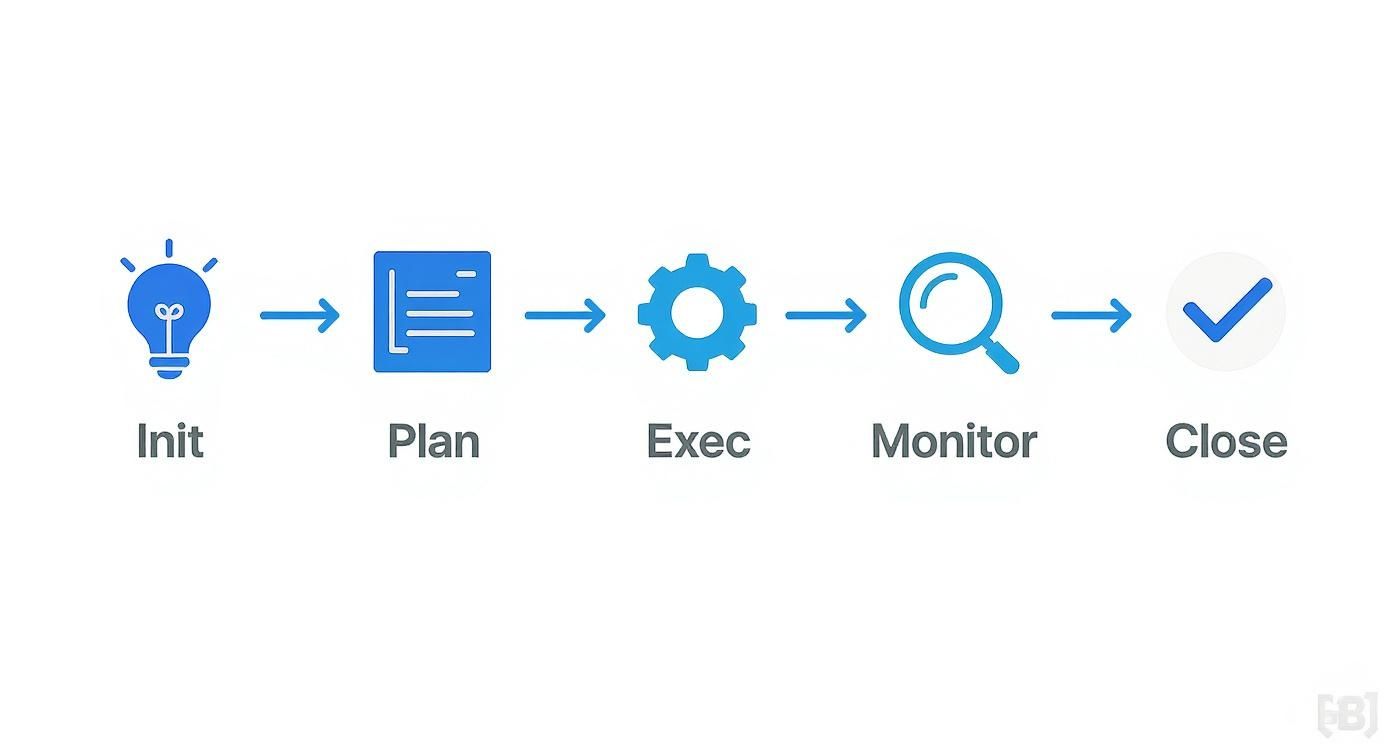
This flow shows how each stage feeds directly into the next, creating a clear and predictable path. Let’s dive into what really happens at each step.
Phase 1: Initiation
Every project starts with an idea, but the Initiation phase is where that idea gets its official birth certificate. This is the moment a concept is formally recognized, defined in broad strokes, and given the green light to move forward. It’s the foundational handshake of the project, establishing its purpose and getting key people on board.
The goal here isn't to map out every single detail. It's about answering one critical question: is this project feasible and worth our time? Key activities include:
- Building the Business Case: This is where you clearly state the problem you're solving or the opportunity you're chasing. It’s the "why" behind the entire effort.
- Identifying Key Stakeholders: You need to figure out who has a vested interest in the outcome—from the executive who signs the checks to the end-users who will benefit from the work.
- Creating the Project Charter: This is the most important document of the Initiation phase. It’s a high-level summary of the project's vision, goals, scope, and key players. Essentially, it's the official authorization that allows the project to exist.
A solid Initiation phase gets everyone aligned from the very beginning, heading off the kind of costly misunderstandings that can derail a project down the line.
Phase 2: Planning
Once the project has been chartered, it's time to roll up your sleeves for the Planning phase. This is often the most intense part of the whole process. Here, you’ll create the detailed roadmap that your team will follow. If Initiation was the handshake, Planning is drafting the full set of architectural blueprints.
Rushing this stage is a classic mistake that almost always leads to blown budgets, missed deadlines, and endless scope creep. The project manager and the team work together to break down the big-picture goals from the charter into a concrete, actionable plan.
The planning phase is where you translate your project’s goals into a concrete schedule of tasks and deliverables. It's the difference between wishing for an outcome and creating a clear path to achieve it.
A well-crafted project plan will almost always cover:
- Work Breakdown Structure (WBS): This involves taking the entire scope of the project and slicing it into smaller, more manageable tasks. This hierarchical view makes it much easier to estimate time, assign work, and track progress. For a complete guide, you can learn more about how to create a powerful project Work Breakdown Structure.
- Budget Estimation: You’ll calculate the projected costs for everything—labor, materials, software, you name it.
- Timeline and Scheduling: This is where you lay out the project schedule, figuring out how long each task will take and how they all depend on one another.
- Resource Planning: You'll identify who needs to be on the team and what tools or equipment they’ll need to get the job done.
- Risk Management Plan: Smart teams think ahead. This involves identifying potential roadblocks and figuring out how you'll handle them if they pop up.
The final output is a comprehensive project plan, a single source of truth that keeps everyone on the same page for the rest of the project.
Phase 3: Execution
This is it—the "go" phase. Execution is where the plan is set in motion. The team starts building, coding, creating, and delivering. It’s the construction phase where your blueprints from the Planning stage finally start to take shape in the real world.
Here, the project manager’s job pivots from planner to conductor, leading the team and coordinating all the moving parts to keep the work flowing. Key activities in the Execution phase include:
- Assembling the Project Team: Getting the right people into the right roles and making sure they have what they need to succeed.
- Managing Task Completion: Assigning work, tracking progress against the schedule, and clearing any obstacles that get in the team's way.
- Facilitating Communication: Keeping everyone in the loop with regular status meetings, progress reports, and clear updates.
Smooth execution is all about clear communication and strong leadership to keep the project's momentum going strong.
Phase 4: Monitoring and Controlling
The Monitoring and Controlling phase doesn't happen after execution; it happens during it. Think of this as the project's quality control system, constantly checking to make sure the work being done still aligns with the original plan. It’s like the project’s GPS, always comparing your current location to the planned route and alerting you if you take a wrong turn.
This phase is all about measurement and course correction. The project manager keeps a close eye on key performance indicators (KPIs) to make sure everything is on track.
Common KPIs to Track:
| Metric Category | Specific KPI Example | Purpose |
|---|---|---|
| Schedule Performance | Schedule Variance (SV) | Measures if the project is ahead of or behind schedule. |
| Budget Performance | Cost Variance (CV) | Determines if the project is over or under budget. |
| Quality Control | Defect Density | Tracks the number of bugs or errors found in deliverables. |
| Scope Management | Change Request Volume | Monitors how many changes are being requested to the original plan. |
This constant vigilance allows the team to spot deviations early and make adjustments before small issues snowball into major problems. This includes handling change requests, dealing with risks as they emerge, and solving problems that threaten the project’s success.
Phase 5: Closing
Finally, we arrive at the Closing phase. This isn’t just about ticking off the last task on the list. It’s about formally and gracefully wrapping up the project, ensuring there are no loose ends. This provides a clean finish line, confirming all the work is done, approved, and handed over.
Key steps to properly close a project include:
- Gaining Formal Sign-Off: Getting the final "okay" from the client or stakeholder, confirming that the deliverables meet all the agreed-upon requirements.
- Releasing Project Resources: Officially disbanding the team so they can move on to their next challenges, and releasing any equipment or other assets.
- Final Reporting: Creating a final project report that summarizes how the project performed against its original goals for schedule, budget, and scope.
- Archiving Project Documents: Storing all project files, plans, and communications in a central place for future reference.
- Conducting a Post-Mortem: Holding a "lessons learned" meeting with the team. This is a crucial step to talk about what went well, what didn't, and how you can be even better on the next project.
Closing a project the right way ensures everything is properly buttoned up and provides invaluable insights that make the entire organization smarter and more effective over time.
Choosing Your Project Management Style
Just as a master chef doesn’t use the same cooking technique for every dish, a project manager can't just slap the same process onto every project. The five phases we’ve covered—from Initiation to Closing—give you a universal framework, but how you actually move through them can look wildly different. This is where you have to make a crucial decision: what style of project management truly fits the work you're doing?
Right now, two dominant philosophies shape how teams get work done: the traditional Waterfall method and the more modern Agile approach. Getting a handle on their core differences is one of the most important things you can do to set your project up for success right from the start.
The Skyscraper vs. The Community Garden
Let's use a simple analogy to get to the heart of what makes these two styles so different.
Imagine you've been hired to build a 100-story skyscraper. The requirements are completely fixed. You know the height, the materials, the number of floors—everything. You'd need a meticulously detailed blueprint and a rigid sequence of construction phases. There's virtually no room for change once you break ground. That's the Waterfall model in a nutshell: linear, predictable, and sequential, where you must finish one phase completely before the next one can even begin.
Now, picture your next project is starting a community garden. The high-level goal is clear—create a vibrant, productive space—but the specifics will evolve. You'll work with the community, see which plants thrive, and adapt to the seasons. You might plant one small section, see how it goes, and let that experience inform what you do next. This is the Agile model: iterative and flexible, built on collaboration and delivering value in small, continuous cycles.
When to Use Each Approach
The Waterfall method is your best bet for projects where the end goal is crystal clear and isn't going to change. Think about manufacturing a new car model or building a bridge. The requirements are locked in, and the path to get there is straightforward. Its greatest strength is its predictability and the detailed paper trail it creates.
On the other hand, Agile shines in dynamic environments where you don't—or can't—know everything upfront. It’s a natural fit for software development, R&D projects, and marketing campaigns. These are projects where customer feedback and market shifts should shape the final outcome. It's no surprise that 71% of organizations now report using Agile approaches, a testament to its power in fast-moving industries.
Choosing a project management style isn't about which one is "better." It's about picking the right tool for the job. Trying to build a skyscraper with an Agile mindset is just as risky as trying to cultivate a garden with a rigid Waterfall plan.
Of course, for many teams, it isn't a strict either/or choice. A hybrid approach, which blends the detailed upfront planning of Waterfall with the iterative flexibility of Agile, is gaining a lot of ground. This allows teams to maintain a clear long-term vision while still having the freedom to adapt along the way.
Waterfall vs Agile: A Head-to-Head Comparison
To really nail down which style fits your next project, it helps to see them side-by-side. This table breaks down their core differences across the most critical aspects of managing a project.
| Aspect | Waterfall (Traditional) | Agile (Modern) |
|---|---|---|
| Planning | Done comprehensively upfront. The entire project is mapped out before any work begins. | Iterative. Planning occurs in short cycles (sprints), with details emerging over time. |
| Execution | Follows a strict, linear sequence of phases (e.g., design -> build -> test). | Work is done in small, incremental sprints, delivering functional pieces of the project. |
| Stakeholder Involvement | Primarily involved during the initial requirements gathering and final review stages. | Constant collaboration and feedback are essential throughout the entire project lifecycle. |
| Adaptability to Change | Change is difficult and costly to implement once the plan is set. It often requires formal change requests. | Change is welcomed and expected. The process is designed to adapt to new information and feedback quickly. |
| Delivery of Value | A single, final product is delivered at the very end of the project timeline. | Value is delivered continuously at the end of each short cycle, allowing for early and frequent releases. |
In the end, both the skyscraper and the garden need a solid project management process to succeed. One just demands a rigid blueprint, while the other thrives on continuous cultivation. By thinking carefully about your project's scope, predictability, and how involved your stakeholders need to be, you can confidently choose the style that will guide your team to a great outcome.
Applying the Process with Scrum
If your team has gone all-in on Agile, the classic five-phase project management process might feel like a stiff, old-fashioned suit. But here’s the thing: the core ideas of Initiation, Planning, Execution, Monitoring, and Closing don't just vanish. They just get a modern, flexible makeover within the Scrum framework.
Instead of a straight line from start to finish, these phases become part of a repeating cycle. They’re woven directly into the rhythm of your Sprints, giving your agile workflow a sturdy foundation. This structure is more important than you might think. Globally, a staggering 35% of projects are considered successful. Yet, teams that implement a formal project management process—whether it's traditional or agile—are 2.5 times more likely to succeed. If you're curious about the data, these insights on project management paint a clear picture.
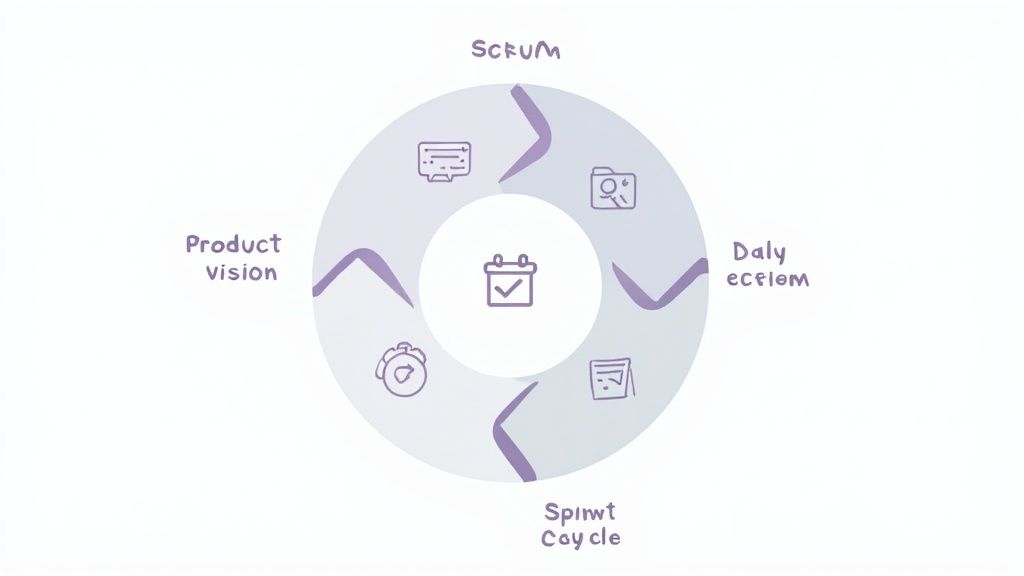
Mapping the Phases to Scrum Events
So, how do these worlds connect? Seeing how the traditional phases align with Scrum events shows you don't have to sacrifice structure for agility. You really can have the best of both.
Initiation is Your Product Vision: In the old world, you’d draft a project charter. In Scrum, this is the birth of the Product Vision and the first draft of your Product Backlog. It’s where you define the "why" behind the work, get stakeholders on the same page, and set the high-level goals that will act as your team’s North Star.
Planning is the Sprint Planning Meeting: Waterfall demands a massive, all-at-once planning effort. Scrum is smarter about it, breaking planning down into focused, sprint-sized chunks. During the Sprint Planning meeting, the team pulls items from the Product Backlog and maps out exactly how they’ll tackle the work in the upcoming Sprint.
This is also prime time for estimation. Using techniques like Planning Poker, teams assign effort values (usually story points) to each task. Getting this right is crucial, and you can dive deeper into the methods with this guide to story point estimation in agile teams.
Execution and Monitoring in Sprints
In Scrum, execution and monitoring aren't separate stages you move through. They're happening all the time, intertwined within every single Sprint. This constant feedback loop is where Scrum’s magic really happens.
The Execution phase is simply the Sprint itself. For those two to four weeks, the development team is laser-focused on one thing: turning the Sprint Backlog into a working, shippable piece of the product. No distractions, just building.
In Scrum, the Monitoring & Controlling phase is not a separate, top-down activity. It's a daily, team-driven commitment to transparency and adaptation, embodied by the Daily Scrum.
At the same time, Monitoring and Controlling happens organically through a few key events:
- Daily Scrum: This isn't a status meeting; it's a quick, 15-minute huddle that acts as the project’s pulse. The team syncs up on what they did, what they’ll do next, and—most importantly—what’s getting in their way.
- Sprint Review: At the end of the Sprint, the team shows off what they built to stakeholders. This demo isn't just for show; it's a critical moment for gathering feedback and making sure the project is still on track to deliver what users actually need.
Closing the Loop with the Retrospective
And what about that final Closing phase? In Scrum, it happens at the end of every Sprint in the Sprint Retrospective. A traditional project might save all the "lessons learned" for one big meeting after everything is over. Scrum teams, on the other hand, are constantly learning and improving.
During the retrospective, the team looks back at the last Sprint to talk honestly about what worked, what didn't, and what they can do better next time. This commitment to continuous improvement is what turns good teams into great ones. By translating the formal project process into the language of Scrum, teams get both structure and speed—a powerful combination for getting things done.
Putting Your Process Into Action
It’s one thing to understand the theory behind project management phases, but it's a completely different ball game to get a process humming along smoothly within your own team. The real goal isn't to wrap everything in red tape; it's to build a reliable framework that helps people do their best work, consistently. Making that jump from concept to reality starts with setting up clear governance from the get-go.
"Governance" can sound a bit stiff, but all it really means is defining the rules of the road for your project. Who makes the final call? How do we talk to each other? What happens when things go wrong? Answering these questions upfront is what keeps a well-intentioned plan from spiraling into chaos.
Establish Clear Roles and Responsibilities
First things first: you need to know who’s doing what. Assigning clear ownership is the bedrock of a functioning process. When everyone understands their exact duties, tasks don't get dropped, and people can take genuine accountability for their work.
- Project Sponsor: Think of this person as the project's executive champion. They have the authority to secure resources, knock down high-level roadblocks, and are ultimately on the hook for the project's business success.
- Project Manager: This is your day-to-day conductor. They’re responsible for the planning, execution, and wrap-up, making sure the team, timeline, and budget all stay in sync. They are the hub for all communication.
- Team Members: These are the experts getting their hands dirty and building the actual deliverables. Their responsibility is to complete assigned tasks on schedule and meet the quality standards.
Nailing down these roles eliminates so much confusion and lets each person focus on what they do best. It’s a simple step, but it’s absolutely foundational.
A project without clearly defined roles is like a ship without a designated captain or crew—everyone might be busy, but no one is steering. Governance provides the direction needed to reach the destination.
Create a Robust Communication Plan
Good communication is the lifeblood of any project. It’s what keeps the gears turning smoothly. A communication plan isn't just a formality; it's a practical agreement on how, when, and to whom information gets shared. It keeps stakeholders in the loop and ensures the entire team is on the same page.
This plan should map out the rhythm of your project—things like weekly status reports, daily stand-ups, and monthly stakeholder updates. To get a better feel for how communication fits into the bigger picture, you might want to look at a comprehensive project plan outline.
Your plan should also nail down the tools you'll use. For some teams, a simple Kanban board in Trello is all you need to see the flow of work. For more complex projects, you might need the power of a tool like Jira or Asana to track dependencies. The trick is to pick tools that serve your team, not the other way around.
Implement a Change Control System
One of the most notorious project killers is scope creep—that slow, sneaky addition of new features and requirements long after the project has started. Your best defense is a solid change control system. This creates a formal process for anyone to request a change, for the team to evaluate its impact on the schedule and budget, and for the right person to give the final yes or no.
This system turns "Oh, can we just add this one little thing?" into a conscious business decision. It stops your project from getting bogged down by a thousand tiny additions.
By starting small with clear roles, a solid communication strategy, and a guard against scope creep, you can build a project management process that fosters creativity while delivering predictable, successful results.
Avoiding Common Project Pitfalls
Even the most meticulously designed project management process will face turbulence. The real test isn't about having a perfect plan, but about how you handle the inevitable bumps in the road. Knowing what these common obstacles are ahead of time is the first step to building a project that can survive contact with reality.
These pitfalls aren't a sign of a bad team; they're just predictable challenges that every seasoned project manager learns to spot from a mile away.
One of the biggest culprits is scope creep. It rarely happens all at once. Instead, it’s a slow trickle of “small” additions and “quick” requests from stakeholders that gradually bloat the project beyond its original boundaries. Another classic is stakeholder misalignment, where everyone has a slightly different picture of what "done" looks like. These two issues alone can create a domino effect, leading to blown budgets and impossible deadlines.
Imagine a marketing team tasked with creating three core promotional videos. The plan is solid. But then, a key stakeholder suggests adding "just one quick" social media clip. Another asks for a short behind-the-scenes cut. Suddenly, the team is scrambling, the budget is stretched thin, and the original delivery date is a distant memory.
Proactive Strategies for Common Challenges
The trick isn't just reacting to problems as they pop up; it’s about having systems in place that prevent them from escalating in the first place. A proactive mindset can turn a potential five-alarm fire into a routine task.
- To Combat Scope Creep: The antidote is a formal change request process. No more verbal drive-by requests. Any new idea must be submitted in writing, clearly explaining its impact on the timeline, budget, and resources. This simple step forces everyone to pause and make a deliberate decision.
- To Prevent Misalignment: Right from the start, create a rock-solid communication plan. This isn't just a vague idea—it's a document that details who gets updates, how often, and in what format. Keeping everyone from the project sponsor to the boots-on-the-ground team on the same page is non-negotiable.
A project plan isn't a museum piece you frame and forget. It's a living, breathing guide that needs to be actively defended from the thousand tiny compromises that pave the road to failure.
Addressing Resource and Timeline Issues
Poor resource planning is another project killer. This is what happens when a project gets the green light without an honest look at who is actually available to do the work. It almost always leads to team burnout, missed deadlines, and work that’s just not up to par.
The fix? Conduct a thorough resource audit during the planning phase. Map out every team member's existing commitments and be brutally honest about their capacity. If you don’t have the people or tools you need, you have two choices: adjust the project scope or push back the timeline. Make that call before you start, not when you’re already behind.
Finally, unrealistic deadlines—often set by external pressure instead of careful estimation—set a project up for failure from day one. By using a structured project management process to break down the work and properly estimate the effort involved, you can walk into any stakeholder meeting with a data-backed timeline. It's the best way to protect your team and the quality of the final product.
Frequently Asked Questions
How Do I Adapt This Process for Different Project Sizes?
This is a great question, and the answer is all about scale. Think of the five project management phases as a set of dials, not rigid steps. You turn them up or down depending on the project's complexity.
For a small, internal project—say, organizing a team-building event—your "Initiation" might be a quick chat and an email confirmation. The "Planning" could be a simple to-do list in a shared document. You don’t need a 50-page charter for a company picnic.
But for a massive project, like launching a new software platform, you’ll need to turn those dials all the way up. Initiation will involve formal business cases, and planning will require detailed risk assessments, multi-page Gantt charts, and formal stakeholder sign-offs. The core process is the same; you just adjust the formality to fit the need.
Which Phase Is the Most Important?
If you ask ten seasoned project managers this question, you might get a few different answers, but most will eventually land on one: the Planning phase. While every stage is crucial, planning is where you lay the foundation for everything else.
A project with a weak plan is like a house built on sand. It doesn't matter how well you execute; it's destined for trouble. Solid planning is what sets you up for success.
This is the phase where you get everyone on the same page, spot potential roadblocks before they happen, and create a clear roadmap for the team. A little extra time spent in planning can save you from massive headaches, budget overruns, and missed deadlines down the road.
Ready to make your planning and estimation a whole lot easier? Scrum Planning Poker is a free and surprisingly powerful tool that helps agile teams get on the same page, fast. You can start your first session in seconds and see how it brings clarity to your workflow.