Your Essential Business Requirements Template Guide
A solid business requirements template is far more than just a document; it's the blueprint for a successful project. It’s what turns a big-picture vision into a concrete, actionable plan that everyone on your team can follow from day one.
Why Clear Requirements Are Your Project's Lifeline

Have you ever been on a project that felt like chaos? Deadlines kept slipping, and the final product just… missed the mark. More often than not, the problem can be traced back to one critical failure point: fuzzy, undefined requirements.
Without a solid foundation, projects are wide open to painful scope creep, blown budgets, and teams that end up building the wrong thing entirely. A business requirements document (BRD) serves as your project's North Star—that single source of truth that keeps everyone marching in the same direction.
This isn't just about creating more paperwork. It's about building your most powerful defense against misunderstandings. It forces stakeholders to get specific about their needs, helps developers understand the why behind the what, and gives project managers the clarity they need to stay in control. When done right, a BRD turns abstract ideas into a tangible roadmap.
The Real Cost of Ambiguity
Vague requirements are a recipe for friction. Think about it: a stakeholder asks for a "user-friendly dashboard." For the marketing team, that might mean beautiful data visualizations. For a developer, it could mean lightning-fast load times. Without clear, written criteria, both teams could do great work that still completely fails to meet expectations.
This is exactly where a structured business requirements template proves its worth. It provides the framework for asking the right questions and capturing all those critical details. That clarity pays off almost immediately:
- Minimizes Rework: When the dev team knows exactly what to build, they get it right the first time. This dramatically cuts down on costly and frustrating revisions later on.
- Aligns Stakeholders: A signed-off BRD is a pact. It confirms that everyone, from the CEO down to the junior developer, is on the same page about the project's goals and scope.
- Controls Scope Creep: The BRD sets firm boundaries. When a new request pops up, you can easily measure it against the approved requirements to see if it’s a true change request.
"A well-crafted Business Requirements Document is more than just a formality; it is a strategic tool that aligns teams, secures buy--in, and paves the way for project success."
Building a Foundation for Success
Ultimately, a great template fosters a culture of clarity and accountability. The data tells a similar story. Organizations that standardize their BRD process see a real impact on their outcomes.
A 2022 survey from the Project Management Institute (PMI) found that companies consistently using structured templates reported a 35% higher likelihood of hitting their project objectives. You can dig deeper into the value of BRDs over at Smartsheet.com.
This proves that structure isn’t a bottleneck—it’s an accelerator. Investing time to document requirements upfront doesn't slow things down. It ensures the project moves faster and more efficiently toward the right destination. You’re not just writing a document; you're building a lifeline that will guide your team to a successful launch.
Taking a Look Inside the Business Requirements Template
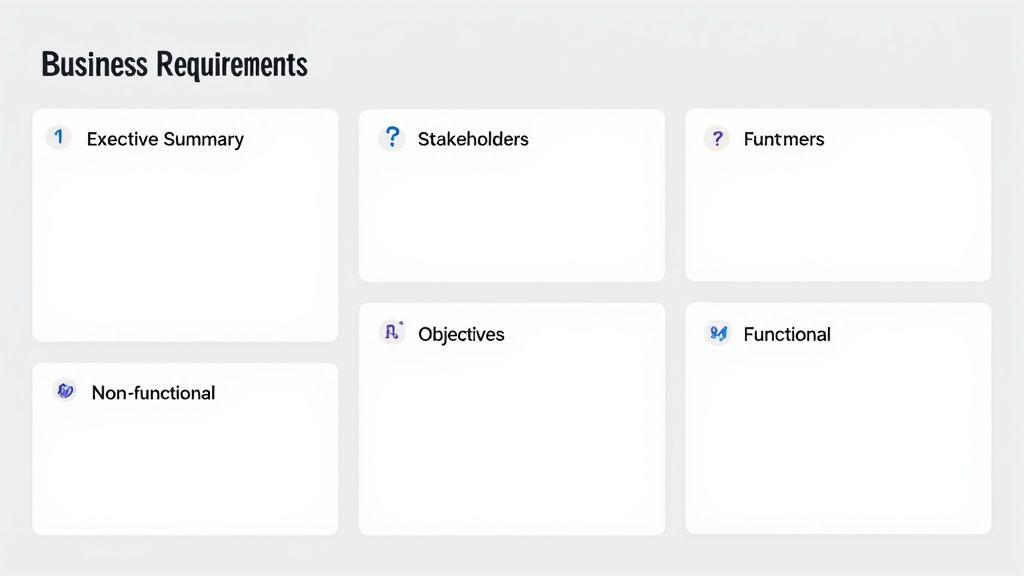
A good business requirements document is far more than a simple form to fill out. Think of it as your project's constitution—a strategic framework that forces you to think through every angle, spark critical conversations, and lock in decisions that will save you from chaos down the road.
Each section has a very specific job to do. Let's break down the essential pieces you'll find in our downloadable template and explore the why behind each one.
The Executive Summary: Your 30-Second Pitch
This is your project's elevator pitch. It’s often the only part senior stakeholders will have time to read, so it has to be sharp, convincing, and straight to the point. The goal is to give a complete, high-level overview of the entire initiative in just a few paragraphs.
Don't get bogged down in technical jargon here. Instead, focus on answering three fundamental business questions:
- What's the problem? Nail down the specific business pain point or opportunity you're tackling.
- How will we fix it? Briefly describe your proposed solution and what it does.
- What does success look like? Define the expected outcome in clear business terms, like boosting revenue, cutting operational costs, or making customers happier.
Here’s a real-world example: Instead of saying, "We need a new inventory system," try this: "We are currently losing an estimated $500,000 annually from stockouts and overstock. This project will deliver a real-time inventory tracking system designed to optimize our stock levels, with a goal of reducing those losses by 75% within the first year." See the difference?
Project Objectives and Scope: Drawing a Line in the Sand
This section is where you set the boundaries. It’s probably the most important part of the entire document for fighting off the dreaded "scope creep" that can derail any project. Objectives state what you want to achieve, while the scope defines exactly what work will (and won't) be done.
I've found that using the SMART framework is the best way to make your objectives truly actionable:
- Specific: Reduce customer support calls by 15%.
- Measurable: We can track call volume before and after launch.
- Achievable: Is a 15% reduction realistic with the planned features?
- Relevant: This directly supports our company goal of improving customer satisfaction.
- Time-bound: We will hit this target within six months of deployment.
With clear objectives in place, your scope becomes a protective fence. List what is "in scope" and, just as crucial, what is "out of scope." Stating this upfront prevents endless debates later about whether a feature was forgotten or just assumed. This level of clarity is foundational for any good project plan outline because it sets firm expectations for everyone involved.
Pro Tip: A project without a clearly defined scope is a project destined for delays and budget overruns. Stating what you are not doing is just as powerful as stating what you are doing.
Stakeholders and Their Roles: Who’s on the Team?
Projects don’t happen in a vacuum. This is where you map out every person, team, or department that has a stake in the outcome. It's more than a list of names; it's a guide to who does what, who needs to be informed, and who has the final say.
Mapping this out early clarifies communication paths and the decision-making hierarchy, ensuring the right people are in the loop at the right time.
Functional and Non-Functional Requirements: The Nitty-Gritty Details
We’re now at the technical heart of the document. This is where you translate those big-picture business needs into the specific things a system must do and the qualities it needs to have.
Functional requirements describe what the system does. They are the concrete actions and features.
- Example: "The system must allow a user to reset their password using an emailed link."
Non-functional requirements define how well the system performs its functions. These are often overlooked but are absolutely critical for a good user experience and long-term success.
- Example (Performance): "Password reset pages must load in under 2 seconds."
- Example (Security): "All personally identifiable information (PII) must be encrypted at rest."
- Example (Usability): "A first-time user must be able to complete the password reset flow without needing to consult a help guide."
A solid BRD provides a single source of truth for the entire team. To give you a bird's-eye view, here's a quick breakdown of what each section in our template aims to capture.
Key Sections of a Business Requirements Document
| Section Name | Purpose | Key Information to Include |
|---|---|---|
| Executive Summary | Provide a high-level overview for quick stakeholder alignment. | The core business problem, the proposed solution, and the expected business outcome. |
| Project Objectives & Scope | Define success and set clear project boundaries to prevent scope creep. | SMART goals, a detailed list of in-scope items, and an explicit list of out-of-scope items. |
| Stakeholders | Identify all key players and clarify their roles and responsibilities. | Names, titles, project roles, key responsibilities, and their level of approval authority. |
| Functional Requirements | Detail the specific actions and capabilities the system must have. | Specific user actions, system behaviors, and workflows (e.g., "User can filter search results by date"). |
| Non-Functional Requirements | Define the quality attributes and operational standards of the system. | Criteria for performance, security, usability, reliability, and scalability (e.g., "System must support 500 concurrent users"). |
By carefully working through each part of this template, you're doing more than just paperwork. You’re building a shared understanding, aligning your team, and laying the foundation for a project that truly delivers value.
Writing Requirements That Bridge Business and Tech
Even the most perfect business requirements template is useless if the words inside don’t connect with the people who need to read it. All too often, business and tech teams talk past each other, almost as if they're speaking different languages. My goal here is to be your translator—to show you how to take a high-level business goal and turn it into the kind of clear, actionable instructions a development team can actually use to build something great.
The whole game is about moving from vague ideas to concrete specifics. A request like "improve the checkout experience" is a starting point, not a finished requirement. It leaves way too much open to interpretation, which is a recipe for expensive rework and frustrated teams. You need to write requirements that are so clear there's no question about what "done" really means.
Functional vs. Non-Functional Requirements
To get that level of clarity, you have to understand the two main types of requirements. I like to think of them as the "what" and the "how well."
Functional requirements are the "what." They describe what the system actually does—the features, the buttons, the actions a user can take. These are the verbs of your project.
- A user must be able to add an item to their shopping cart.
- The system must send an order confirmation email after a successful purchase.
- An admin must be able to issue a full or partial refund.
Non-functional requirements are the "how well." They define the quality and performance characteristics of the system. These are the crucial details that separate a good user experience from a terrible one.
- (Performance): The shopping cart page must load in under 1.5 seconds, even with 50 items in it.
- (Security): All customer payment info must be encrypted; it should never be stored in plain text.
- (Usability): A first-time user should be able to finish the guest checkout in under 90 seconds.
Forgetting about non-functional requirements is one of the most common mistakes I see. A shopping cart that technically works but takes ten seconds to load is, for all practical purposes, a broken cart.
A requirement isn't truly defined until you can test it. If you can't figure out how to write a test case to prove it works, you need to go back and add more detail.
From Vague Ideas to Actionable Instructions
Let’s run through a quick, real-world example from an e-commerce project. A stakeholder comes to you and says, "We need a better search function so people can find products faster." That's a solid business goal, but it’s not a requirement a developer can build from.
Our job is to break that down.
The Vague Idea: "A better search function."
Actionable Functional Requirements:
- As a user types in the search bar, the system will show real-time search suggestions.
- Search results must be filterable by category, price range (in $50 increments), and customer rating (1-5 stars).
- The search algorithm needs to handle common misspellings (e.g., a search for "swetshirt" should still show results for "sweatshirt").
Actionable Non-Functional Requirements:
- Those real-time search suggestions need to appear within 200 milliseconds of a user pausing their typing.
- For 95% of all searches, the results page must load in under 2 seconds.
See the difference? Each one of these points is now specific and, most importantly, testable. The QA team can verify the filters, a developer can measure the response times, and the product manager can confirm the misspelling feature is working as expected. All the guesswork is gone.
Adopting User Stories for Agile Teams
If your team is working in an Agile environment, framing these requirements as user stories is a fantastic way to keep everyone focused on delivering value to the user. The classic format—"As a [type of user], I want [an action], so that [a benefit]"—is popular for a reason: it constantly reminds the team why they're building the feature.
Let's take one of our functional requirements and convert it.
The Requirement: "Search results must be filterable by price range."
The User Story: "As a budget-conscious shopper, I want to filter search results by a price range, so that I can quickly find products I can afford."
This simple change in perspective is powerful. It gives the development team empathy for the user's situation and makes it much easier to prioritize work. When you're planning a sprint, a good meeting agenda outline built around these user-focused stories helps the team rally around what matters most. This approach perfectly connects your business requirements to the day-to-day work of your engineering team, creating a backlog that’s ready for estimation and execution.
Avoiding Common Requirement Documentation Pitfalls
Knowing how to fill out a business requirements template is one thing. Knowing how to spot the hidden traps before you fall into them? That's what separates a decent project from a truly successful one.
Even the most meticulous BRD can lead a project off a cliff if it’s built on a shaky foundation. These common pitfalls aren’t about formatting; they’re about the messy, human side of gathering information and making decisions. The good news is, with a little foresight, they're entirely avoidable. Think of this as your early-warning system.
The Danger of Unchecked Assumptions
Every project kicks off with a head full of assumptions. That's normal. The real trouble starts when those assumptions are left unspoken and unverified.
I once saw a project where a key feature was built assuming all users had the same permissions. It worked beautifully for the project team, who all had admin rights. But on launch day, standard users couldn't see or use it at all. A simple, unchecked assumption led to a last-minute scramble.
The fix is surprisingly simple: make your assumptions explicit. Carve out a dedicated section in your template to list them out.
- Assumption: All users will access the new dashboard from a desktop browser.
- Verification Question: Have we actually asked the sales team if they need to use this on their tablets in the field?
- Assumption: The marketing team is providing all the new product page images.
- Verification Question: Does marketing have the budget and photographers available to get this done by our deadline?
When you write them down, you drag invisible risks into the daylight where they can be dealt with. This one habit can prevent a world of pain and rework down the line.
How to Fend Off Gold-Plating and Feature Creep
"Gold-plating" is that irresistible urge to add extra features that weren't in the original plan just because they seem cool. It almost always starts with a well-meaning stakeholder saying, "You know what would be really neat...?"
These additions, however small, pile on complexity, time, and cost without any proven business value. Your business requirements document is your best shield against this. Every single feature request has to earn its place by connecting directly back to a business objective you’ve already defined.
A requirement without a clear link to a business goal isn't a requirement; it's a distraction.
Use your BRD to firmly but politely ask, "Which specific business objective does this new feature help us achieve?" This question keeps everyone honest and prevents the project's scope from silently ballooning.
The Problem with Vague, Ambiguous Language
Words like "fast," "user-friendly," and "robust" are project-killers. Seriously. They mean completely different things to everyone on the team and are impossible to test against. What feels like a "fast" page load to a developer might feel like an eternity to a customer.
Your business requirements template should force you to get specific. The solution is to hunt down every subjective adjective and replace it with a cold, hard, measurable metric.
- Vague: "The system should be fast."
- Specific: "All core pages must load in under 2.5 seconds on a standard broadband connection."
- Vague: "The platform needs to be easy to use."
- Specific: "A new user must be able to complete registration and their first login in under 90 seconds without needing to consult a help guide."
This kind of precision leaves no room for interpretation. It gives your development team a clear target to hit and your QA team a concrete benchmark for success.
This push for clarity is even more critical for remote teams. A 2021 Asana survey found that 73% of remote teams use BRD templates to stay aligned on goals, a practice that leads to a 30% reduction in project start-up time. You can read more about how templates streamline remote work at Asana.com. When everyone shares the same definition of "done," it doesn't matter where they're working from.
From Document to Actionable Project Backlog
Getting your business requirements document (BRD) signed off is a huge milestone. It feels like you've reached the summit, but in reality, it's just the base camp. That document represents a shared vision, but it's the starting pistol, not the finish line.
The real work starts now: translating that strategic blueprint into a tactical, actionable backlog that your development team can actually build from. This is where so many projects lose their way. A brilliant BRD is useless if it just gathers digital dust. You have to break it down.
The goal is to deconstruct those big, sweeping business goals into small, independent, and testable chunks of work. This is the crucial step that connects your high-level strategy to the day-to-day coding that brings your vision to life.
Before we get into the "how," it's worth remembering the common pitfalls that can derail this process. A few unverified assumptions can quickly spiral into gold-plating and ambiguity, creating chaos down the line.
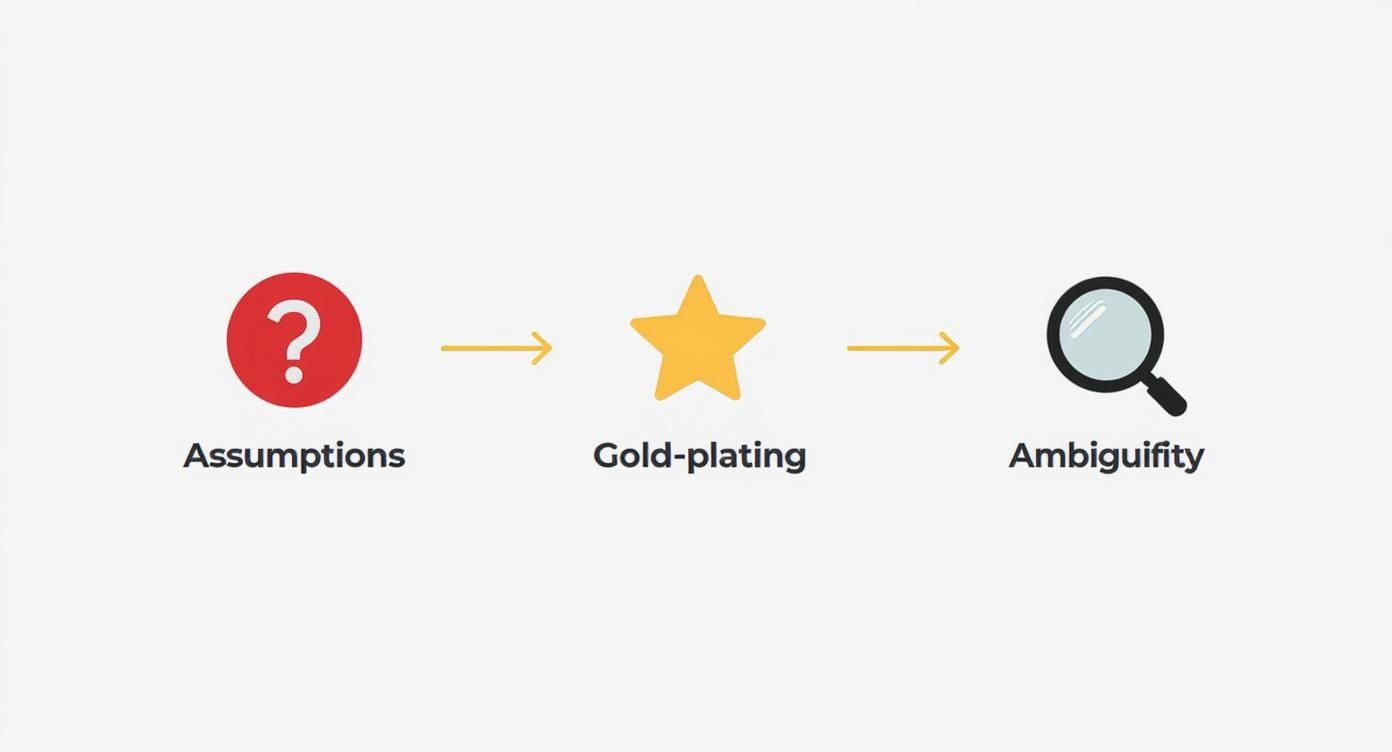
This little chain reaction—a small assumption leading to bloated features and confusion—is exactly why a precise translation process is so critical.
Crafting User Stories From Business Goals
So, how do you bridge the gap between a business need and a development task? The best tool I've found for this is the user story. It's a simple but incredibly effective way to reframe requirements from the user's perspective, making sure every single task delivers real value.
You’ve probably seen the classic format: As a [user type], I want to [perform an action], so that I can [achieve a benefit].
Let's make this real. Your BRD might have a requirement like: "The system must allow users to manage their communication preferences." That’s a good starting point, but it's way too vague for a developer to pick up and run with. We need to slice it into smaller, digestible user stories.
- Story 1: As a registered user, I want to opt-in or out of the weekly promotional newsletter, so that I can control the marketing emails I receive.
- Story 2: As a registered user, I want to subscribe to new product alerts for specific categories, so that I am only notified about items I care about.
- Story 3: As a registered user, I want to see a single dashboard of all my current email subscriptions, so that I can easily manage my preferences in one place.
See what happened there? One broad business requirement just turned into three clear, manageable, and value-focused tasks for the backlog. This deconstruction is fundamental to building a solid roadmap. For those who want to take this a step further, organizing these tasks into a project work breakdown structure can give you an even more granular view of the entire project.
Defining Acceptance Criteria For Clarity
A user story isn’t really complete without its other half: acceptance criteria. These are the specific, testable conditions that must be met for the story to be considered "done." They kill ambiguity and give developers and QA testers a shared checklist for success.
Think of them as the "definition of done" for one specific feature, written as a simple pass/fail checklist from the user’s point of view.
Acceptance criteria transform a user story from a good idea into a concrete, testable contract. If a story fails even one criterion, it’s not finished.
Let's go back to our first story and flesh it out with some solid acceptance criteria.
User Story: As a registered user, I want to opt-in or out of the weekly promotional newsletter, so that I can control the marketing emails I receive.
Acceptance Criteria:
- Given I am logged in and on the notifications page,
- When I uncheck the "Weekly Newsletter" box,
- Then the system saves my preference and I no longer receive the newsletter.
- And I see a confirmation message that says, "Your preferences have been updated."
- And my choice is correctly reflected if I navigate away and return to the page.
This level of detail is non-negotiable for a healthy, high-functioning team. It’s what ensures the feature you imagined in your business requirements template is exactly what the development team builds, creating a seamless path from concept to a valuable, finished product.
Got Questions About Business Requirements? Let's Clear Them Up
Even with the best template in the world, you're going to have questions. That's not just normal; it's a sign you're digging into the details where strategy and execution actually meet. I've been there, so let's walk through some of the most common sticking points I see in the field.
Think of this as a quick-reference guide to help you handle those gray areas that inevitably pop up once a project gets rolling.
How Often Should a BRD Be Updated?
Once everyone signs off on the initial version of a business requirements document, it's considered "baselined." It becomes the official map for the project. But that map isn't carved in stone, especially when the landscape is constantly changing.
In the early discovery phase of an agile project, I treat the BRD as a living document. It's meant to evolve as the team learns more. However, once development kicks off, any major change—say, a new feature that shifts the project's core purpose—needs to go through a formal change control process.
If a change gets the green light, the BRD must be updated. This is non-negotiable. It keeps the document as the single source of truth and prevents the classic "but I thought we were building this" conversation down the line.
Who Is Responsible for Writing and Approving the BRD?
While writing the BRD is definitely a team effort, you need one person in the driver's seat. That's typically a Business Analyst or a Product Manager. Their main job is to lead the conversations, pull the real needs out of stakeholders, and translate all that talk into a coherent, structured document.
But when it comes to approval? That’s an all-hands-on-deck moment. Getting a sign-off isn't just about checking a box. Key stakeholders, particularly the project sponsor who's footing the bill, need to give their formal approval.
This sign-off is a critical checkpoint. It’s the moment everyone officially agrees, "Yes, this document accurately reflects our business needs, and we're all pointing in the same direction before we spend serious time and money."
What Is the Difference Between a BRD and an FRD?
This one trips people up all the time. The easiest way to remember the difference is to think "what" versus "how."
Business Requirements Document (BRD): This is all about the "what." It outlines the high-level business goals. It's focused on the problem we're trying to solve from a business perspective.
Functional Requirements Document (FRD): This dives into the "how." It details the technical specifics of what the system will actually do to meet the business goals. It describes how the software will function to solve the problem.
Here’s a practical example: a BRD might state, "The system must allow users to securely access their account information." The FRD would then get into the nitty-gritty, specifying things like password complexity rules, two-factor authentication options, and session timeout triggers. The BRD sets the vision; the FRD draws the blueprint.
Can This Template Work for Agile Projects?
Absolutely. People often associate massive, hundred-page BRDs with old-school waterfall projects, but a lean version of a BRD is a secret weapon for agile teams. In an agile world, the document serves a slightly different but just as crucial purpose.
Instead of trying to define every last detail upfront, an agile BRD establishes the product vision, clarifies the business objectives, and sets the high-level scope. It provides the guardrails for the entire project.
This keeps the team laser-focused on the bigger picture. It ensures that every user story and feature developed in a sprint is directly tied to the core business goals, giving the team both the alignment and the autonomy they need to succeed.
Ready to make your team's planning sessions more focused and efficient? Scrum Planning Poker offers a free, simple tool to help your team deliver accurate estimations without the hassle. Start your first session in seconds—no signup required.