
Online Planning Poker: Master Remote Estimation with online planning poker Tips
Running a successful online planning poker session is about more than just logging into a tool. It's a focused, collaborative process where the whole team uses a gamified system to agree on the effort needed for user stories. This simple practice is how you turn fuzzy ideas into concrete, team-backed numbers before anyone starts coding.
Laying the Groundwork for Accurate Estimates
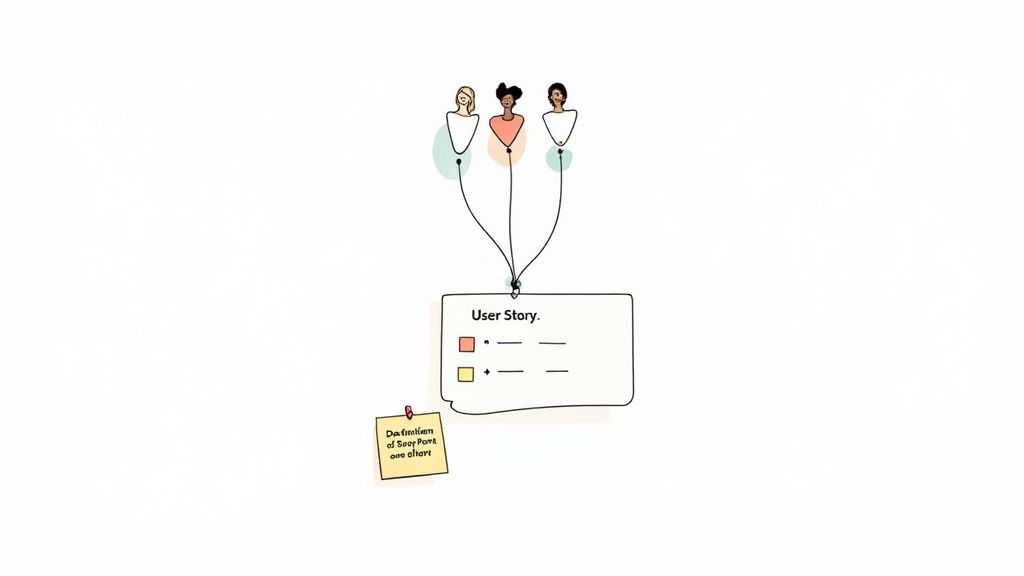
The fate of a remote estimation session is sealed long before the video call even starts. It all comes down to how well-prepared your product backlog is. If you show up with vague, one-line tasks, you’re setting yourself up for long, circular debates that go nowhere. The real goal is to get your ideas refined into "estimation-ready" user stories.
What makes a story "estimation-ready"? Simple: any developer on the team should be able to read it and grasp the core requirement without needing a 20-minute explanation. The story has to be clear, concise, and, crucially, testable. Getting this right beforehand is non-negotiable if you want the session to be productive.
Crafting Clear User Stories
A well-written user story is the bedrock of a solid estimate. It's not just a to-do item; it’s a conversation starter that frames the work from the perspective of the person who will actually use it. Before you even think about bringing a story to the team for pointing, make sure it has these three things:
- A Clear Title: A short, descriptive summary that says what the feature is.
- User-Centric Description: You can't beat the classic "As a [user], I want [something], so that I can [achieve a goal]" format. It instantly provides vital context.
- Specific Acceptance Criteria: These are the non-negotiable conditions that must be met for the story to be marked "done." They are your best defense against ambiguity and scope creep.
Without rock-solid acceptance criteria, your team is forced to guess, which almost always leads to wildly different estimates and painful scope arguments later on.
One of the biggest mistakes I see teams make is trying to estimate stories that are actually epics. If a story feels way too big to put a number on, it probably is. The best move is to slice it into smaller, more digestible chunks before the meeting.
Defining Your Estimation Scale
Next up, your team needs a shared language for what an estimate even means. A "story point" can represent pure effort to one person, complexity to another, and a mix of effort, complexity, and uncertainty to a third. You have to have this conversation and get on the same page.
With that definition in hand, it's time to choose your scale. The two most common options each have their place:
- Fibonacci Sequence (1, 2, 3, 5, 8, 13…): This is the crowd favorite for a reason. The widening gaps between the numbers are brilliant because they naturally reflect the increasing uncertainty that comes with larger tasks. The difference between a 2 and a 3 is minor, but the jump from an 8 to a 13 forces a much-needed discussion about hidden risks and complexity.
- T-Shirt Sizes (XS, S, M, L, XL): This scale is perfect for high-level backlog grooming or initial roadmap planning. It’s less about pinpoint precision and more about quickly sorting a big pile of work into relative size categories.
Which one is right for you? It really depends on your team's experience and what you're trying to accomplish. For detailed sprint planning, Fibonacci is almost always the better choice. For long-range forecasting, T-shirt sizes can be far more practical. Getting this foundational alignment right is what prevents the simple misunderstandings that can completely derail a remote session.
Picking the Right Online Planning Poker Tool
Choosing your team's planning poker tool is a bigger deal than it might seem. Get it right, and your estimation sessions will feel effortless and productive. Get it wrong, and you'll spend more time fighting with the software than actually talking about the work—and nobody wants that.
The market is flooded with options, all claiming to be the best. The secret is to ignore the flashy marketing and focus on one thing: how well the tool fits into your team's existing rhythm. A great tool should feel like it's not even there, just a simple digital table that lets the conversation flow.
What Really Matters in a Planning Poker Tool
When you start comparing options, it's easy to get lost in a sea of features. But from my experience, only a handful of things make a real difference day-to-day. Before you look at anything else, make sure the tool nails these basics.
- Jira/Azure DevOps Integration: This is a big one. You want a tool that plugs directly into your project management system. The ability to pull stories from your backlog and push estimates back automatically saves a ton of time and eliminates silly copy-paste errors.
- Flexible Card Decks: Most teams stick with Fibonacci, but what about when you're doing high-level roadmap planning? You might need T-shirt sizes (S, M, L, XL). A good tool lets you customize and save different card decks for different situations.
- Solid Security and Privacy: If you're in a larger company, this is non-negotiable. Look for features like Single Sign-On (SSO) for easy, secure access. At a minimum, password-protected rooms are a must for keeping your project details private. And make sure their privacy policy is clear, especially regarding GDPR.
- Good Facilitator Controls: The person running the session needs to be in control. That means being able to reveal all votes at once to avoid anyone being swayed by the first card thrown. It also means having a clear "re-vote" button for when discussions lead to a new consensus, and an "observer" mode for stakeholders who need to watch but not vote.
The best tool is the one that gets out of your way. It should support your process, not dictate it. If a platform forces you to change a workflow that’s already working well for your team, it’s the wrong choice.
Comparing the Top Contenders
To help you see how different tools stack up, here’s a quick comparison of some popular options and how they handle the key features.
Comparison of Popular Online Planning Poker Tools
| Feature | Tool A (e.g., PlanningPoker.com) | Tool B (e.g., Jira Plugin) | Tool C (e.g., Miro Add-on) |
|---|---|---|---|
| Direct Integration | Manual import/export or API | Native, lives inside Jira | Native, lives inside Miro board |
| Custom Decks | Yes, fully customizable | Limited, uses Jira fields | Basic options (Fibonacci, T-Shirt) |
| Security (SSO) | Available on enterprise plans | Inherits Jira's security | Inherits Miro's security |
| Observer Mode | Yes, dedicated role | Depends on Jira permissions | Yes, anyone with board access |
| Pricing Model | Freemium, paid per user | Paid per Jira instance | Included with Miro subscription |
This table is just a starting point, of course. The right choice depends entirely on your team's ecosystem. A team living in Jira will likely get the most value from a native plugin, while a design-heavy team that uses Miro for everything else might prefer an add-on they already know.
Making Your Final Call
Beyond the core features, think about your team's unique needs. Are you spread across multiple time zones? A tool that supports asynchronous voting might be a lifesaver. Working on a shoestring budget? There are plenty of fantastic free tools out there that do the job perfectly well.
It's interesting to see how sophisticated user expectations have become. We see it in other digital spaces, too. For instance, the online poker market is projected to explode from USD 7.98 billion in 2024 to a staggering USD 37.19 billion by 2030. That growth is fueled by platforms that offer seamless, reliable, and genuinely engaging experiences. Users now expect that same level of polish from their work tools.
Ultimately, it’s a balancing act. A small, scrappy startup will probably value speed and a free price tag over enterprise-grade security. A large, regulated company will have the opposite priorities.
To make your decision easier, we’ve already done a lot of the legwork. Check out our in-depth review of the 5 best online planning poker tools. It breaks down the pros, cons, and ideal use cases for each, so you can find the perfect fit for your team.
Running a Smooth Remote Estimation Session
Alright, you’ve groomed your backlog and picked your tool. Now for the main event: running the actual online planning poker session. A successful session is so much more than just collecting numbers; it's a dynamic conversation that gets everyone on the same page. The facilitator, who is often the Scrum Master or Product Owner, is key to making this happen.
Their role is to steer the ship and keep things moving. They kick things off by presenting each user story, but a good facilitator does more than just read the title aloud. They have to connect the "what" (the feature) with the "why" (the value to the user). This little bit of context is crucial—it transforms a simple backlog item into a tangible piece of work the team can actually wrap their heads around.
Kicking Off the Conversation
Once a story is introduced, it's time for questions. This is where a skilled facilitator really earns their stripes. The goal here isn't to design the entire feature on the spot, but to encourage clarifying questions that root out any fuzzy requirements or hidden assumptions.
The conversation needs to stay focused on what's necessary to estimate the work. If the team starts spiraling into a deep technical rabbit hole or adding new scope on the fly, it's the facilitator's job to gently pull them back. A simple, "That's a great point for when we get to implementation, but for now, what else do we need to know to size this story as it's written?" usually does the trick.
This high-level process—assessing needs, comparing features, and then picking a tool—is fundamental to setting your team up for success.
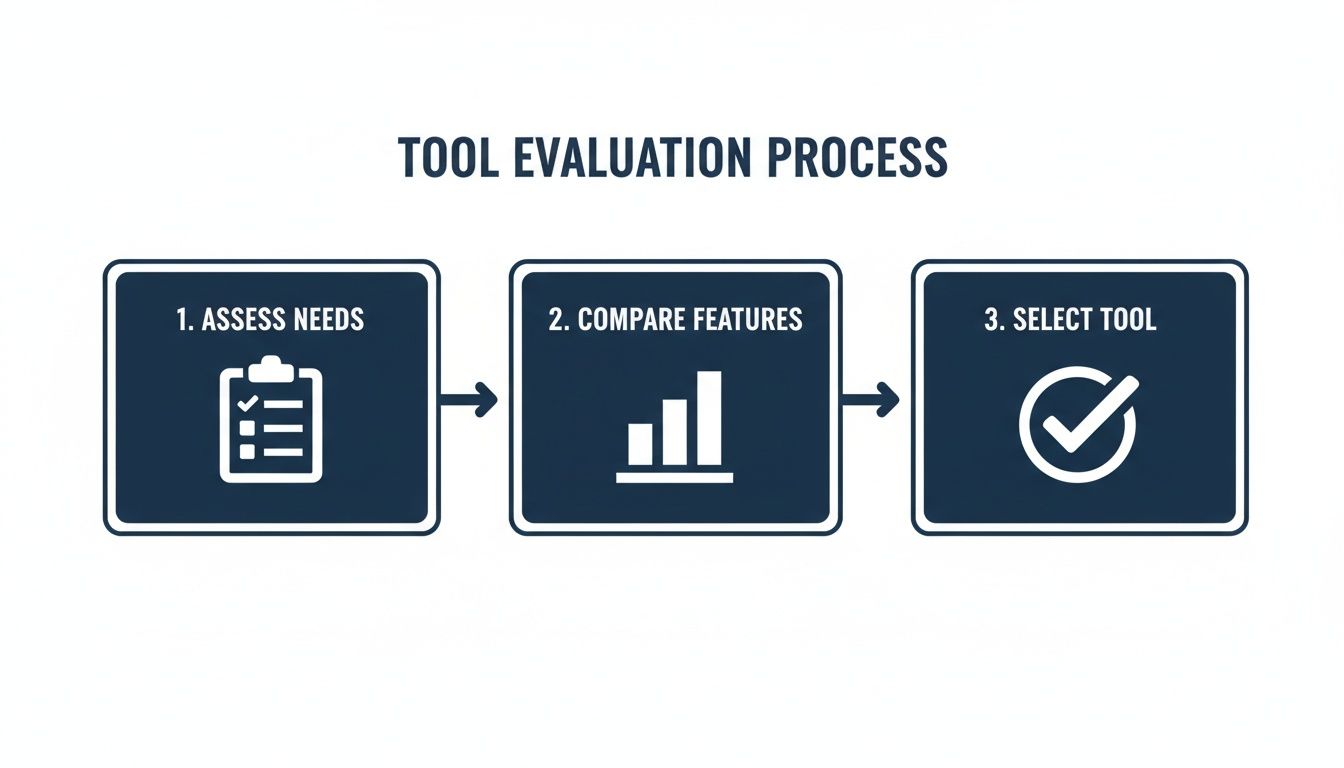
When you follow a structured approach like this, you end up with a tool that actually fits your team's workflow, not one that forces you to change it.
The Vote, Reveal, Discuss Loop
When the questions die down, it’s time to vote. Each team member privately chooses a card from their digital deck that they feel best represents the effort. Voting in private is non-negotiable—it's the best way to prevent "anchoring," where the first or loudest voice in the room sways everyone else's opinion.
Next, the facilitator reveals all the votes at once. This is the moment of truth. If the numbers are pretty close, say a cluster of 3s and 5s, you can often just agree on the higher number and move right along. But the real value of planning poker shines when the votes are all over the map.
A huge split in the votes—like one person voting a '3' and another a '13'—isn't a failure. It’s a massive opportunity. It tells you there are hidden assumptions, misunderstood requirements, or unseen risks that need to be brought into the light.
When you see that divergence, don't just put the outliers on the spot. Instead, invite them to explain their reasoning. A calm, curious approach works best. Try phrases like:
- "Interesting! Could the person who voted '13' walk us through the complexities they're seeing?"
- "And for the person who voted '3', what's your take on the effort here?"
This simple, non-confrontational framing turns a potential disagreement into a productive knowledge-sharing moment. The developer who voted low might have missed a key acceptance criterion, while the developer who voted high might know about a tricky dependency the rest of the team wasn't aware of.
This type of open dialogue is the bedrock of good estimation, no matter which variation of poker you're using. If the concept is new to you, our guide on online scrum poker offers a deeper dive into the principles behind this powerful agile practice.
Driving Toward Consensus
After the discussion, you vote again. Most of the time, this second round brings the estimates much closer together because everyone is now operating with the same information. If you're still wildly far apart after a second go, it’s a big red flag. It usually means the story is either too big or too vague to be estimated reliably.
Don't force a number. The best move is to table the story and hand it back to the Product Owner to refine or split into smaller, more digestible chunks.
This whole process taps into the same collaborative energy that makes other online platforms thrive. For example, recent interstate compacts in the US online poker market have led to a 42% growth in daily tournament participation. Players are flocking to these connected networks for the bigger prize pools and more diverse competition. In the same way, online planning poker pools your team's diverse perspectives to produce a more accurate and rewarding outcome for everyone involved.
Advanced Strategies for Experienced Teams
Once your team has the basics down, you can start evolving your online planning poker process from a simple ceremony into a powerful strategic tool. It's time to move beyond the standard vote-discuss-revote cycle.
These next-level techniques are all about fine-tuning the machine. For mature teams, this is how you turn a good estimation process into a great one, gaining deeper insights and making your sessions laser-focused.
Implementing Strict Time-Boxing
Have you ever been in a planning session where the discussion on one story just drags on and on? A simple vote split can easily spiral into a ten-minute debate. This is where strict time-boxing comes in.
When a vote reveals a wide gap in estimates, immediately set a timer for the discussion—say, three to five minutes. This simple constraint forces everyone to get straight to the point. The high estimator has to quickly justify their concerns, and the low estimator needs to explain their reasoning just as fast. It’s a fantastic way to cut out the fluff and keep the energy up.
A timer isn't about rushing to a conclusion; it's about respecting everyone's time and energy. It encourages concise communication and prevents 'estimation fatigue' from setting in during longer sessions.
If the team can't find common ground after a couple of timed rounds, take that as a sign. The story is probably too ambiguous or just too big. Table it for later refinement. Suddenly, the clock becomes a brilliant tool for spotting poorly understood work before it ever hits a sprint.
Mastering Asynchronous Estimation
For teams spread across different continents and time zones, live planning poker can be a logistical nightmare. This is where asynchronous estimation becomes a lifesaver, spreading the process out over a day or two instead of a single meeting.
The flow usually looks something like this:
- The Pitch: The Product Owner records a quick video walkthrough or posts a detailed brief for a batch of stories.
- Solo Voting: Team members review the stories on their own schedule and cast their votes in your planning poker tool. A good tool will keep the votes hidden until everyone's in.
- The Reveal: Once all votes are cast, the facilitator reveals the numbers. If there's a clear consensus, you're done. Lock it in.
- Focused Discussion: When estimates are all over the place, the debate moves to a threaded conversation in Slack or Microsoft Teams. Outliers explain their thinking, and the facilitator can call for a re-vote right there in the chat.
This approach is a huge win for distributed teams, allowing for more thoughtful, less-pressured estimates. Just as regulatory reforms have legitimized the online poker industry by creating interconnected platforms for better liquidity, asynchronous tools create a more fluid and accessible environment for distributed agile teams. You can read more about these progressive market changes in the online poker industry on globenewswire.com.
Leveraging Estimation Analytics
Every time your team votes, you're creating a treasure trove of data. Don't let it sit there gathering digital dust. Most modern planning poker tools come with analytics dashboards that can uncover some fascinating trends.
Start digging through the data and ask some hard questions:
- Are we consistently overestimating? If the team always points stories higher than the actual effort, it might signal a lack of confidence or that you're constantly bracing for unknown risks.
- Do we have team blind spots? Maybe your front-end estimates are always spot-on, but back-end work is a total guess. This can highlight skill gaps or parts of your stack that need better documentation.
- Who are the outliers? If one developer consistently votes way higher or lower than the group, what's behind it? It could be a deeper understanding of the problem or a unique perspective the team needs to hear more from.
By bringing these insights into your retrospectives, you can move from "feeling" like you're getting better at estimating to actually knowing it, with the data to back it up.
Navigating Common Online Poker Pitfalls
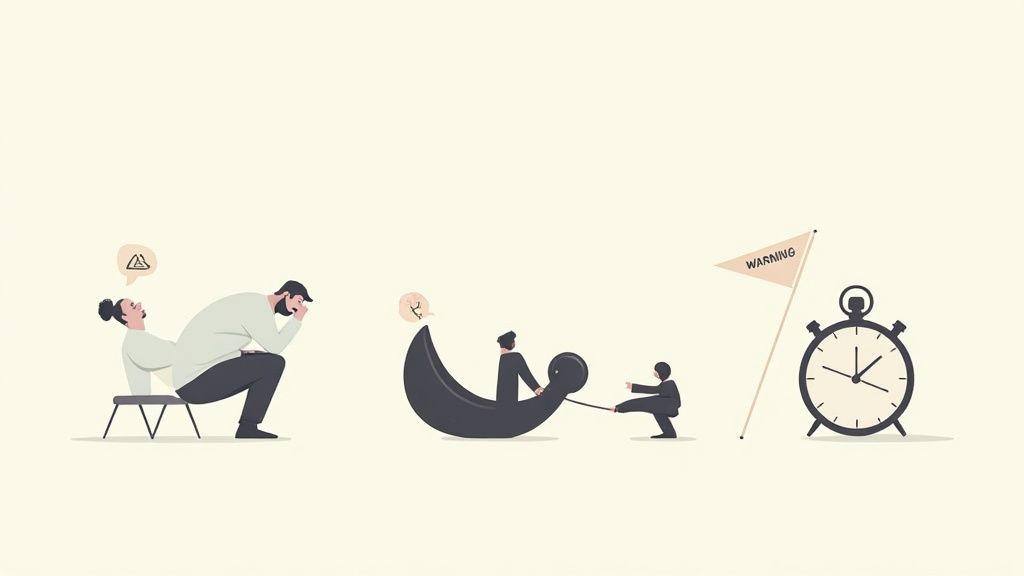
Even with a polished backlog and the best tool, remote estimation sessions can easily go off the rails. Knowing how to steer your team through the inevitable rough patches is what separates a frustrating meeting from a genuinely productive one.
One of the sneakiest problems I see is estimation anchoring. It happens the moment a team lead or senior developer voices their estimate before everyone has voted. Whether it's intentional or not, that first number taints the entire round. Suddenly, everyone else is second-guessing their own gut feeling, which completely undermines the whole point of voting privately.
Overcoming Estimation Anchoring
The only way to beat anchoring is with a bit of process discipline. As the facilitator, you have to be the guardian of the "no numbers before the reveal" rule. If someone blurts out their estimate, you need to gently but firmly steer the conversation back on track.
- Enforce Private Voting: Make it a non-negotiable rule. All estimates are locked in privately before anyone sees the results.
- Rotate Who Speaks First: When you're discussing the results, don't always call on the same senior person. Mix it up. Ask the person who voted lowest to explain their thinking, then the person who voted highest.
- Focus on 'Why': The magic is in the reasoning, not the number. Instead of asking, "Why a 13?", try asking, "What did you factor into your estimate that others might have missed?"
This simple shift ensures the estimate you agree on is based on the team's collective insight, not just the loudest voice in the room.
Dealing with Disengagement and Deadlock
Another classic pitfall is quiet disengagement. You know the signs: someone is clearly multitasking or just not participating. The best way to combat this is to keep the energy up. Keep the pace brisk, and make a point to actively call on quieter members for their thoughts. This creates an expectation that everyone's input is needed and valued.
But what happens when the team just can't agree? You've done two or three rounds of voting, and the estimates are still all over the map. This isn't a failure—it's a signal.
A team that can't reach consensus is actually succeeding. They've just identified a user story that is too big, too vague, or simply not understood well enough to estimate. Forcing them to pick a number is a surefire way to derail a sprint.
When you hit a deadlock, the smartest move is to table the story. It's on the Product Owner to go back, get more details, or break it down into smaller, clearer pieces.
Learning to navigate these situations is what makes online planning poker work. For a deeper look, check out these 5 common planning poker mistakes killing sprint planning. Getting this right keeps your sessions moving and your team happy.
Your Top Online Planning Poker Questions, Answered
Even the most seasoned agile teams run into questions when running planning poker sessions online. Let's tackle some of the most common ones I hear.
How Long Should a Planning Poker Session Run?
Keep your estimation meetings tight—aim for 90 minutes, max. If you're staring down a massive backlog, resist the temptation to book a marathon session. It's much better to schedule two shorter meetings.
Why? Because "estimation fatigue" is a real thing. After about an hour and a half, people get tired, focus wanes, and the quality of estimates plummets. A good rule of thumb is to get through 5 to 10 stories per session, depending on how much discussion each one sparks.
A focused, high-energy 60-minute session will always beat a three-hour slog. The goal is accurate estimates, not just getting through the list.
Who Should Be in the Room?
The core group is always the people who will actually do the work. This means your developers and testers are front and center. A sweet spot for this group is usually between three and eight people.
Of course, the Product Owner is crucial for explaining the why behind each story and answering questions. And the Scrum Master is there to facilitate and keep the conversation moving. It's fine to have stakeholders observe, but it's absolutely critical that they do not vote. Their input, however well-intentioned, can easily skew the team's estimates.
What Happens When We Can't Agree on an Estimate?
This is a classic scenario. If you've gone through a couple of rounds of voting and discussion and the team is still miles apart, don't force a consensus. It's not a failure; it's a sign.
A wide gap in votes almost always means one of three things:
- The story isn't clear enough.
- The story is way too big.
- Key information is missing.
The best move here is to simply table the story. This gives the Product Owner a chance to refine it, break it down into smaller, more manageable pieces, and bring it back when it's truly ready for estimation.
Ready to put this into practice? You can run a seamless estimation session with Scrum Planning Poker. It’s free, requires no sign-ups, and you can get started in seconds. Try it out at https://onlineplanningpokere.com.