
Mastering Online Scrum Poker for Remote Teams
Ever tried to get your entire remote team to agree on how complex a task is over a jumbled video call? It’s usually a mess. Online scrum poker takes that chaos and turns it into a surprisingly effective and structured process. Think of it as a digital card game where everyone on the team votes on the effort needed for a task at the very same time.
This simple act of simultaneous voting is powerful. It stops one person's opinion from swaying the entire group and makes sure every single voice is actually heard.
What Is Online Scrum Poker and Why It Matters

At its heart, online scrum poker is a gamified approach that makes the abstract work of software estimation tangible and, more importantly, collaborative. Instead of a single person declaring how long a task should take, the whole team works together to find a consensus.
This one change fixes a massive problem for remote and hybrid teams: how do you get everyone aligned on effort when the loudest person in the virtual room tends to dominate the conversation?
The process couldn't be simpler. The product owner or scrum master presents a user story. Then, each team member privately picks a digital card that represents their estimate of the effort involved. Once everyone has chosen, all the votes are revealed at once.
That simultaneous reveal is the secret ingredient. It completely neutralizes a cognitive bias called "anchoring," where the very first number mentioned tends to heavily influence everyone else's guess.
Moving Beyond Guesswork to Collective Intelligence
Let's be honest, old-school estimation often feels like pure guesswork. A senior developer throws out a number, and more junior team members, not wanting to rock the boat, just go along with it. This almost always leads to wildly inaccurate timelines and a team that doesn't feel true ownership over the work.
Online scrum poker completely flips that dynamic around.
It creates a space where every developer, no matter their seniority, can give their honest opinion without feeling pressured. The goal isn't just to land on a number; it's to kickstart a meaningful conversation.
The real value of online scrum poker isn't the final number but the discussion that creates it. It systematically uncovers hidden assumptions, clarifies requirements, and exposes knowledge gaps before any code is written.
When the votes are miles apart—say, one developer votes a "3" and another votes a "13"—that's not a problem. It's a signal. It tells you there's a critical misunderstanding that needs to be addressed.
The conversation that follows is where the real work gets done. The person with the high estimate might know about a tricky dependency no one else considered. Meanwhile, the developer with the low estimate might know about a reusable component that could save days of work. These discussions build a shared understanding that is infinitely more valuable than the estimate itself. You can facilitate this entire process smoothly with a dedicated online planning poker tool built specifically for agile teams.
Why It’s a Game-Changer for Remote Teams
When your team is spread out across different locations, the usual challenges of communication and alignment get amplified. You lose all the subtle in-person cues, and misunderstandings can crop up easily. Online scrum poker provides the structure needed to bridge that geographical gap.
Here's a quick look at how it shifts the dynamic from a traditional, in-person session to an efficient remote one.
Traditional vs Online Scrum Poker at a Glance
This table breaks down the key differences and shows why moving this process online is such a huge win for distributed teams.
| Aspect | Traditional Poker (In-Person) | Online Scrum Poker (Remote) |
|---|---|---|
| Location | Requires a physical room and all participants to be present. | Fully remote and asynchronous-friendly; anyone can join from anywhere. |
| Materials | Physical decks of cards for each team member. | Digital card decks accessible via a web or desktop application. |
| Voting | Manual card reveal; susceptible to anchoring if not perfectly timed. | Simultaneous, automated reveal ensures unbiased, private voting. |
| Pace | Pacing is manual and can be inconsistent. | Features like timers and automated workflows keep the session on track. |
| Data & History | Estimates are manually recorded, often on sticky notes or a whiteboard. | Automatically records all estimates, discussions, and final consensus for future reference and analytics. |
| Integration | Disconnected from project management tools. | Can integrate directly with tools like Jira or Azure DevOps to update tickets automatically. |
Ultimately, the online approach takes a great idea and makes it practical for the way modern teams actually work.
This collaborative method delivers some serious benefits:
- Improved Accuracy: By pulling from everyone's unique perspective, the final estimate is far more realistic and reliable.
- Increased Engagement: The game-like format is simply more engaging. It keeps team members focused and actively involved in planning.
- Shared Ownership: When the whole team agrees on an estimate, they feel a much stronger sense of responsibility for getting the work done.
In the end, this all leads to more predictable sprints, a healthier and more collaborative team culture, and a final product that truly reflects the combined expertise of its creators.
The Hidden Wins of Remote Poker Sessions
Putting numbers on tasks is just the start. When you move your estimation process online with scrum poker, you're doing a lot more than just getting story points—you're fundamentally changing how your team communicates and works together. The real magic happens just beneath the surface, turning a simple estimation meeting into a powerful way to build a stronger, more connected remote team.
This isn't a surprise, really. We're seeing a huge shift toward digital collaboration everywhere. Just look at the online poker market—it's booming, hitting around USD 3.86 billion and expected to jump to USD 6.90 billion by 2030. That growth, detailed in a full industry report, is fueled by better tech making gamified platforms more accessible. Agile teams are riding the same wave, grabbing onto smart online tools to knock down the barriers of remote work.
Creating a Safe Space with Anonymity
Think about a typical estimation meeting. The first person to throw out a number—usually a senior dev or the most confident voice in the room—sets the tone. That number becomes an anchor, consciously or not, pulling everyone else's estimates toward it. It's a classic case of groupthink, and it can easily silence team members with a different, perfectly valid perspective.
Online scrum poker flips the script with anonymous, simultaneous voting. Everyone submits their estimate privately before a single number is revealed.
Suddenly, it’s a level playing field. The junior developer’s '8' carries the same initial weight as the tech lead’s '3'. This anonymity builds psychological safety, giving quieter or less senior members the confidence to share their true assessment without fear of immediate judgment.
Turning Estimation into a Discovery Process
The best part of a planning poker session isn't when everyone agrees. It's when they don't. A huge gap in votes—say, a '3' from one person and a '13' from another—isn't a sign of failure. It's a giant, flashing sign that your team isn't on the same page about the work.
This is where the meeting transforms from a number-generating chore into a genuine discovery session. The conversation that follows is where the real value lies.
- What's behind the high number? The developer who voted '13' might be the only one who knows about some nasty technical debt lurking in that part of the codebase.
- Why the low estimate? The developer who voted '3' might have just worked on a similar feature and knows a shortcut or a reusable component that will save a ton of time.
These discussions bring hidden assumptions and knowledge gaps out into the open before a single line of code is written. The goal stops being about just getting a number and becomes about building a rock-solid, shared understanding of the user story.
When you make it safe to disagree, you tap into the team's collective brainpower. The final estimate isn't just a number; it's the natural result of genuine alignment.
Sharpening Accuracy and Building a Data History
By taking biases like anchoring out of the equation and forcing these crucial conversations, online scrum poker naturally produces more realistic forecasts. The team isn't just spitting out numbers; they're crafting an estimate backed by a range of perspectives and deep discussion.
Even better, digital tools automatically log everything. Every vote, every discussion, and every final consensus gets recorded, creating a rich history of your team's estimation process. Over time, this data becomes incredibly valuable. It helps you:
- Track your velocity with real confidence.
- Spot patterns and refine future estimates.
- Get new team members up to speed quickly by showing them concrete examples of how you size work.
In the end, these "hidden" benefits are what really matter. Teams using online scrum poker don't just get better at estimating. They get better at talking, working together, and ultimately, delivering great software.
How to Run a Flawless Online Scrum Poker Session
Running a productive online scrum poker session isn't really about the tool you choose—it's all about the process. A well-run meeting can take what could be a chaotic mess and turn it into a focused, insightful, and surprisingly efficient planning exercise. Think of the facilitator as an orchestra conductor; each team member plays their part, and the conductor keeps them in sync to create something great.
This whole process is built on a foundation of psychological safety. When people feel safe to speak up, it opens the door for genuine discovery, which is the secret ingredient for landing on accurate estimates.
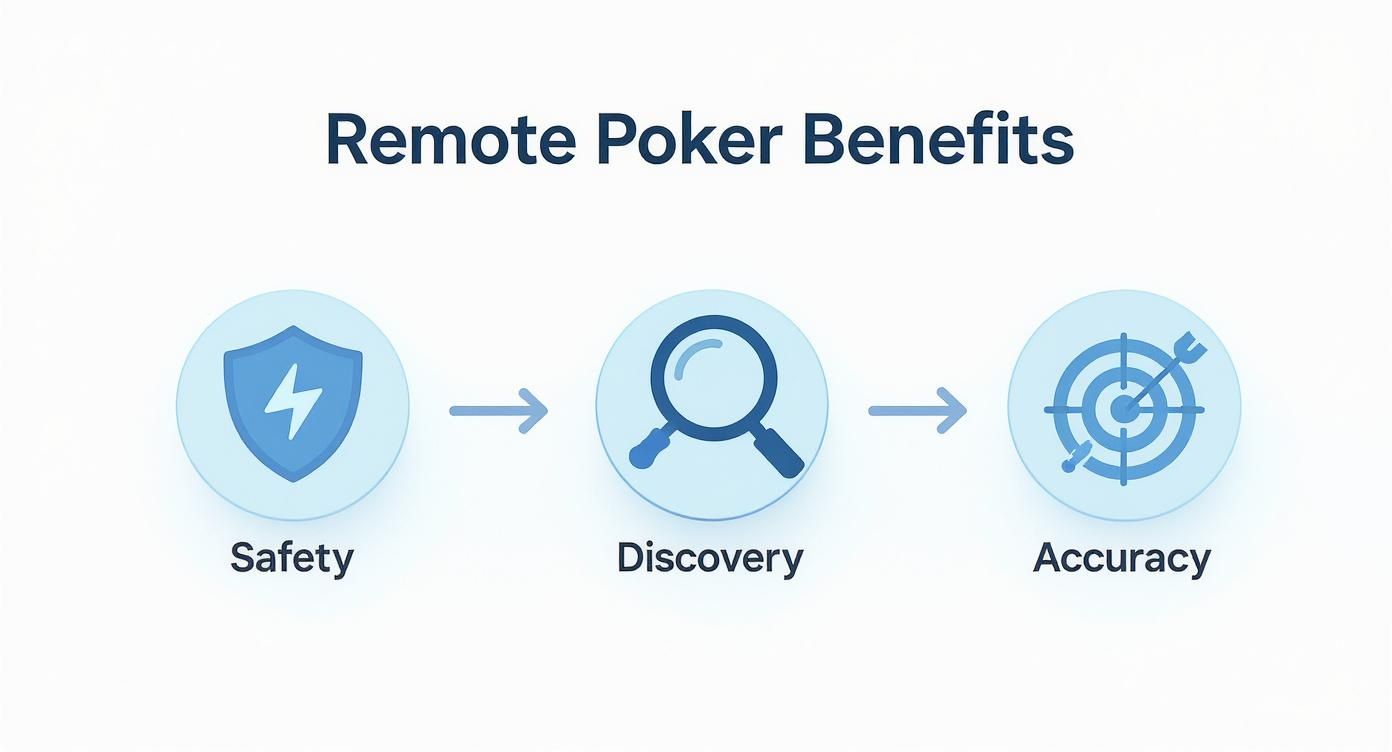
You can see how one benefit builds on the next. Safety allows for the open discussion needed for discovery, and that shared understanding is what ultimately produces estimates you can trust.
Setting the Stage for Success
Before you even start the meeting, a little prep work makes a world of difference. The Scrum Master needs to make sure every user story is actually ready to be estimated, meaning it meets the team's Definition of Ready. Each story should be clear, testable, and detailed enough for the team to wrap their heads around it. Trying to estimate a vague story is a one-way ticket to frustration and wasted time.
Next, get your roles straight. Everyone should know who's doing what:
- The Facilitator (usually the Scrum Master): This person runs the show, keeps an eye on the clock, and makes sure the conversation stays on point. They are a neutral guide and don't vote.
- The Presenter (usually the Product Owner): They explain the "what" and "why" behind each story, answering any questions that pop up. They don't vote either.
- The Estimators (the Development Team): These are the folks who will actually build the feature. They are the only ones who get to vote.
Finally, agree on your deck. The Fibonacci sequence (1, 2, 3, 5, 8, 13...) is incredibly popular for a reason. The growing gaps between numbers naturally reflect the increasing uncertainty that comes with bigger, more complex tasks. Some teams prefer T-shirt sizes (XS, S, M, L, XL), which can feel a bit more intuitive and less granular.
The Five Steps of a Poker Round
Every single user story goes through the same simple, five-step cycle. This structure is key—it keeps the meeting moving and ensures every item gets the attention it deserves without letting one big discussion derail the whole session.
- Present the Story: The Product Owner gives a quick overview, explaining the user's goal and the acceptance criteria.
- Clarify with Questions: This is where the magic starts. The dev team asks questions to poke holes, find edge cases, and clear up any confusion. You'd be surprised how many hidden complexities surface right here.
- Vote Privately: Each team member picks a card from their digital deck that reflects their gut feel on the effort, complexity, and risk involved. The key is that this is done privately so no one is influenced by others.
- Reveal Simultaneously: The facilitator gives the signal, and everyone reveals their vote at the exact same time. This is the core mechanic that prevents anchoring bias, where the first number spoken sways the entire group.
- Discuss and Align: Now the real conversation begins. If the votes are all close, fantastic! Record the consensus and move on. If they're all over the map, it's time to talk.
Mastering the Post-Reveal Discussion
When you see a '3' and a '13' for the same story, that’s not a problem—it’s an opportunity. The real value of online scrum poker comes from the conversation between the highest and lowest estimators. The facilitator’s job is to invite both people to explain their thinking without judgment.
The goal of the discussion is not to prove who is 'right,' but to build a shared understanding. The highest vote may see a risk others missed, while the lowest vote might know of a simpler solution.
For instance, a Senior Engineer might vote a '3' because they know a pre-existing library can do most of the heavy lifting. Meanwhile, a QA Engineer might vote a '13' because they know this feature touches a fragile, legacy part of the system that will require a full, painful regression test. Both perspectives are valid, and both are crucial for an accurate estimate.
After a brief, time-boxed discussion, the facilitator calls for a re-vote. Almost every time, the second round of votes will be much closer because the team now shares a much deeper understanding. If you still don't have a consensus after two or three rounds, it's a strong signal that the story itself is the problem—it's likely too big or too vague and needs to be broken down or refined before the team tries again.
Choosing the Right Online Scrum Poker Tool
Picking an online scrum poker platform seems straightforward at first glance. But the best tools do a lot more than just flip digital cards—they genuinely make your team’s entire workflow smoother. While the market is crowded with options, they are definitely not all the same. A great tool just works, letting your team focus on the conversation, not the software.
When you're choosing, you need to look past the flashy voting buttons and think about how the tool will actually fit into your team's day-to-day. The real goal is to find something that cuts down on busywork and gives you useful insights, freeing up your team to have better, more focused discussions about the work ahead.
Core Features Every Tool Must Have
Before getting wowed by fancy extras, you need to make sure any tool you're considering nails the fundamentals. These are the non-negotiable features that are the foundation of a smooth and productive planning poker session.
- Voting Anonymity: The whole point of poker is to get honest, unbiased estimates. To do that, the tool absolutely must keep everyone's vote hidden until the final reveal. This is the only way to prevent people from being swayed by the first or loudest voice in the room.
- Multiple Card Decks: Teams work differently. A solid tool will offer standard decks like Fibonacci (1, 2, 3, 5, 8…) and T-Shirt Sizes (XS, S, M, L, XL), but it should also let you create your own custom decks to match exactly how your team estimates.
- Observer Mode: Not everyone in the meeting is there to estimate. Product Owners, stakeholders, or even new team members should be able to watch the session without casting a vote. This keeps them in the loop without accidentally influencing the development team's numbers.
Without these basics, you're not really doing planning poker. You're just clicking buttons. A tool that misses these fundamentals will cause more headaches than it solves.
The best online scrum poker tool is one your team barely notices. It should be so intuitive that the focus stays on the user story and the conversation, not on figuring out the software.
Think of that as your benchmark. If your team is constantly getting tripped up by the interface or wrestling with clunky features, it's the wrong tool.
Advanced Features That Boost Efficiency
Once you've got the essentials covered, you can start looking for the features that separate a decent tool from a great one. These are the capabilities that turn a simple card-flipper into a powerful planning assistant that actively saves your team time and frustration.
The single most impactful advanced feature is seamless integration. A tool that connects directly to your project management platform, like Jira or Azure DevOps, is an absolute game-changer. Imagine automatically pulling stories from your backlog into the session and, even better, having the final estimate written back to the ticket automatically. This simple connection saves hours of mind-numbing data entry and cuts down on human error.
Another powerful feature to look for is session analytics. A platform that tracks your team's estimating patterns over time gives you incredible data. You can spot where your team tends to agree or disagree, identify who is consistently a high or low outlier, and see how your estimates are lining up with the actual effort spent. These insights are gold for a Scrum Master looking to coach the team toward more accurate and predictable forecasting.
To help narrow down your options, it's worth taking a look at a side-by-side comparison. This guide to the 5 best online planning poker tools breaks down how different platforms stack up on these advanced features.
Finally, a few other high-value features can make a real difference:
- Integrated Timers: Keeping discussions from dragging on is key to an efficient meeting. A built-in timer helps the facilitator keep conversations focused and the session on track.
- Story Management: Some tools let you import, edit, and organize your user stories right inside the platform, creating one central hub for the entire planning meeting.
- Security Options: If your team works with sensitive project information, look for features like password-protected sessions or single sign-on (SSO) to add an essential layer of security.
The following checklist can help you evaluate and prioritize what your team needs most.
Essential Feature Checklist for Poker Tools
When you're trying to decide between different digital planning poker tools, it's easy to get lost in the details. This checklist breaks down the most important features to look for, from the absolute must-haves to the powerful nice-to-haves that can seriously level up your planning sessions.
| Feature | Importance | What It Solves |
|---|---|---|
| Anonymous Voting | Essential | Prevents anchoring bias and groupthink, ensuring independent estimates. |
| Multiple Card Decks | Essential | Allows teams to use familiar estimation scales (Fibonacci, T-Shirt, Custom). |
| Observer Mode | Essential | Lets non-estimating stakeholders watch without influencing the vote. |
| Jira/ADO Integration | High | Automates data entry by syncing stories and estimates with your backlog. |
| Session Analytics | High | Provides data to help the team improve estimation accuracy over time. |
| Integrated Timer | Medium | Keeps discussions time-boxed and prevents meetings from running over. |
| Custom Decks | Medium | Offers flexibility for teams with unique or non-standard estimation methods. |
| Security (SSO, etc.) | Varies | Protects sensitive project information and controls access to sessions. |
| Story Management | Varies | Creates a single, self-contained workspace for managing stories during planning. |
Ultimately, choosing the right tool is an investment in your team’s productivity and collaborative health. By focusing on features that remove friction and provide real, actionable insights, you'll end up with a platform that truly supports and enhances your agile process.
Best Practices for Successful Remote Estimation
Knowing the rules of online scrum poker is just the start. Making it a practice that actually adds value? That's a whole different ball game. To get beyond just clicking buttons and move toward genuine collaboration, your team needs some ground rules. These aren't about adding bureaucracy; they're about avoiding common traps and making your estimation sessions fast, insightful, and effective.
Think of it like this: the global online poker market is huge, but success looks different everywhere. In North America, which holds about 35% of the market share, factors like local laws and player habits dictate strategy. Just as a poker pro adapts to the table, an agile team must adapt its practices to its own unique dynamics. You can see more on these regional market trends and insights to get the picture.
Establish Clear Ground Rules
Every productive estimation session is built on a solid foundation of shared rules. These aren't loose suggestions—they're the non-negotiables that keep the process honest and ensure everyone can contribute meaningfully.
First up, the Product Owner explains the story but never, ever votes. Their job is to be the voice of the customer, providing clarity and answering questions. They are not there to influence the team's estimate of effort. Letting them vote introduces bias and chips away at the development team's ownership of their forecast.
Second, every user story must meet your team's Definition of Ready before it even shows up for estimation. This means the story is clear, has acceptance criteria, and is genuinely ready to be worked on. Nothing kills momentum faster than trying to estimate a vague, half-baked idea. It’s a surefire way to frustrate everyone and produce meaningless numbers.
Anchor Your Estimates with a Reference Story
One of the trickiest parts of estimation is keeping everyone's scale consistent. A story that feels like a "5" this week might suddenly feel like an "8" a month from now. The best way to fight this "story point inflation" is to establish a reference story.
Find a simple, well-understood story your team has already completed. Everyone should agree that this story represents a specific point value, like a 3 or a 5. From then on, before estimating a new item, the facilitator can simply ask, "Is this bigger or smaller than our reference story?" This one question anchors the entire conversation and keeps your relative sizing on track from sprint to sprint.
A reference story acts as your team's North Star for estimation. It's a shared benchmark that prevents story point inflation and ensures estimates remain relative and comparable over time.
This simple habit is a game-changer for maintaining a reliable team velocity, making your sprint planning far more predictable. It forces the conversation away from abstract numbers and toward a concrete comparison of effort.
Focus on the Human Element
At the end of the day, successful planning poker is less about the tool you use and more about the people on your team. Building a culture of trust and psychological safety is the secret ingredient for getting honest, accurate estimates.
Here are a few ways to keep the human side front and center:
- Treat estimates as forecasts, not deadlines. The moment estimates are used to punish a team, people will start padding their numbers to protect themselves. You have to constantly reinforce that these are just planning tools, not performance metrics.
- Time-box discussions to avoid fatigue. No one wants to get bogged down in a 30-minute debate over a single story. Use a timer to keep conversations focused. If you can't reach a consensus after a couple of rounds, it's often better to table it and move on.
- Embrace outliers as learning opportunities. When the votes are all over the place, don't see it as a problem. Celebrate it! It means someone on the team has a different perspective that everyone else needs to hear. For more on this, check out our guide on how remote teams master story point estimation.
By weaving these practices into your routine, you can turn online scrum poker from a mandatory ritual into a powerful driver of communication, alignment, and predictability for your team.
Got Questions About Online Scrum Poker? We've Got Answers.
Even with the best intentions, remote teams often hit the same snags when they first start using online scrum poker. Getting past these common hurdles is what separates teams that just go through the motions from those who truly master remote estimation. Let's tackle the questions that come up time and time again.
Think of these questions less as problems and more as guideposts. Each one is an opportunity to tune up your process, get your team on the same page, and make your planning sessions genuinely useful.
What If the Team Just Can't Agree on a Number?
You've done a few rounds of voting, and the estimates are still all over the place. It's so tempting to just average the numbers or nudge someone to change their vote so you can move on. Don't do it.
When you can't find consensus, it's a huge red flag. It almost always means the user story is too big, too vague, or that different people have wildly different ideas about what "done" looks like. Forcing an agreement now just shoves the problem under the rug, leading to busted sprint commitments later.
Instead, the Scrum Master should hit pause on the voting. The goal is no longer to get a number; it's to figure out why the numbers are so far apart.
A lack of consensus isn't a team failure; it’s a story clarity failure. The smartest move is to stop estimating and start refining.
Often, the best path forward is to split the story into smaller, more digestible chunks. The other option is to send it back to the Product Owner with specific questions that need answering. It's always better to bring a well-defined story back to the next session than to cram a half-baked one into the current sprint.
Should We Bother Estimating Bugs and Chores?
Yes, without a doubt. A classic rookie mistake is to only estimate shiny new features. But here’s the reality: any work that takes up your team’s time and energy needs to be accounted for. If it consumes capacity, it gets an estimate.
This includes:
- Bugs: The estimate for a bug isn't just for the fix itself. It should cover the whole process: digging into the root cause, writing the code, adding tests, and making sure the solution actually works.
- Technical Chores: This is all the behind-the-scenes work like refactoring messy code, upgrading a library, or tweaking the deployment pipeline. The estimate reflects the total effort to get it done.
When you use the same relative scale (like story points) for everything, your team's velocity becomes a true, reliable measure of its total output. This makes your sprint planning far more accurate and stops the team from getting derailed by "hidden" work nobody planned for.
How Do We Handle Someone Who Always Estimates Way Higher or Lower?
It can be frustrating when one person consistently throws a number that's miles away from everyone else's. But this isn't a problem with the process—it's one of its biggest strengths. That outlier is sitting on a goldmine of information.
The Scrum Master's job is to create a safe space for that person to explain their thinking without feeling like they're on trial. It’s not about putting them on the spot; it's about unlocking their unique perspective.
- A high estimator might be seeing risks the rest of the team missed. Maybe they remember a nightmare project in a similar part of the codebase or are thinking about dependencies no one else has considered.
- A low estimator might know about a ready-made component, a clever technical shortcut, or a new tool that could slash the required effort.
The conversation that follows is where the real magic of online scrum poker happens. It's how you systematically uncover blind spots and build a shared, and far more accurate, understanding of the work ahead.
Can Teams Outside of Tech Use Online Scrum Poker?
Absolutely. Online scrum poker may have started in the software world, but its core idea is simple and works for any team that needs to figure out the relative effort of a to-do list. The structured, "gamified" format is just as effective for non-technical work.
For instance:
- A marketing team can use it to size the effort for a new ad campaign, a series of blog posts, or putting on a webinar.
- A design team can estimate the work needed to create wireframes, produce high-fidelity mockups, or map out a complex user flow.
- An HR team could plan the relative effort for various recruiting drives or overhauling the onboarding process.
The process helps any group of experts get aligned on the complexity and scope of their work. You can even customize the cards to use scales like "Simple, Moderate, Complex" or "Quick Win, Major Project"—making it a super flexible tool for any collaborative team.
Ready to run smoother, more effective estimation sessions with your team? Scrum Planning Poker is a completely free, browser-based tool that lets you start in seconds. No sign-ups, no friction—just fast, collaborative planning. Start your free session now.