
A Practical Guide to Fibonacci Sequence Agile Estimation
In agile development, Fibonacci estimation is a clever way teams use a specific number sequence—typically 1, 2, 3, 5, 8, 13—to size up their work. Instead of getting bogged down in guessing exact hours or days, teams assign a value called a story point to each task. This isn't about time; it's about relative size.
The real goal is to figure out how big a task is compared to another. Is this task a small cherry, a medium apple, or a massive watermelon?
Why Agile Teams Estimate with Fibonacci Numbers
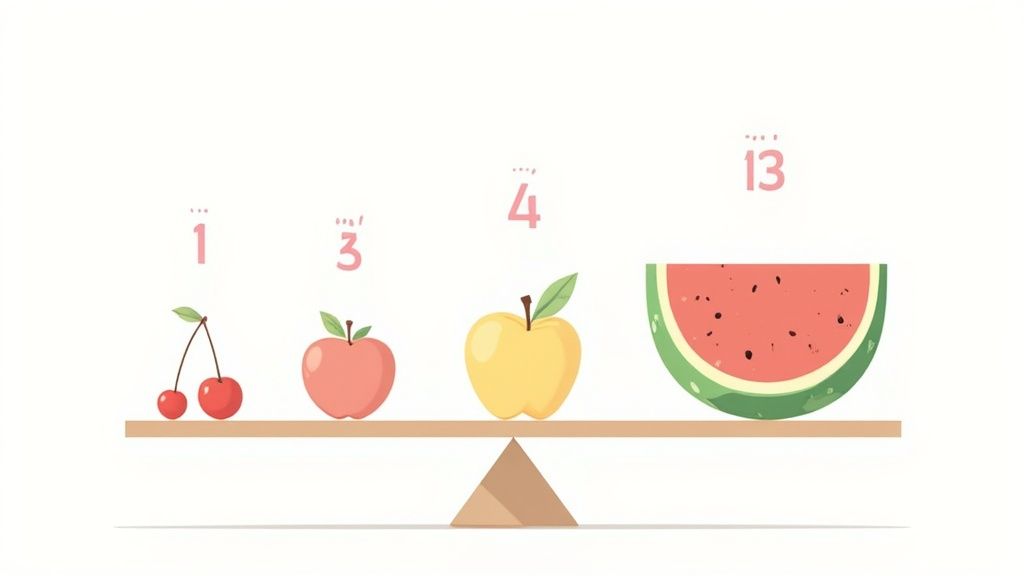
Think about it this way: if I asked you to guess the exact weight of a cherry, an apple, and a watermelon slice, you’d probably hesitate. Your team would end up in a long debate over grams and ounces. But what if I just asked you to compare them? It’s simple. A cherry is tiny, an apple is bigger, and that watermelon slice is way bigger. That's the essence of Fibonacci agile estimation.
We humans are just better at comparing things than we are at giving absolute, precise estimates. The Fibonacci sequence leans into this natural ability by providing a scale that grows in a way that feels intuitive to us.
Embracing Uncertainty with a Non-Linear Scale
Here's the thing about software development: the bigger a task seems, the more unknowns are hiding inside it. A simple task, like changing a button color, is pretty straightforward. But a huge feature, like integrating a new payment gateway, is packed with potential complications.
The Fibonacci sequence is brilliant because it mirrors this reality. The gaps between the numbers get wider as they go up. The jump from 3 to 5 is small, but the jump from 8 to 13 is significant. This built-in buffer forces the team to have a real conversation. You're no longer nitpicking whether a task is a '12' or a '13.' You have to decide if it's an '8' or a '13,' which is a much bigger discussion that often uncovers hidden assumptions or risks.
The goal of estimation isn't to achieve perfect accuracy. It's to create a shared understanding of the work required, fostering alignment and collaboration within the team.
This technique became a go-to for agile teams after gaining traction in the early 2000s. Many experts now recommend a modified version—1, 2, 3, 5, 8, 13, 20, 40, 100—because those even larger jumps cut down on debate time. By 2010, countless companies running Scrum were using Fibonacci for planning, finding it made their forecasts far more reliable. If you're curious about the psychology behind it, you can discover why this sequence works well for estimating on Mountain Goat Software's blog.
Key Benefits of Fibonacci Estimation
So, why has this method stuck around? It comes down to a few core advantages that make agile planning smoother and more effective.
The table below breaks down the main reasons agile teams consistently choose the Fibonacci scale for their estimation sessions.
Why Agile Teams Choose Fibonacci for Estimation
| Benefit | Explanation |
|---|---|
| Encourages Consensus | The widening gaps in the sequence push teams toward agreement by highlighting significant differences in perceived effort. |
| Accounts for Uncertainty | The non-linear scale naturally represents the growing ambiguity and risk associated with larger, more complex tasks. |
| Speeds Up Planning | Teams avoid getting bogged down in minor details, leading to faster and more productive estimation sessions. |
| Improves Predictability | By consistently using a relative scale, teams can establish a reliable velocity, making future sprint planning more accurate. |
Ultimately, these benefits lead to more realistic plans, better team alignment, and a more sustainable pace of work.
The Science Behind the Numbers: Unpacking the Golden Ratio
The Fibonacci sequence works so well for agile estimation because it's deeply rooted in how we perceive the world. Those numbers—1, 2, 3, 5, 8, and so on—might seem random at first glance, but they have a special property that helps teams grapple with the uncertainty that comes with any complex project. The real magic is in how the sequence grows.
As you move up the scale, the ratio between any number and the one before it gets closer and closer to a famous mathematical constant: the golden ratio, or phi (φ), which is roughly 1.618.
This isn't just a fun math fact. It means that when your team chooses a 13 over an 8, you're not just adding 5 points. You're acknowledging that the task is about 60% bigger. This built-in exponential jump forces everyone to admit that a larger task isn't just a little more work—it's a whole different beast, packed with more complexity and unknowns.
Why This Matters for Your Team
This mathematical property mirrors a psychological principle known as Weber's Law. Put simply, the law states that our ability to tell the difference between two things depends on their relative size, not the absolute difference.
Think about it this way: you could probably feel the difference between a 1kg weight and a 1.1kg weight. That extra 100 grams is noticeable. But what if you tried to distinguish between a 20kg weight and a 20.1kg weight? That same 100-gram difference suddenly becomes almost impossible to detect.
The Fibonacci sequence is basically Weber's Law in action for project estimation. It understands that arguing whether a task is a '12' or a '13' is a waste of time, because the perceived effort is practically the same. But the jump from an '8' to a '13'? That's a difference everyone on the team can feel and have a meaningful conversation about.
This is precisely why fibonacci sequence agile estimation delivers such reliable results. By the time a team is debating an 8-point story, the ratios in the sequence are already within 2% of the golden ratio. This creates a curve that more accurately reflects how complexity explodes in the real world. In fact, a detailed study found that Scrum teams using Fibonacci hit 85% velocity forecast accuracy, blowing past the 72% accuracy of teams using simple linear scales. You can dig into the data yourself in this paper on Fibonacci points from Columbia.edu.
From Theory to Practical Consensus
Ultimately, this structure shifts the team's entire mindset from a pointless search for precision to a productive quest for clarity. The goal isn't to nail a perfect number; it's to get everyone to agree on which "bucket" of complexity a task belongs in.
- Small Buckets (1, 2, 3): These are for your straightforward, low-risk tasks. The gaps are small because the work is well-understood.
- Medium Buckets (5, 8): Here, you're dealing with tasks that have a bit more to them. The jump from 3 to 5 is a clear signal that there's a noticeable increase in effort.
- Large Buckets (13, 21+): These are reserved for the big, hairy, audacious tasks. The massive gaps between these numbers force a critical conversation: "Do we really understand this, or does it need to be broken down?"
Using this scale lets you sidestep those endless, draining debates over tiny differences. Instead, the team's energy is focused on what actually matters: understanding the work, flagging risks, and building a shared consensus. The Fibonacci sequence is the framework that makes these conversations happen, leading to faster, more reliable, and far less stressful planning.
How to Use Fibonacci Numbers in Planning Poker
So, how do you actually put the Fibonacci sequence to work? It all comes together in a team ceremony called Planning Poker. Think of it less as a formal meeting and more as a structured conversation that turns the abstract idea of "effort" into something the whole team can agree on.
The goal here isn't just to slap a number on a task. It's about building a shared understanding of what it will really take to get the job done.
During a Planning Poker session, you’ll typically have three key players in the room:
- The Product Owner: This person presents the user story. They’re the storyteller, explaining the "why" behind the feature and answering any questions the team has about the requirements. Crucially, they don't get a vote.
- The Development Team: These are the folks who will actually build the thing. They get to dig into the details, ask the tough questions, and are the only ones who estimate the work.
- The Scrum Master: The facilitator. Their job is to keep the process running smoothly, make sure everyone gets a chance to speak, and help the team work through disagreements without taking sides.
Establishing a Baseline for Consistency
Before you even think about playing your first card, you need to do one thing: establish a baseline story. This is the single most important step for getting consistent estimates.
A baseline is just a small, simple piece of work that everyone on the team knows inside and out. For example, your team might decide that changing the text on a button is a "2-point" story. Done.
That "2" now becomes your yardstick. From this point forward, every new story is measured against it. The question is no longer, "How many hours will this take?" Instead, the team asks, "Is this new story bigger or smaller than our baseline '2'?" This simple shift is what makes the whole fibonacci sequence agile estimation process click.
This image really drives home how we move from a gut-feel linear guess to a more realistic, relative scale.
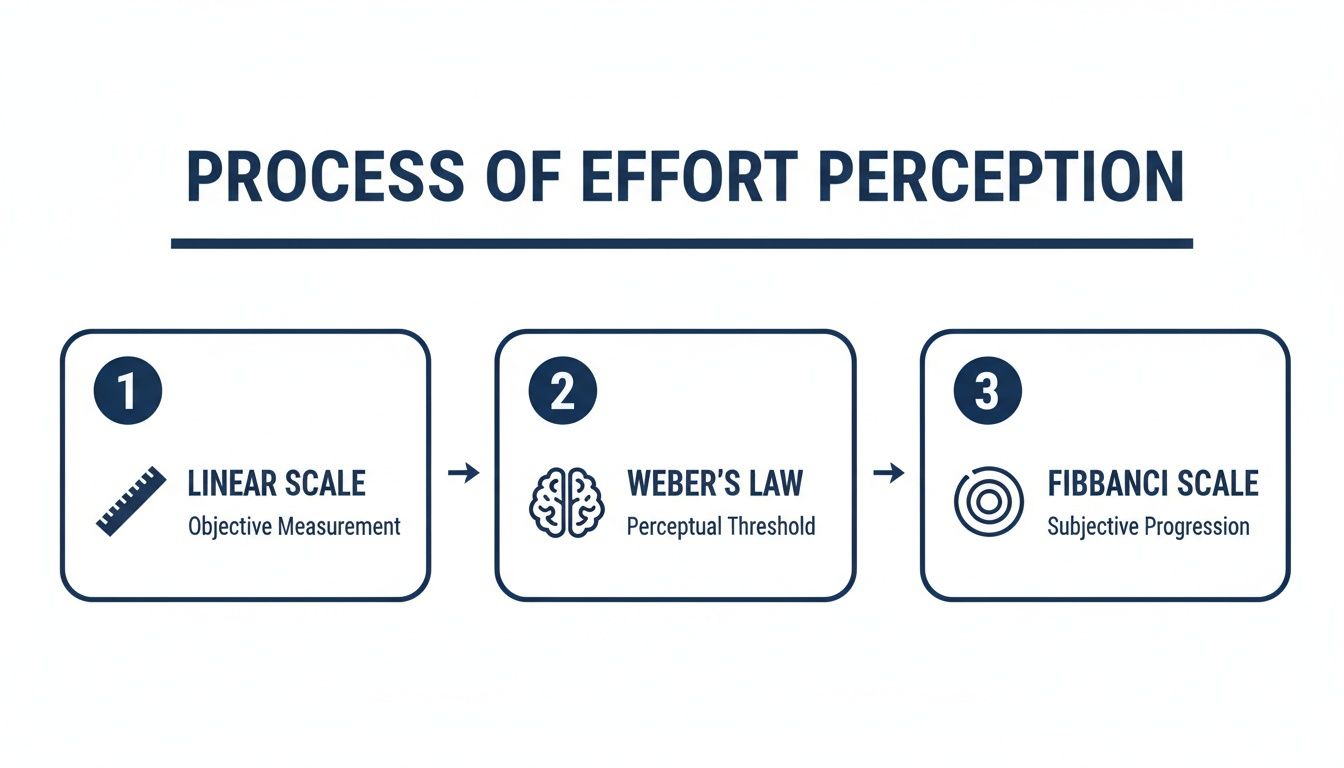
As you can see, the Fibonacci scale is built to embrace the uncertainty that comes with bigger tasks, which lines up perfectly with how our brains perceive effort.
The Planning Poker Process Step-by-Step
With a baseline in place, the actual estimation process follows a simple, repeatable rhythm. This structure is specifically designed to avoid anchoring bias—that pesky human tendency to be influenced by the first number someone says out loud.
- Story Presentation: The Product Owner walks the team through a user story, explaining the goals and what "done" looks like.
- Clarification and Discussion: Now it's the dev team's turn. They ask questions to poke holes in the story, clarify assumptions, and talk through potential technical hurdles or dependencies.
- Private Voting: Each team member quietly chooses a Fibonacci card (1, 2, 3, 5, 8, etc.) that they feel best represents the story's overall size and complexity.
- Simultaneous Reveal: Everyone shows their card at the same time. This is the moment of truth.
- Discussion and Consensus: If the votes are pretty close (say, a mix of 3s and 5s), the team can quickly agree on a number and move on. But if the numbers are all over the place, that's where the real value is.
The most valuable part of Planning Poker isn't the final number. It's the conversation that happens when the numbers are different. This is where you uncover hidden risks, flawed assumptions, and brilliant shortcuts.
Navigating Disagreements and Reaching Consensus
What if one developer throws down a ‘3’ and another reveals a ‘13’? That's not a failure—it's a massive success! It means you've just uncovered a huge gap in understanding before a single line of code has been written.
The Scrum Master will typically ask the people with the highest and lowest estimates to share their thinking. The dev who voted '13' might explain, "I'm worried this touches the old payment module, which means we'll need a risky database migration." Meanwhile, the '3' voter might say, "Oh, I thought we could just use the new API endpoint we built last month."
Boom. That conversation is the whole point. It’s not about finding out who was "right." It’s about getting everyone on the same page.
After a quick discussion, the team votes again. Almost always, the second or third round brings the estimates much closer together as a shared picture of the work emerges. If you want to dig deeper into these dynamics, check out our complete guide to Fibonacci Planning Poker. This structured dialogue transforms estimation from a guessing game into an exercise in collective intelligence.
Getting Fibonacci Estimation Right: Best Practices
Getting good at Fibonacci sequence agile estimation is more than just throwing cards on a table. It's about building the right habits—the kind that lead to predictable sprints and real, valuable results. A few key practices can take your estimation sessions from a simple chore to one of your most powerful planning tools.
One of the first traps teams fall into is trying to map story points directly to hours or days. Story points are designed to be abstract for a reason. They're a relative measure that bundles three key things together:
- Effort: How much work is actually involved?
- Complexity: How hard is this thing to figure out and build?
- Uncertainty: How much do we not know? What are the risks?
When a team member chooses a number, they should be weighing all three of these factors. This combined view is what makes story points so effective. It shifts the conversation from a time-tracking exercise to building a shared understanding of the problem.
How to Handle Stories That Are Way Too Big
Every now and then during Planning Poker, a huge number will pop up—a 40, 89, or even higher. This isn't just an estimate; it's a giant red flag. A number that big is the team’s way of saying a user story is too massive and vague to fit into a single sprint.
An estimate of 20 or higher isn't a commitment. It’s a signal to stop and break the story down into smaller, more manageable pieces before it can be properly estimated and planned.
Instead of trying to cram this "epic" into a sprint, the Product Owner and the team need to huddle up. The immediate goal is to slice that big story into several smaller, independent stories that can each deliver a piece of value. Once broken down, those new stories can be estimated again, and you'll likely see them land in the much more reasonable 3, 5, or 8 range. This is a huge win for reducing risk and keeping work flowing smoothly.
The Scrum Master's Role: The Neutral Guide
The Scrum Master’s job during estimation is crucial, but it's not what some people think. They aren't there to vote or push the team toward a certain number. Their job is to be a neutral facilitator, making sure the process itself is sound.
This means creating a space where everyone feels safe to contribute, especially the quieter folks. When the votes are all over the place, the Scrum Master steps in to guide the conversation. They’ll ask the high and low estimators to share their reasoning, focusing the discussion on why they chose their numbers. This helps the team uncover hidden assumptions and reach a true consensus, not just a mathematical average.
Consistency is Key for Predictable Forecasts
Consistency is the foundation of trustworthy agile estimation. What a "5-point" story means to the team needs to stay relatively stable over time. A 5-pointer today should feel about the same size as a 5-pointer from six months ago. This is why having a few "reference stories" that everyone agrees on is so valuable.
This consistency is what makes your team's velocity—the average number of story points you finish per sprint—a reliable metric. With a stable velocity, you can forecast future work using the simple "yesterday's weather" principle. If your team has consistently delivered around 30 story points over the past few sprints, planning for another 30 is a pretty safe bet.
By putting these practices into play, your team can sharpen its Fibonacci sequence agile estimation skills. You'll end up with better sprint forecasts, smarter risk management, and a development pace that everyone can sustain. That simple card game suddenly becomes a cornerstone of your team's success.
Comparing Estimation Techniques: Fibonacci vs. Other Methods
While the Fibonacci sequence is a go-to for many agile teams, it’s certainly not the only game in town. The truth is, there's no single "best" method. The right choice really depends on your team's experience, the kind of work you're sizing, and how much detail you actually need.
Think about it: a simple 1-10 linear scale seems logical at first, right? But it often traps teams in pointless debates, like haggling over whether a task is a 7 or an 8. This is exactly the kind of time-wasting argument that relative sizing methods, including Fibonacci, are designed to avoid.
Common Estimation Alternatives
Each estimation scale has its own personality and purpose. Let’s break down a couple of the most popular alternatives.
- T-Shirt Sizing (XS, S, M, L, XL): This is as intuitive as it gets. It’s perfect for those early, high-level conversations when you're just trying to get a feel for the size of big initiatives or epics on a roadmap. It keeps everyone focused on the big picture instead of getting lost in the weeds.
- Powers of 2 (1, 2, 4, 8, 16): This scale is a close cousin to Fibonacci. The gaps between numbers get bigger and bigger, which really drives home the idea that larger tasks are exponentially more complex and uncertain. Some teams love it because the jumps are so stark and unambiguous.
This screenshot from Atlassian's guide to estimation shows how different techniques are used throughout the agile process.
As the image shows, estimation isn't just one activity; it's woven into the fabric of agile project management, giving teams a way to forecast effort and manage expectations.
The goal isn't to find one "perfect" estimation method but to select the one that generates the most valuable conversations for your team at a specific point in your planning cycle.
If you want to explore these and other options more deeply, check out this guide to different agile estimation techniques to see what might click for your team.
Making the Right Choice for Your Team
So, how do you pick? It all comes down to context. T-Shirt Sizing is your best friend for early backlog grooming or when you just need a rough order of magnitude. But when it's time for sprint planning, you need something with a bit more fidelity. That's where Fibonacci or Powers of 2 really shine.
To make the decision easier, let's compare these methods side-by-side.
Comparison of Agile Estimation Techniques
This table breaks down how the most common sizing scales stack up against each other, helping you see where each one fits best.
| Technique | Best For | Pros | Cons |
|---|---|---|---|
| Fibonacci | Sprint-level task and story estimation for development teams. | Reflects growing uncertainty well; speeds up consensus by avoiding minor debates. | Can be less intuitive for brand new teams or non-technical stakeholders. |
| T-Shirt Sizing | High-level roadmap planning, epics, and initial backlog sizing. | Extremely fast and easy to understand for everyone, including business stakeholders. | Too vague for detailed sprint planning; lacks the granularity for velocity tracking. |
| Powers of 2 | Teams that want to emphasize the exponential growth of complexity. | Forces clear distinctions between sizes; eliminates ambiguity. | The jumps can feel too large for some teams, making it hard to size mid-range items. |
Ultimately, the Fibonacci sequence agile estimation method often hits that sweet spot for sprint-level work. It's detailed enough for solid forecasting but prevents teams from getting bogged down in the false precision of arguing about tiny differences. It’s a pragmatic balance between the need for speed and the need for a shared understanding of what you're building.
Adapting Fibonacci Estimation for Remote and Hybrid Teams

Just because your team is distributed doesn't mean you have to abandon the collaborative magic of Planning Poker. The fibonacci sequence agile estimation method works just as well for remote and hybrid teams—the trick is simply swapping physical cards for the right digital tools.
The goal is to preserve the core principles of the ceremony, and the most important rule is the simultaneous reveal. This single practice prevents anchoring bias, where the first estimate thrown out unconsciously sways everyone else's vote. Thankfully, there are plenty of digital solutions built to do exactly this.
Online tools like Scrum Planning Poker let teams jump into a session instantly, no sign-ups required. You share a link, everyone votes privately, and then all the Fibonacci cards are revealed at the same time. This keeps the focus right where it belongs: on the conversation, not on fighting with the tech.
Essential Tools for Virtual Estimation
If your team is already living in a larger project management ecosystem, an integrated tool might be the smoothest option. Many platforms now offer features or plugins that bring estimation directly into your existing workflow.
- Jira Plugins: Tools like Agile Poker for Jira embed the estimation process right into your backlog, so story points are automatically linked to their corresponding tickets.
- Collaboration Hubs: Digital whiteboards like Miro or Mural have templates and apps for running visually engaging Planning Poker sessions that feel much more interactive and dynamic.
- Dedicated Tools: Standalone web apps provide a clean, distraction-free space designed for one thing: quick and easy remote estimation.
The specific tool you choose is less important than its ability to support the core agile principles: focused discussion, private voting with a simultaneous reveal, and a clear path to consensus.
Keeping Remote Sessions Engaging and Effective
Running a remote estimation session takes a little more conscious effort to keep everyone tuned in. Having cameras on is non-negotiable; so much of the debate is understood through non-verbal cues that get lost otherwise.
To keep things moving, use a timer to put a container around each discussion. The Scrum Master should also make a point to call on quieter team members, ensuring every perspective is heard and creating a space where everyone feels comfortable sharing their reasoning.
With thoughtful facilitation and the right digital toolkit, the fibonacci sequence agile estimation method can absolutely thrive, no matter where your team is located. If you're looking for more ways to sharpen your virtual planning, check out our guide on how remote teams master story point estimation.
Frequently Asked Questions
Even after you get the hang of it, a few common questions always seem to pop up when teams first start using the Fibonacci sequence for agile estimation. Let's tackle some of the most frequent ones I hear during planning sessions and retrospectives.
Think of these as quick insights to help your team get unstuck and really nail down the process.
What Happens When a Story Is Estimated Too High?
Sooner or later, your team will throw down a 20, 40, or even a 100 on a user story. This isn't just a big number; it's a giant red flag. It’s the team's way of saying, "This is way too big and complicated to fit into a single sprint. We don't really know what we're getting into."
When this happens, don't try to tackle it. The best move is to immediately break the work down. The Product Owner and the dev team should huddle up and slice that massive story (often called an "epic") into several smaller, more focused user stories. Once you've done that, estimate the new, smaller pieces. You’ll probably find they land in a much more comfortable 3, 5, or 8 range. This drastically cuts down on risk and helps you deliver value much more predictably.
Should We Ever Change Past Story Points?
The short answer is a hard no. Never go back and change the points on a story after it's done. That original estimate was a forecast—your best guess with the information you had at that time. The actual effort it took is a totally separate piece of information.
The whole point of story points is to help your team get better at forecasting. Changing the number after the fact completely defeats the purpose. It’s like editing your old predictions to match the final score—it erases a valuable learning opportunity and messes up your velocity, making future planning a guessing game.
If a story you called a "3" turned into a monster, that’s a perfect topic for your next retrospective. Dig into why the estimate was off, learn from it, but leave the original number as is.
How Do New Team Members Start Estimating?
Getting a new person up to speed with your team's estimation rhythm is crucial. Start by having them sit in on a Planning Poker session or two as a quiet observer. Let them get a feel for the team's conversation and how they weigh different factors.
Next, show them your "baseline" stories. These are the classic examples of work the whole team agrees is a solid "2" or a "3." The Scrum Master should explain that points are all about relative size—a mix of effort, complexity, and uncertainty—not a stand-in for hours.
When they’re ready to join in, encourage them to vote and, more importantly, to explain their reasoning. The goal isn't for them to be "right" from day one, but for them to start understanding and syncing up with the team's unique scale.
At Scrum Planning Poker, we built a free, no-fuss tool to help your team master agile estimation. Our platform supports Fibonacci, T-shirt sizes, and custom decks, making it easy for remote and in-person teams to collaborate in real-time. No sign-ups, no friction. Start your free Planning Poker session today.