
Boost Sprint Planning with agile planning poker
Think of Agile Planning Poker as a gamified approach that helps teams agree on how much effort a task will take. Instead of one person guessing how many hours something will take, the whole team uses numbered cards to vote on its complexity. This little game sparks crucial conversations and leads to far more accurate, collaborative forecasts.
What Is Agile Planning Poker and Why Does It Work?
Picture this: you and a few friends are trying to guess how much a heavy, sealed box weighs. One person might guess way too high, another too low. But what happens if you all start talking about it? You discuss its size, what it might be made of, and how it felt when you tried to nudge it. Suddenly, your collective guess becomes much, much more accurate.
That’s the simple but powerful idea behind Agile Planning Poker.
It takes the pressure out of sprint planning. No more stressful guessing games. It becomes a structured, collaborative exercise that pulls from the collective wisdom of the entire development team, rather than relying on a single "expert" whose guess could easily be off.
Tapping into Collective Intelligence
The real magic of Planning Poker is how it surfaces different perspectives almost instantly. A backend developer might see a task as a piece of cake, but a frontend developer knows the UI will be a nightmare. At the same time, the QA engineer is already thinking about all the tricky edge cases they'll need to test.
Planning Poker makes sure every one of those voices is heard. This leads to a few key benefits:
- Shared Understanding: The discussion forces everyone to get on the same page about the scope of work and clear up any assumptions before a single line of code is ever written.
- Increased Accuracy: It’s a well-known fact that group estimates are more reliable. This process cancels out individual biases and fills in knowledge gaps that one person might have.
- Team Ownership: When the entire team has a say in the estimate, they build a shared commitment to the work and the timeline they've created together.
This is what a typical Planning Poker card deck looks like. Notice how it uses a modified Fibonacci sequence.
The numbers aren't linear for a reason. Those bigger gaps between the higher numbers (like 13, 20, 40) are intentional. They push the team to think in terms of relative size and complexity, not precise hours.
From Individual Guesses to Reliable Forecasts
This technique was made popular by Agile pioneers like James Grenning and Mike Cohn to fix a chronic problem: unreliable solo estimates. We've all been there. When someone estimates a task alone, their prediction can be wildly off base. But when you put those same smart people in a room with an agile planning poker deck, the conversations that follow produce estimates that are far more dependable. You can dive deeper into how teams use these numbers in our guide on story point estimation.
By turning estimation into a transparent and engaging conversation, teams do more than just land on a number. They build a solid foundation of shared knowledge. This process uncovers hidden complexities early, which prevents nasty surprises down the road and makes the entire sprint forecast something you can actually trust. The value isn't just in the final number—it's in the rich discussion that gets you there. You can read more about the research supporting collaborative estimation techniques on Simpliaxis.com.
Getting to Grips With the Rules and How It All Works
Agile Planning Poker isn't just about picking cards; it's a facilitated conversation with a clear purpose and process. To get the most out of it, you need to understand how the "game" is played. This structure is what turns chaotic estimation meetings into focused, productive sessions where everyone is on the same page.
Each person has a specific role to play. Think of it like a well-run workshop.
The Product Owner kicks things off by presenting a user story. They’re there to explain the what and the why—giving the team all the business context they need. They're the voice of the customer, but it's crucial they don't vote on the estimate itself.
The Scrum Master is the facilitator. Their job is to keep the meeting on track, make sure the rules are followed, and ensure everyone’s voice is heard. They guide the process without influencing the outcome.
Finally, the Development Team—the engineers, designers, and testers who will actually build the thing—are the voters. They ask the tough technical questions and use their hands-on expertise to estimate the effort.
How a Typical Session Unfolds
A round of Planning Poker follows a simple, repeatable sequence. The goal isn't just to land on a number but to build a shared understanding of what the work actually involves. This flow is designed to surface assumptions and get everyone aligned.
- The Pitch: The Product Owner introduces a user story and its acceptance criteria. They'll answer any initial questions to make sure the team gets the user's need and the definition of "done."
- The Huddle: The development team then discusses the story amongst themselves. This is their chance to hash out implementation ideas, flag potential technical roadblocks, and think through any dependencies.
- The Private Vote: Each team member secretly selects a card from their deck that reflects their personal estimate of the effort. Keeping this private is key to avoiding anchoring bias, where the first number mentioned sways the entire group.
- The Big Reveal: Once everyone has a card picked, the Scrum Master calls for everyone to show their cards at the same time. This single moment gives an instant, honest snapshot of the team's alignment.
This core loop of estimating, discussing, and coming to a consensus is what makes the whole thing work.
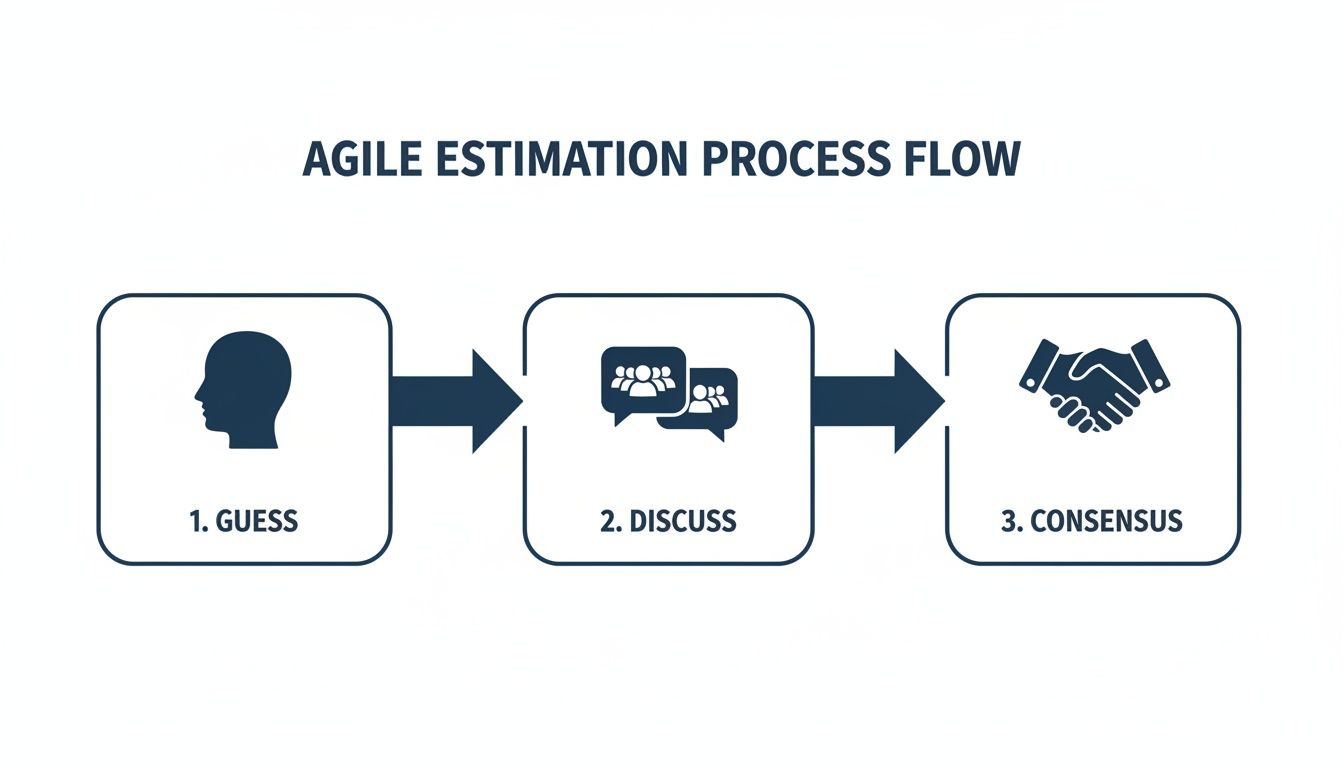
It’s this simple rhythm that transforms individual guesses into a well-reasoned, collective estimate.
Why Different Estimates Are a Good Thing
So, what happens when the cards are all over the place? This is where the magic happens. A wide spread of votes—say, one developer plays a 3 while another plays a 13—isn't a sign of failure. It's a huge opportunity. It means people are interpreting the work in fundamentally different ways.
The real value of Planning Poker isn't the final number; it's the conversation that gets you there. The discussion sparked by mismatched estimates is where you uncover hidden risks, forgotten dependencies, and false assumptions.
When estimates are far apart, the facilitator invites the people with the highest and lowest numbers to explain their thinking. The person who voted high might point out a tricky database migration everyone else forgot. The person who voted low might know of an existing component that could be reused, saving a ton of time. This is the heart of the exercise.
After everyone has their say, the team votes again. You repeat this cycle of voting and discussing until the numbers start getting closer. Consensus doesn't mean everyone has to play the exact same card, but the team should be able to quickly agree on a final number. This process ensures the final estimate is backed by a genuine, shared understanding of the work ahead.
The Real Benefits of Adopting Planning Poker
It’s easy to think of Agile Planning Poker as just a way to put a number on a task, but that's really just scratching the surface. The true magic is in the process itself. It’s a framework that cleverly sidesteps the usual traps of estimation and turns a routine planning meeting into a genuine team-building activity.

The game’s structure is its secret weapon. By having everyone show their cards at the same time, it completely defuses one of the biggest problems in group estimation: the anchoring effect. You know how it goes—the first person to speak up throws out a number, and suddenly everyone else’s thinking is subconsciously tethered to that initial suggestion.
Planning Poker flips the script, making sure everyone’s first thought is truly their own. This simple rule change gives you a far more honest and diverse set of initial estimates to kick off the conversation.
Fostering Shared Ownership and Understanding
Too often, estimation is a solo act performed by a lead developer. Planning Poker blows that up and makes it a team sport. When developers, testers, designers, and anyone else with a stake in the work are all part of sizing a user story, they start building a shared picture of what it’s actually going to take.
This approach pays off in a few huge ways:
- Deeper Technical Dialogue: When someone has to explain why they chose a high or low number, it forces critical conversations about implementation details, potential roadblocks, and hidden dependencies that might have gone unnoticed.
- Early Risk Identification: The QA engineer might play a higher card because they see a bunch of tricky test cases. A backend dev might do the same because a third-party API is notoriously unreliable. You want these insights to surface before the sprint starts.
- Collective Commitment: Once the team lands on a number together, it’s not just one person’s guess anymore. It’s a team commitment, and everyone feels a sense of ownership over hitting that sprint goal.
This is the big leagues of agile teamwork—moving from individual guesswork to collective forecasting.
Driving Alignment Through Healthy Debate
The moments when estimates are wildly different are actually the most valuable parts of an agile planning poker session. When one person plays a 3 and another plays a 13, that’s not a failure. It’s a sign that you've just uncovered a major gap in understanding.
The goal of Planning Poker isn't just consensus; it's clarity. The debate between the highest and lowest estimators forces the team to challenge assumptions and build a detailed, shared mental model of the task at hand.
This built-in debate makes sure every voice is heard. The quiet junior developer who sees a potential flaw gets the same airtime as the confident senior architect. This democratic process doesn't just produce better estimates; it leads to stronger technical solutions because the work has been stress-tested from every possible angle.
It’s no wonder this practice has become so popular. As Agile adoption in software teams skyrocketed from 37% in 2020 to 86% in 2021, Planning Poker emerged as a key technique, used by 58% of organizations. You can dig into the data yourself by reviewing these Agile adoption trends and their impact. It's clear that this method is central to how modern teams work.
Ultimately, Planning Poker delivers so much more than an accurate sprint backlog. Teams who use it consistently communicate better, collaborate more effectively, and feel a stronger sense of unity. It turns estimation from a boring chore into a powerful ritual that makes the whole team smarter and more prepared for whatever comes next.
How to Facilitate a Productive Planning Session
The difference between a chaotic estimation meeting and a focused, productive one often comes down to one person: the facilitator. Think of them as the conductor of an orchestra. Their job isn't to play an instrument but to ensure every section is heard and the team works together in harmony.
Typically, this role falls to the Scrum Master. They guide the process, protect it from common pitfalls, and create a safe space for the honest, insightful conversations that lead to great estimates. A good facilitator doesn't have the "right" answers or try to sway the vote. Instead, they ask the right questions, keep the discussion on track, and make sure everyone plays by the rules. When they do their job well, the entire agile planning poker session feels smooth, efficient, and genuinely valuable.
Preparing for a Successful Session
Great planning sessions don't just happen by accident—they're the result of solid preparation. A little upfront work goes a long way, preventing confusion and wasted time so the team can focus on what matters: estimating and collaborating.
Before you even book the meeting room (or open the video call), a few key elements need to be locked in. This prep work is a small investment that pays off big time in meeting efficiency and the quality of your estimates.
Here’s a simple checklist to run through before you start:
- Well-Defined User Stories: The Product Owner needs to bring stories that are actually ready for estimation. This means a clear description and, most importantly, concrete acceptance criteria. If a story is vague, the estimates will be too.
- Set a Clear Agenda: Everyone should know what you're trying to accomplish. Briefly outline the stories up for discussion and the time you've set aside. This helps manage expectations and keeps the team focused.
- Technical Readiness: For remote teams, this is crucial. Make sure your digital Planning Poker tool works and everyone has access. A quick tech check can save you from a frustrating false start.
Keeping the Conversation on Track
Once the session starts, the facilitator's primary job is to manage the flow and energy in the room. You want to encourage deep discussion without letting it spiral into a never-ending debate. A couple of simple techniques can make a world of difference here.
One of the most effective tools is a timer. When a conversation about a single story starts to drag, set a timer for two or three minutes. This injects a healthy sense of urgency, encouraging the team to be concise and stick to the most critical points.
A facilitator's greatest skill is knowing when to let a conversation breathe and when to gently guide it back to the main path. The aim isn't to rush to a number but to efficiently uncover the knowledge needed to estimate confidently.
Another key responsibility is making sure everyone participates. In any group, some people are naturally more outspoken than others. The facilitator needs to create space for quieter team members to share their perspectives—their insights are often just as valuable. A simple, direct question like, "What are your thoughts on this?" can be a powerful way to bring them into the fold.
Facilitating for Remote and Distributed Teams
Running an agile planning poker session with a distributed team adds a few wrinkles, but modern tools have made it easier than ever to keep that collaborative spark alive. The core principles don't change, just the way you execute them.
For remote sessions, a dedicated digital tool is a must. Platforms like Scrum Planning Poker are designed to replicate the in-person experience. They allow for simultaneous, private voting and a synchronized reveal of the cards, which is absolutely critical for avoiding the anchoring bias we talked about earlier.
Here are a few extra tips for running a smooth remote session:
- Cameras On: Encourage everyone to turn on their cameras. Seeing facial expressions and body language bridges the distance and makes communication much clearer.
- Use Digital Hand-Raising: Most video conferencing tools have a "raise hand" feature. Use it to manage the speaking order and prevent people from talking over each other.
- Over-Communicate: Check in regularly to make sure everyone is following the discussion. It's much easier for people to get lost or tune out when they aren't in the same room.
The right tools don't just make remote estimation possible; they can actually improve it. Recent data shows that 92% of users report more efficient meetings with online poker tools, and 74% feel the sessions are more inclusive. You can learn more about how digital tools are fueling Agile's commercial impact. By embracing these practices, you can make sure your planning sessions are productive and engaging, no matter where your team logs in from.
Common Planning Poker Mistakes to Avoid
Even with the best of intentions, it’s surprisingly easy for teams to fall into common traps that quietly undermine the whole point of Planning Poker. These "anti-patterns" can take what should be a collaborative, insightful process and turn it into a frustrating chore. Spotting these pitfalls early is the key to keeping your estimations honest and productive.
One of the most common mistakes I see is letting a senior developer or manager's opinion carry too much weight. It often happens without anyone meaning for it to. A tech lead might explain their reasoning first, and suddenly, everyone else starts second-guessing their own, lower estimates. This creates a subtle "anchoring" effect that kills the simultaneous reveal.
The whole idea behind Planning Poker is to get a bunch of independent, diverse opinions on the table at once. When one voice dominates, you lose out on the valuable perspectives of others who might be seeing the problem in a completely different light.
Rushing the Discussion Phase
Another trap is treating estimation like a race to the finish line. Teams often feel pressure to churn through the backlog, so they barrel through the discussion, especially when the initial votes are pretty close. They might just average the numbers or agree on a middle ground without digging into why they had different ideas in the first place.
This is such a missed opportunity. The conversations that come out of different estimates are often more valuable than the final number itself. Skipping over them means you could be ignoring huge technical risks, hidden dependencies, or other complexities that will come back to bite you later.
The objective of Planning Poker is not speed; it's shared understanding. A few extra minutes of discussion can save days of rework later by ensuring everyone is aligned on the actual scope of the task.
A good facilitator will intentionally slow things down when the numbers are all over the place. They’ll ask probing questions to get to the bottom of the disagreement, making it clear that the goal is clarity, not just getting a number on the board.
Converting Story Points to Hours
This one is probably the most destructive mistake of all: converting story points directly into hours or days. It completely misunderstands why we use relative estimation. Story points are meant to be an abstract measure of effort, complexity, and uncertainty—they have nothing to do with a ticking clock.
As soon as someone on the team (or worse, in management) starts saying things like, "one story point equals eight hours," the system breaks down. Here's why:
- It creates false precision. A 5-point story is not a guarantee of 40 hours of work. Thinking this way just sets everyone up for failure with unrealistic expectations and unnecessary pressure.
- It discourages honest estimation. People will start estimating based on the hours they have in the week, not the actual complexity of the task. This completely skews your data.
- It masks uncertainty. The Fibonacci sequence is used for a reason. It reflects the fact that as tasks get bigger, our ability to predict the effort involved gets fuzzier. Converting points to hours completely ignores this reality.
Instead, look at your team's velocity—the average number of story points they complete in a sprint. That’s your real forecasting tool. It’s a proven measure of your team’s capacity over time, which is far more reliable for planning than any made-up time conversion.
Forgetting It Is a Team Sport
Finally, estimation is doomed to fail if the whole team isn't in the room. I’ve seen teams where only the developers vote, leaving out QA engineers, designers, or anyone else who will have a hand in the work. This siloed approach always leads to inaccurate estimates because you're not seeing the full picture.
Your QA engineer knows a feature will require a mountain of complex testing. Your designer can spot a UI challenge from a mile away. Without their input, the developers are basically estimating with blinders on. A good Planning Poker session needs input from every single person who will touch the work. Only then will the final number reflect the true, end-to-end effort required.
Choosing the Right Planning Poker Tools

While physical cards have a certain old-school charm for co-located teams, let’s be real: modern development is often remote or hybrid. This is where digital agile planning poker tools step in, turning what could be a logistical headache into a smooth and genuinely engaging part of your workflow.
The right software does more than just mimic a deck of cards. It elevates the entire process with features built for clarity and speed. Finding the perfect tool comes down to your team's specific needs, but a few key features always separate the great from the just-okay.
Core Features to Look For
When you're shopping around, focus on what actually supports the principles of Planning Poker. The goal is to find something that removes friction, not adds another layer of complexity to your sprint planning.
Here’s what you should consider non-negotiable:
- Real-Time Collaboration: Everyone needs to vote and reveal their cards at the same time. This is the only way to prevent anchoring bias and get honest, independent thoughts.
- Built-in Timers: A simple countdown clock is surprisingly effective at keeping discussions on track and stopping estimation sessions from spiraling into endless debates.
- Customizable Decks: The Fibonacci sequence is the classic, but having the option to use T-shirt sizes or even create your own custom deck means the tool adapts to you, not the other way around.
- Anonymity Features: Votes must be private until the reveal. This is crucial for psychological safety and ensures people are estimating the work, not what they think the senior dev will say.
These basics form the bedrock of any solid digital estimation platform. They ensure the spirit of the game stays intact, no matter where your team is dialing in from.
Integrations and Advanced Capabilities
Beyond the fundamentals, the real game-changers are the tools that plug right into your existing development ecosystem. A tool that connects directly to your project management software, like Jira or Azure DevOps, is a massive win.
Think about it: no more manually updating tickets with story points after the meeting. The backlog is always accurate, and you just saved the team a ton of tedious administrative work.
For a good overview of the landscape, you can check out this comparison of the 5 best online planning poker tools to see how different options stack up.
A great Planning Poker tool should feel like a natural extension of your workflow, not a separate task. The goal is to make accurate, collaborative estimation as easy as clicking a button.
For example, a tool like Scrum Planning Poker is designed with this simplicity in mind, letting teams jump into a session in seconds without even needing to sign up.
By picking software with a smart feature set and an intuitive interface, you set your team up for planning sessions that aren't just productive—they're actually something people won't dread.
Got Questions About Planning Poker? We've Got Answers.
Even after you've got the basics down, a few practical questions always pop up when a team first tries agile planning poker. Let's walk through some of the most common ones that I've heard over the years.
Think of this as a quick-start guide for handling those tricky "what if" moments. Getting these sorted out early on will make your team's transition to Planning Poker a whole lot smoother.
What If the Team Can't Agree on an Estimate?
You've seen it happen. After a few rounds of voting, the team is stuck. Half the group is holding up a 5, the other half is showing an 8. You could debate it for another twenty minutes, but that's rarely the best use of anyone's time.
When you hit a stalemate like this, forcing everyone to agree on a single number isn't the point. The real goal is to get a shared understanding and a good-enough estimate to move forward.
Here’s a simple trick I've used dozens of times: the facilitator can just ask the room, "Can we all live with the higher number and move on?"
This little technique works wonders because:
- It honors the uncertainty. Picking the higher number automatically bakes in the risk or complexity that some team members were pointing out.
- It respects the team's time. You avoid getting stuck in a loop over a small difference in opinion.
- It keeps the energy up. The team can bank a reasonable estimate and move on to the next item with a sense of progress.
Who Needs to Be in the Room?
The simple answer? Everyone who will do the work. This isn't just a suggestion; it’s essential for getting estimates that mean anything. If you leave people out, you’re creating blind spots that will come back to bite you later.
A good estimation session should always include:
- Developers: They're the ones in the code, so they know the technical hurdles.
- QA Engineers: They bring a critical eye for what it will take to properly test the feature and think about edge cases.
- Designers (UX/UI): They can speak to the effort needed to create mockups, assets, and prototypes.
- The Product Owner: Their job is to explain the user story and answer questions about what's needed. They don't vote.
- The Scrum Master: They facilitate the meeting, keeping things on track. They also don't vote.
When you bring all these different skills to the table, your estimate reflects the total effort to get a story well and truly "done"—not just the time it takes to write the code.
Planning Poker's magic comes from tapping into different perspectives. An estimate made without input from everyone who will touch the work is just a guess, and a risky one at that.
Should We Bother Estimating Bugs and Spikes?
Absolutely, but you need a consistent way to handle them.
When it comes to bugs, if it’s more than a one-line fix, it needs an estimate. Estimating bugs makes the invisible work of fixing them visible, allowing the Product Owner to prioritize that effort against building new features. It's all just work, after all.
The same goes for spikes—those little research tasks you create to figure out a complex problem. The estimate for a spike is for the research itself, not the feature you might build afterward. This carves out dedicated time for learning and de-risking future work, which is a hallmark of a healthy agile team.
Ready to run estimation sessions that are less talk and more action? Scrum Planning Poker is a free, dead-simple tool that lets you start a session in seconds. No sign-ups, no fuss. Bring clarity and collaboration to your team's planning by visiting https://onlineplanningpoker.com today.