
sprint planning best practices: Run effective sprints
Sprint planning isn't just another meeting to cram onto the calendar.Let's be honest—many teams dread it. But when done right, it's less of a mandatory meeting and more of a strategic huddle that sets the tone for the entire sprint. The real magic happens before the session even starts, with continuous refinement and team alignment. This proactive work transforms planning from a chore into a powerful tool for predictable, high-quality delivery.
Why Effective Sprint Planning Matters More Than the Meeting

Many teams fall into the trap of seeing sprint planning as an isolated event. It's not. The most successful planning sessions are really just the culmination of ongoing refinement and strategic prep work.
The true purpose is to get everyone on the same page with a shared, achievable goal for the next couple of weeks. This isn't about etching a plan in stone. Think of it as a collaborative forecast that gives the team the clarity and focus needed to do their best work.
The Core Purpose and Key Players
At its heart, sprint planning is about answering two deceptively simple questions: What can we deliver in this sprint, and how are we going to get it done? When the meeting is over, everyone should walk away knowing exactly how they contribute to that collective goal.
To pull this off, everyone needs to know their part:
The Product Owner owns the "why" and the "what." They come prepared to champion a clear sprint goal and present the highest-priority items from the product backlog. Their job is to maximize the value the team produces.
The Development Team figures out the "how." They're the ones on the ground, so they forecast what they can realistically pull into the sprint and sketch out a plan to deliver it.
The Scrum Master is the facilitator and coach. They make sure the meeting runs smoothly, stays on track, and adheres to its time-box, ensuring everyone follows the spirit of Scrum.
A common myth: Sprint planning is where management assigns tasks. Wrong. It’s a pull system. The Development Team pulls work from the backlog based on their capacity, which is critical for building a sense of ownership and commitment.
To better understand the anatomy of a productive session, let's break down its essential components. The following table outlines the inputs you need, the activities that take place, and the outputs you should walk away with.
Core Components of a Successful Sprint Planning Session
| Component | Description | Key Objective |
|---|---|---|
| Inputs | A prioritized Product Backlog, the latest Product Increment, projected team capacity, and historical performance data (like velocity). | To enter the meeting with all the necessary information to make informed decisions. |
| Activities | Discussing the Sprint Goal, selecting backlog items, decomposing items into tasks, and estimating the work. | To collaboratively create a realistic and actionable plan for the upcoming sprint. |
| Outputs | A clear Sprint Goal and a Sprint Backlog containing the selected items and the team's plan for delivering them. | To leave the meeting with a shared understanding and a tangible commitment. |
Having these elements clearly defined ensures that the meeting is a productive working session, not just a discussion.
Adapting to Modern Work Environments
The game has changed with the rise of remote and hybrid teams. We can't just lean over a desk to ask a quick question anymore. This new reality of asynchronous work and less face-time means we have to be much more intentional.
Sprint goals and user stories must be crystal clear right from the start. Many successful remote teams rely on standardized templates to make sure nothing gets lost in translation. This shift puts a much bigger emphasis on solid written documentation and getting stakeholders aligned before planning even begins. As a great article on easyagile.com explains, you have to over-communicate to compensate for the lack of in-person cues.
How to Prepare for Predictable Sprint Outcomes
A successful sprint planning meeting doesn’t start when everyone joins the call—its success is determined long before that. The most predictable and productive sprints I’ve ever been a part of were the direct result of deliberate, consistent preparation. This is where the real work happens.
Forget walking into the meeting with a rough idea and hoping for the best. A team that's truly primed for a great sprint comes to the table with a refined product backlog, a clear preliminary goal, and a shared understanding of what "ready" actually means. This prep work is the difference between a chaotic four-hour debate and a focused, efficient planning session.
What a Genuinely Ready Backlog Looks Like
So many teams talk about backlog refinement, but it often becomes a rushed, last-minute chore. True refinement is a continuous process, not a pre-meeting scramble. It's the Product Owner's job to lead this charge, making sure the team always has a healthy buffer of well-understood items at the top of the backlog.
A genuinely ready backlog item is more than just a title on a card; it has substance. Every story should meet the INVEST criteria:
Independent: Can it be delivered without being blocked by another story in the same sprint?
Negotiable: Does it leave room for a real conversation about how it will be implemented?
Valuable: Is the benefit to the end-user or the business crystal clear?
Estimable: Does the team have enough information to put a rough size on it?
Small: Can it realistically be finished within a single sprint?
Testable: Do we have a clear way to verify that it’s done and works correctly?
Real-World Tip: Don't let refinement sessions turn into mini-planning meetings. The goal is to clarify and size upcoming work, not break it down into a million tiny tasks. Focus on the "what" and "why," leaving the "how" for the actual sprint planning session.
When your user stories consistently meet these criteria, estimation becomes far more accurate. This clarity fuels better discussions during planning, especially when you're using techniques like Planning Poker. For a deeper dive, check out our guide on how remote teams master story point estimation for more insights into making this process click.
The Product Owner’s Crucial Role
The Product Owner is the guiding light for the upcoming sprint. They need to show up to the planning meeting with more than just a list of items; they need a vision. This means proposing a compelling sprint goal that gives the team a cohesive mission, transforming a random collection of tasks into a meaningful objective.
For example, instead of a vague goal like "Work on user profile features," a strong goal is specific: "Allow users to securely update their profile information and reset their password to improve account self-service." That kind of clarity provides focus and helps the team make smarter trade-off decisions when things get tough during the sprint.
Grounding Forecasts in Reality
One of the most powerful things you can do is use historical data to create a realistic forecast. This means looking beyond gut feelings and using actual numbers to guide what the team takes on. The team's velocity—the average number of story points completed in previous sprints—is your single most reliable predictor of future capacity.
Reviewing this data is essential for dodging the common pitfall of overcommitment. By grounding the plan in what the team has consistently achieved, you build a much more sustainable and predictable workflow. You can explore more about using data-driven sprint planning to see how metrics lead to smoother execution.
Ultimately, this preparation isn't about creating a rigid, unchangeable plan. It's about building a foundation of shared understanding. When the team walks into the meeting with a well-refined backlog, a clear potential goal, and an honest awareness of their capacity, the planning session becomes a collaborative exercise in confirming a great plan, not trying to create one from scratch.
Facilitating a Truly Productive Sprint Planning Meeting
The quality of your sprint planning meeting is a direct reflection of your preparation. When the pre-work is solid, this session transforms from a dreaded calendar block into an energizing huddle that aligns the entire team. This is where the theoretical plan meets reality, and the facilitator—usually the Scrum Master—is the one who guides this process, making sure it’s both productive and respectful of everyone’s time.
A great meeting isn’t about rigid control. It’s about creating a structure that encourages collaboration and clear decision-making. The facilitator’s main job is to protect the time-box, keep the conversation on track, and ensure every voice is heard. This creates an environment where the team can confidently commit to a shared goal.
This visual guide shows the essential flow leading into the meeting itself: starting with a refined backlog, defining a clear goal, and identifying dependencies early.
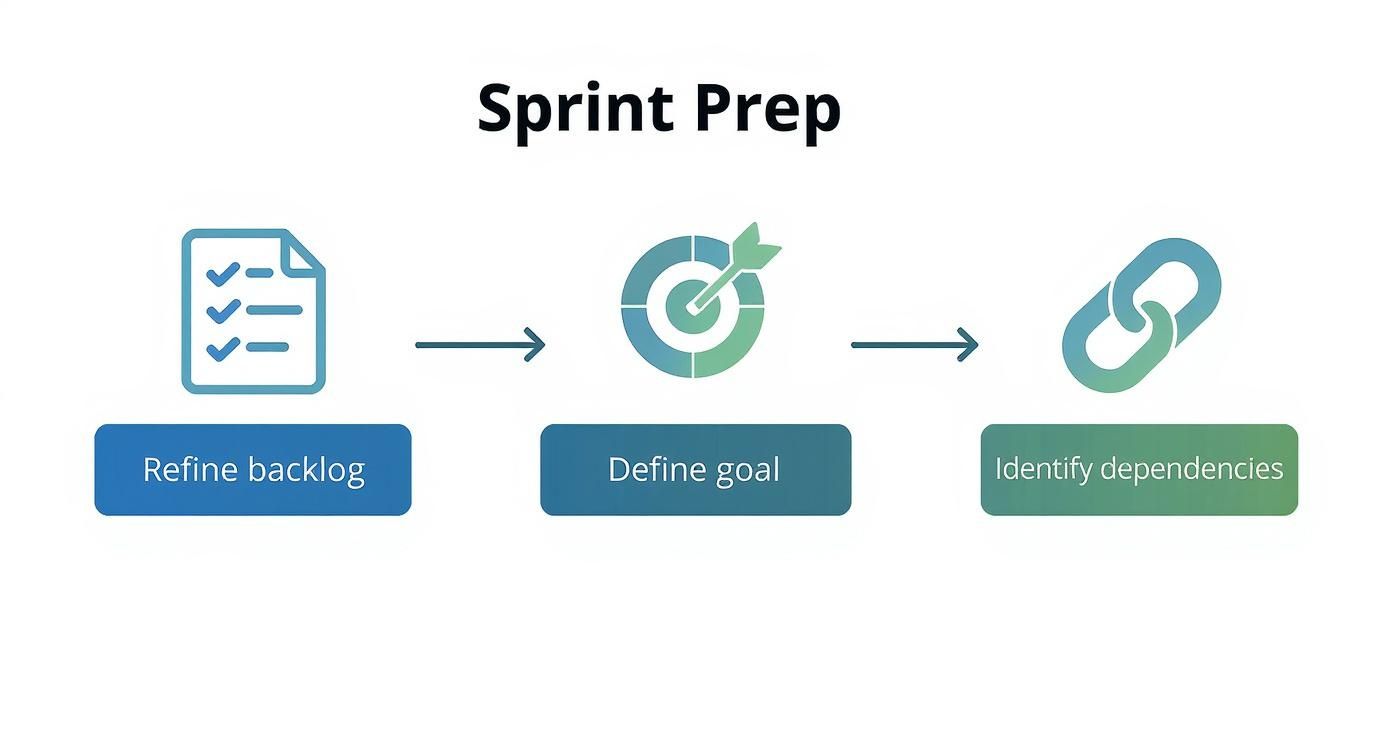
Each step here builds on the last, ensuring that by the time you sit down for the planning session, the biggest questions have already been answered.
Structuring the Meeting for Clarity and Focus
A well-structured agenda is your best defense against meetings that drag on or lose their way. For a standard two-week sprint, a four-hour time-box is pretty common. I've found it's best to split this into two distinct parts, which helps the team tackle one problem at a time and prevents the conversation from jumping between high-level goals and granular task details.
Part 1: The "What"
Duration: Roughly 1-2 hours.
Focus: The Product Owner kicks things off by presenting the proposed sprint goal and the highest-priority items from the product backlog. This is the team's chance to ask clarifying questions to really dig into the user stories and acceptance criteria.
Goal: To collaboratively define and agree upon a single, compelling sprint goal and select the backlog items that will get us there.
Part 2: The "How"
Duration: Typically 2-3 hours.
Focus: Now the Development Team takes the lead. They break down the selected backlog items into smaller, more manageable tasks and start building out the sprint backlog.
Goal: To create a realistic plan for delivering the work, making sure the team feels confident in their forecast.
Your role as facilitator is to be a guide, not a director. I like to use open-ended questions to spark deeper conversation and collective ownership. Try things like, "What needs to be true for us to achieve this?" or "What are the smallest steps we could take to get this story to 'done'?"
To make this more concrete, here’s a sample agenda you can adapt.
Sprint Planning Agenda Example (Two-Week Sprint)
This table breaks down how you might structure a four-hour meeting to keep it on track and purposeful.
| Activity | Time Allotment | Primary Goal |
|---|---|---|
| Welcome & Goal Setting | 15 minutes | Align on the meeting's purpose and review the proposed sprint goal. |
| Backlog Review (The "What") | 60-75 minutes | Discuss priority items, ask clarifying questions, and finalize the sprint goal. |
| Story Selection | 30 minutes | The team pulls work from the product backlog into the sprint backlog. |
| Short Break | 10 minutes | A quick reset to keep energy levels up. |
| Task Breakout (The "How") | 75 minutes | Decompose stories into smaller tasks and discuss implementation strategies. |
| Estimation & Capacity Check | 30 minutes | Estimate the work and check the plan against the team's known capacity. |
| Final Commitment | 15 minutes | The team formally commits to the sprint goal and the work they've planned. |
Remember, this is a template, not a rulebook. Adjust the times based on your team's needs, but always protect the overall time-box.
Fostering Engagement and Collaborative Estimation
Keeping the energy high, especially in a longer meeting, is absolutely critical. This is where interactive techniques like collaborative estimation come in handy. Tools like Planning Poker are invaluable, not because they produce perfect numbers, but because they spark essential conversations.
When one developer estimates a story as a 3 and another says it’s a 13, the discussion that follows is where the real value is. That difference in votes uncovers hidden assumptions, overlooked complexities, or different ideas on how to approach the work. It forces the team to align on scope and effort before anyone writes a single line of code. If you're new to this, it's worth reading up on getting started with Planning Poker to see how it drives consensus.
As the Scrum Master, your job is to guide this process:
Make sure everyone votes at the same time. This prevents "anchoring," where the first or loudest estimate influences everyone else.
Focus on the outliers. Ask the folks with the highest and lowest estimates to briefly explain their reasoning. This is usually where the most important insights come from.
Time-box the discussion for each item. You’re aiming for a "good enough" consensus and shared understanding, not a perfect number or an endless debate.
Adapting Facilitation for Remote and Hybrid Teams
Running sprint planning for a remote or hybrid team requires a different toolkit and a more deliberate approach to engagement. You just can't rely on the natural energy you get when everyone's in the same room.
You have to be more intentional.
Use digital whiteboards like Miro or Mural for brainstorming and task breakdowns so everyone can contribute at once.
Leverage virtual voting tools or even just the chat function for estimation to keep the process quick and engaging.
Make frequent check-ins. I make a point to call on quieter team members by name to ensure they're engaged and have a chance to speak.
Visual aids are everything. Share your screen constantly and use tools that visualize the sprint backlog as it’s being built.
Schedule breaks! Staring at a screen for hours is draining. Build in short, 5-10 minute breaks every hour to help everyone stay fresh.
By mastering these facilitation techniques, you can run sprint planning sessions that your team will actually find valuable, leaving them with the clarity and motivation they need to build something great.
Crafting Realistic Goals and Data-Driven Forecasts
https://www.youtube.com/embed/iUwMUr5x14o
Two things separate a chaotic sprint from a predictable one: a meaningful goal and a realistic forecast. I’ve seen so many teams get bogged down here, treating the sprint goal like a simple summary of tasks and basing their forecast on pure optimism. If you want to get sprint planning right, you have to master these two areas first.
A powerful sprint goal is what turns a random collection of user stories into a cohesive, shared mission. It’s the answer to the question, "Why are we even doing this?" and gives the team a north star to guide them through the inevitable hiccups and trade-offs of a sprint. Without a strong goal, the team is just checking off a to-do list.
Moving Beyond a Simple To-Do List
A weak sprint goal sounds like a laundry list of features. Something like, "Complete the user profile page, fix three bugs, and update the API." This doesn't inspire anyone, and it certainly doesn't provide direction. It's just a collection of work items that happen to be scheduled together.
A strong, outcome-focused goal sounds completely different. It clearly describes the value the team intends to deliver for the user or the business.
Weak Example: "Build the new search filters."
Strong Example: "Enable users to find products in under five seconds by implementing dynamic category and price filters on the search results page."
See the difference? The second example gives the team a crystal-clear target. It empowers them to make small, tactical decisions throughout the sprint. When a technical debate pops up, they can ask themselves, "Which approach gets us closer to that five-second search goal?" That kind of clarity is priceless.
Using Data to Build a Confident Forecast
Once you have a compelling goal, the next step is figuring out what you can realistically accomplish. This is where many teams fall into the trap of wishful thinking, which almost always leads to overcommitment, burnout, and failed sprints.
The antidote is surprisingly simple: use your own data.
Your team's historical velocity is the single most reliable predictor of its future capacity. Velocity is just the average amount of work (measured in story points) your team has actually completed in previous sprints. It’s not a hopeful guess; it’s a reflection of your team's demonstrated ability to deliver.
A team's velocity is their historical truth. It automatically accounts for all the messy, real-world stuff—meetings, interruptions, and unexpected technical hurdles. Ignoring it during planning is like trying to navigate a ship without a map.
To get started, calculate your team's average velocity over the last 3-5 sprints. This gives you a solid, evidence-based baseline for how many story points you can likely tackle in the upcoming sprint. For instance, if your team finished 28, 32, and 30 points in the last three sprints, your average velocity is 30 points. That’s your starting number.
Adjusting Your Forecast for Reality
Of course, your average velocity is a baseline, not an unbreakable law. The final, crucial step is to adjust this number based on what’s actually happening in the upcoming sprint. This is where you account for all the little variables that eat into your team's available time.
Talk through these factors as a team and adjust your baseline velocity accordingly:
Team Availability: Is anyone on vacation or taking a few personal days? You need to reduce your capacity. If a developer is out for a full week of a two-week sprint, you might knock your total capacity down by 10-15%.
Public Holidays: Don't forget to account for any company-wide holidays that fall within the sprint.
Other Commitments: Are there mandatory training sessions or all-hands meetings on the calendar? That’s time not spent on sprint work, and your forecast needs to reflect it.
Sprint Complexity: Is the work this sprint particularly risky or full of unknowns? It might be wise to play it safe and pull in slightly fewer points than your average suggests.
Let's go back to our example. If your baseline velocity is 30 points, but you have a national holiday coming up and one developer on vacation for two days, you might realistically adjust your target capacity down to 25 points. This data-driven approach shifts your team from a plan based on feelings to a forecast based on facts, which dramatically increases your chances of a successful and sustainable sprint.
7 Common Sprint Planning Pitfalls and How to Sidestep Them

Even the most disciplined agile teams can slip into bad habits. A great sprint planning session isn't just about ticking boxes on an agenda; it’s about spotting the anti-patterns that can quietly derail your team’s progress. These common traps often start as minor issues but can quickly snowball into missed sprint goals, team burnout, and a general lack of faith in the process.
The trick is to catch these problems early. When you notice meetings consistently running long or that the same two people are doing all the talking, it’s a clear signal that a course correction is needed. Ignoring these signs lets them become part of your team's culture, making them much harder to root out later.
The Overcommitment Cycle
One of the most common traps is chronic overcommitment. Fueled by good intentions or external pressure, the team bites off way more than their historical velocity says they can chew. This almost always ends in a frantic scramble, half-finished work spilling into the next sprint, and a nosedive in team morale.
The warning signs are easy to spot:
Sprint goals are missed more often than not.
Team members are regularly working late or on weekends just to keep up.
Quality starts to dip as people cut corners to hit an impossible deadline.
The fix? Ground your forecast in real data, not wishful thinking. Your team's average velocity should be the firm foundation for your capacity. If a Product Owner pushes to add "just one more small thing," the team needs to feel safe enough to respond, "Okay, what item of a similar size are we swapping out to make room for it?"
A sprint plan is a forecast, not a blood oath. When a team commits to an unrealistic plan, you're setting them up for failure and eroding the trust needed for honest, sustainable work.
When Planning Turns Into a Design Marathon
Another classic pitfall is letting the planning session get sucked into a deep, technical design debate. Sure, some high-level technical talk is needed to estimate complexity, but sprint planning is absolutely not the time to architect the entire feature. When this happens, the meeting grinds to a halt, people start zoning out, and you can kiss your time-box goodbye.
This problem often points back to user stories that are too big or poorly defined. If you can't estimate a story without designing it on the spot, it probably isn't "ready" for the sprint. A good Scrum Master will step in and enforce the time-box, saying something like, "This is a great conversation, but it's getting too deep for this meeting. Let's schedule a separate 30-minute spike for the developers involved and keep moving."
The Sound of Silence: A Disengaged Team
A quiet room is a major red flag. If the Product Owner and one senior engineer are the only ones talking, you're not getting a real team commitment. Disengagement can stem from anything from a lack of psychological safety to sheer boredom, and it leads directly to flimsy estimates and zero ownership over the sprint backlog.
As a facilitator, you have to actively make space for every voice. Try a simple round-robin, asking each person for their thoughts one by one. Tools like Planning Poker are fantastic for this because they force everyone to participate at the same time, preventing the loudest voices from steering the conversation. To get this right, you’ll want to avoid these common Planning Poker mistakes that kill sprint planning.
The rhythm of your sprints also makes a huge difference. A 2025 analysis found that 59.1% of teams have settled on a two-week sprint. This cadence seems to hit the sweet spot—it's frequent enough to stay agile but gives the team enough runway to do meaningful work, which naturally keeps them more invested in the planning process.
Your Sprint Planning Questions Answered
Even with a perfect playbook, sprint planning in the real world gets messy. As teams start putting these practices into action, the same questions tend to bubble up. Think of this section as your quick-reference guide to troubleshoot those common "what if" and "how to" moments we hear about all the time.
This isn't about theory; it's about fine-tuning your process on the fly. Whether you're trying to solve a specific problem or just need a gut check, these are the straight answers you need.
How Long Should a Sprint Planning Meeting Be?
This is easily the most common question I get, and for good reason—nobody wants to be stuck in another marathon meeting. The rule of thumb, straight from the Scrum Guide, is to time-box two hours of planning for every week of your sprint.
So, for a standard two-week sprint, you're looking at a four-hour maximum. But here's the key: that's a limit, not a target. A team with a well-groomed backlog that's truly ready to go can often wrap up a solid plan in half that time.
The trick is to use that time wisely. A good split is about half for the "What" (locking in the sprint goal and pulling in stories) and the other half for the "How" (breaking down the work into tasks). Sticking to this time-box forces you to be decisive and respects everyone’s calendar, which is a cornerstone of any good planning session.
What Is the Difference Between Sprint Planning and Backlog Refinement?
Getting this right is absolutely critical. Mixing these two up is one of the most common ways teams derail their sprints before they even start.
The easiest way to remember the difference is this: one is an ongoing activity, and the other is a formal meeting.
Backlog refinement (or grooming) is what you do continuously throughout a sprint to get work ready for the next sprint. It’s a collaborative effort to clarify stories, add acceptance criteria, split big items, and get a rough estimate on things. It’s all about making sure the top of the backlog is a tidy, well-understood list of "ready" work.
Sprint Planning is the official event that kicks off the sprint. You walk into this meeting, look at that refined backlog, and pull a specific chunk of work into the sprint. This is where you commit to a sprint goal and create an actionable plan to get it done.
In short, refinement is like doing your mise en place before you cook—chopping the onions, measuring the spices, prepping the protein. Sprint planning is when you decide on the final dish and actually start cooking.
Can We Add Work After a Sprint Has Started?
Ideally, no. Once the sprint starts, that sprint backlog should be locked. That stability is what lets the development team get into a state of flow and deliver high-quality work without constantly being pulled in different directions. You're protecting them from the chaos of shifting priorities.
But we all know reality can be messy. Agility is about responding to change, after all. If a truly urgent, high-impact issue pops up—think a critical production bug that’s tanking the user experience—the Product Owner can negotiate with the Development Team to add it to the sprint.
Notice the word "negotiate." It’s not a command. If something new comes in, something of a similar size almost always has to come out. This trade-off is crucial to protect the sprint goal, prevent burnout, and keep the team’s commitment realistic. This should be a rare exception, not the rule, and it needs to be transparent to everyone.
Who Has the Final Say on How Much Work Is in a Sprint?
This is a non-negotiable in Scrum: The Development Team has the final and definitive say on how much work they can forecast for an upcoming sprint. This empowers the people who are actually doing the work, which builds a massive amount of ownership and accountability.
The Product Owner's job is to prioritize the backlog and clearly explain what the most valuable work is and why. They propose the sprint goal. But they cannot force work onto the team. The team pulls work from the backlog, based on what they know about their past performance (their velocity) and their capacity for the upcoming sprint.
This dynamic is built on trust. The Product Owner brings the "what" and the "why," but the team determines "how much." The sprint backlog is the outcome of their conversation, but the team's forecast is the final word on scope.
Ready to make your sprint planning sessions more collaborative and data-driven? Scrum Planning Poker is a free, simple-to-use tool that helps your team run efficient estimation sessions in seconds. Start a session with no signup required and get everyone on the same page, whether you're in the same room or miles apart. Find out more at https://onlineplanningpoker.com.