
agile what is a sprint: A Practical Explainer
In agile development, a sprint is a short, time-boxed period where a Scrum team focuses on completing a specific chunk of work. Think of sprints as the very heartbeat of Scrum. They create a consistent rhythm, helping teams deliver real, tangible value in focused cycles that usually last anywhere from one to four weeks.
The Foundations of an Agile Sprint
Imagine trying to build a new car by manufacturing every single part before you even start to assemble anything. It could be months, maybe even years, before you know if the engine, wheels, and electronics actually work together. This is the classic pitfall of long-cycle project management.
Agile, and specifically the Scrum framework, flips this entire model on its head with the sprint.
A sprint is basically a mini-project. It's a short, repeatable cycle where the team grabs ideas from the product backlog and turns them into a valuable, potentially shippable piece of the final product. Instead of building the whole car at once, you might focus one sprint on creating a fully functional infotainment system. This iterative approach is powerful.
- Predictability: Sprints establish a consistent cadence, which makes forecasting delivery timelines much easier.
- Adaptability: Short cycles mean you get feedback fast, allowing you to pivot based on what you learn or what the market demands.
- Focus: With a clear goal and a fixed deadline, teams can zero in on a specific set of tasks without getting sidetracked.
- Motivation: Nothing builds momentum like regularly shipping finished work. It creates a powerful sense of accomplishment.
Before we go deeper, here’s a quick overview of a sprint's core characteristics.
Sprint Core Characteristics at a Glance
This table breaks down the essential components and attributes of a standard sprint in Scrum.
| Attribute | Description | Common Practice |
|---|---|---|
| Duration | A fixed, time-boxed period for work. | 1-4 weeks, with 2 weeks being the most popular. |
| Goal | A single, high-level objective for the sprint. | "Implement secure user login and registration." |
| Ceremonies | Structured meetings that guide the sprint. | Planning, Daily Scrum, Review, and Retrospective. |
| Team | The cross-functional group doing the work. | Product Owner, Scrum Master, and Developers. |
| Artifacts | Tools used to manage work and create value. | Product Backlog, Sprint Backlog, and Increment. |
Understanding these elements is the first step to running effective sprints that consistently deliver value.
How Long Should a Sprint Be?
The concept of a sprint is central to Scrum, which happens to be the most popular agile framework out there, used by a whopping 87% of agile teams. As a time-boxed event, a sprint's duration is key. While it can range from one to four weeks, the sweet spot for most is two weeks—66% of teams prefer this cadence because it strikes a great balance between planning and delivery speed. You can dig into more of these numbers in these agile project management statistics and adoption rates on mosaicapp.com.
A sprint's real power comes from its consistency. When the duration is fixed, the team learns its own capacity, gets better at estimating, and establishes a reliable rhythm that stakeholders can count on. Constantly changing sprint lengths just disrupts this flow and kills predictability.
Sprint Goals and User Stories
Every single sprint kicks off with a Sprint Goal. This isn't just a to-do list; it's a high-level objective that gives the team a shared purpose for that cycle. It’s the "why" behind all the work. For example, a Sprint Goal could be: "Implement a secure and simple user login and registration flow."
To hit that goal, the team pulls work from the product backlog, usually in the form of user stories. These are short descriptions of a feature told from the perspective of the person who will use it. They are the fundamental building blocks of the sprint.
Getting good at writing them is crucial, and reviewing some practical examples of user stories can be a great starting point. By breaking down the larger goal into these smaller, actionable items, the team creates a clear and achievable roadmap for the sprint ahead.
The People and Cadence of a Sprint
A sprint is more than just a block of time on a calendar. Its success really comes down to two things: the people involved and the rhythm they follow. This combination of a well-defined team and a predictable series of meetings (often called ceremonies) is what keeps everyone synchronized and moving toward the same goal. Without that structure, a sprint can easily fall into chaos.
To really get why this works, you have to understand who does what and how the process flows. Let's break down the key players who make it all happen.
The Three Core Roles in a Scrum Team
Scrum throws out the idea of a traditional project manager. Instead, it spreads accountability across three distinct roles, creating a more collaborative and self-sufficient team.
- The Product Owner (The "What"): Think of the Product Owner as the voice of the customer. They are laser-focused on value, managing and prioritizing the Product Backlog to ensure the team is always working on the most important thing next. In short, they own the what.
- The Development Team (The "How"): This is the group of people who actually build the product. It’s a cross-functional team with all the skills needed—design, coding, testing, etc.—to turn an idea into a working piece of software. They are self-organizing and decide how to tackle the work they've committed to.
- The Scrum Master (The "Process"): The Scrum Master is a facilitator, a coach, and a problem-solver. They aren't managing the team; they're protecting the Scrum process. Their main job is to remove any roadblocks getting in the team's way and help everyone stick to agile principles.
These three roles create a natural system of checks and balances, keeping the team focused, productive, and pointed directly at the business objectives.
This is how that whole process flows together—from setting a clear goal to doing the work and ultimately getting a piece of the product out the door.
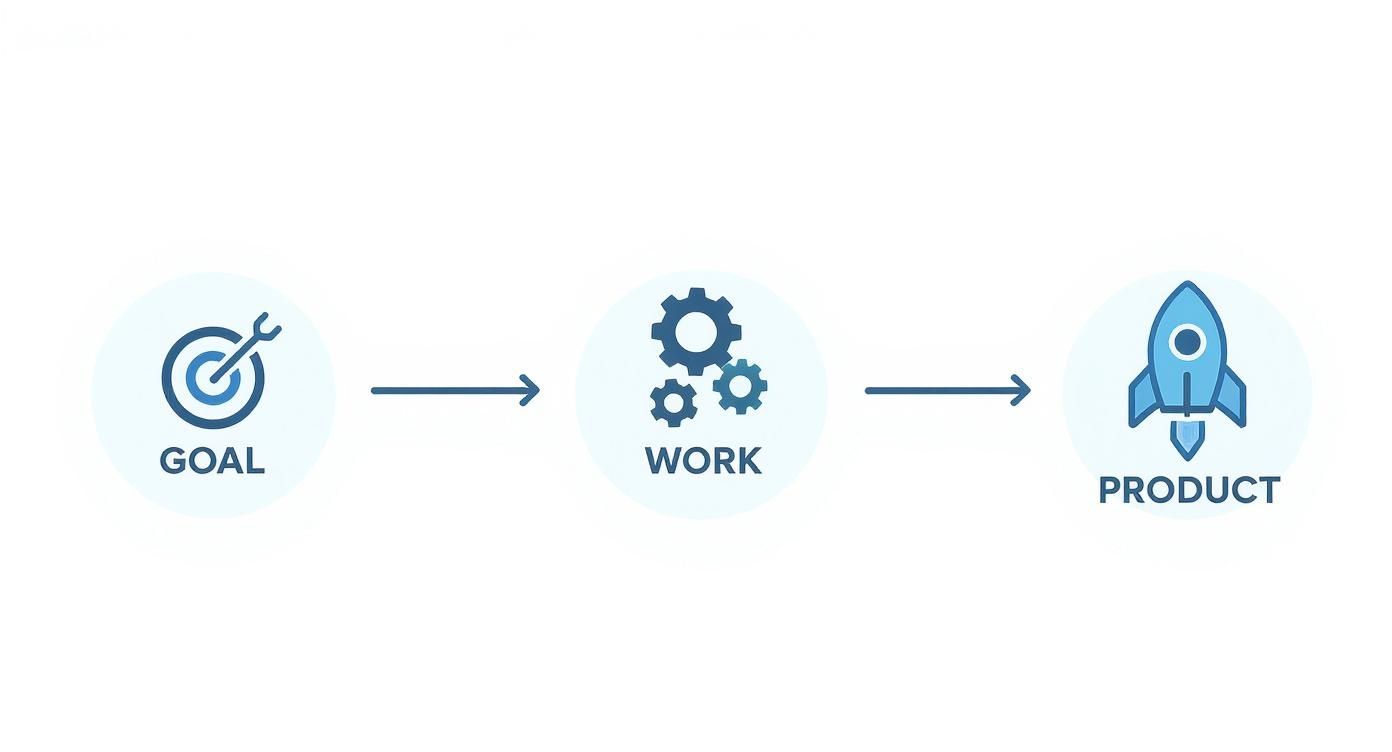
The key takeaway here is that every single sprint is a mini-project designed to produce something real and usable, not just check off a list of tasks.
The Four Essential Sprint Ceremonies
The rhythm of a sprint is set by four key meetings. These aren't just status updates; they are crucial touchpoints for planning, inspecting the work, and adapting as you go.
- Sprint Planning: This is where it all begins. The whole team gets together to define a realistic Sprint Goal and pull in the work from the Product Backlog they believe they can finish. The outcome is the Sprint Backlog—their game plan for the next couple of weeks.
- Daily Scrum: You might know this as the "daily stand-up." It's a quick, 15-minute sync for the Development Team to align on their plan for the next 24 hours. It’s not a report for management; it's a huddle for the people doing the work.
- Sprint Review: At the end of the sprint, the team shows what they’ve built. This isn't a formal presentation; it's a hands-on session with stakeholders to get direct feedback on the product. That feedback goes right back into the Product Backlog, influencing what comes next.
- Sprint Retrospective: This is the last, and arguably most important, meeting. The team looks back on the sprint and asks: What went well? What didn't? And what will we do differently next time? It’s all about continuous improvement.
The Sprint Retrospective is the engine of improvement in Scrum. Teams that consistently skip this ceremony often find their progress stagnating, as they miss the structured opportunity to learn from their experiences and solve process-related problems.
When teams truly commit to these roles and ceremonies, they create a powerful, repeatable system for getting things done. The roles provide clear accountability, and the cadence of the meetings builds momentum and a culture of learning. This is what turns a simple timebox into a focused, value-generating engine.
How to Run an Effective Sprint Planning
Sprint planning is where the magic really starts. It's the moment a team gets together and transforms a list of ideas from the backlog into a concrete, achievable plan. This isn't just another meeting to hand out tasks; it's a strategic huddle where the entire Scrum Team agrees on a shared goal and maps out how they’ll get there. When you nail this session, everyone walks away with a clear sense of purpose and ownership, ready to build something great.
At its core, sprint planning is all about answering two fundamental questions:
- What can we deliver in this next sprint that actually adds value?
- How are we going to build it?
Getting these answers right is what turns a wish list into an actionable Sprint Backlog and a powerful Sprint Goal.
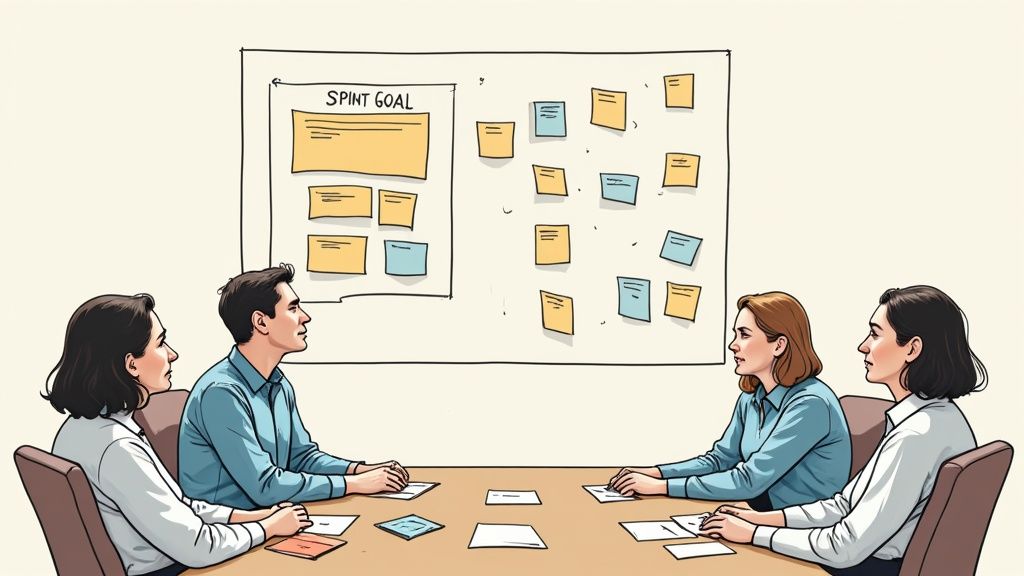
Defining the Sprint Goal
Before anyone even thinks about pulling individual tasks, the first order of business is to define the Sprint Goal. Think of it as the mission statement for the next couple of weeks—a single, clear sentence that explains why the team is doing the work. This gives everyone a north star to guide them.
For example, instead of just listing "add payment fields" and "integrate API," a much better Sprint Goal would be: "Implement a secure and streamlined checkout process for guest users to reduce cart abandonment." This goal empowers the team to make smart decisions on the fly and focuses their energy on the outcome, not just the output.
Selecting and Sizing the Work
With a clear goal in mind, the team can now turn to the Product Backlog. The Product Owner will champion the highest-priority items that align with the mission, and the Developers will then forecast how much of that work they can realistically pull into the sprint. This isn't a wild guess; it’s based on their past performance (velocity) and current availability.
This is where estimation plays a key role. Forget trying to pin exact hours on tasks—it's a recipe for frustration. Instead, most agile teams focus on relative sizing. One of the most popular and effective techniques for this is Planning Poker.
Planning Poker is a consensus-based approach where team members use numbered cards to estimate the effort for each backlog item. The real value isn't the number itself, but the conversation it sparks. It quickly brings different perspectives and hidden assumptions to the surface, helping the team arrive at a much more reliable forecast.
By talking through and agreeing on the size of each item, the team develops a shared understanding of what it will take to get the job done. This collaborative process is crucial for creating a plan everyone can stand behind. If you're new to this, exploring a guide on running a successful agile sprint planning session can make a huge difference.
Breaking Down User Stories
Once the high-level stories are selected, it’s time to get granular. The team breaks each one down into smaller, bite-sized tasks. A great rule of thumb is to ensure no single task takes more than one day to complete. This isn't micromanagement; it's a smart strategy that:
- Clarifies the exact steps needed to finish a story.
- Makes progress visible and easy to track on the sprint board.
- Allows multiple people to swarm on a complex story.
- Uncovers technical roadblocks or unanswered questions early.
This detailed plan—the Sprint Goal plus the backlog items broken into tasks—officially becomes the Sprint Backlog. It’s a living, breathing plan made by the team, for the team.
Common Sprint Planning Pitfalls and How to Avoid Them
Even with the best intentions, sprint planning can easily go off the rails. It’s a skill that teams refine over time. Recognizing common missteps is the first step toward building a more effective and less frustrating planning process.
| Common Pitfall | Impact on Sprint | Solution |
|---|---|---|
| No Clear Sprint Goal | The team lacks focus and direction, leading to disconnected work and a low-value increment. | Start every planning session by drafting and agreeing on the Sprint Goal before selecting any backlog items. |
| Product Owner Dictates the Plan | Developers feel no ownership and are less committed. The forecast is often unrealistic. | The Product Owner sets the what and why; the Developers determine the how and how much. Foster a collaborative environment. |
| Ignoring Team Capacity | The team is overloaded and stressed, leading to burnout, poor quality, and a failed sprint. | Always account for vacations, holidays, and other commitments. Use historical velocity as a guide, not a target. |
| Vague or Poorly Defined Stories | The team wastes time mid-sprint seeking clarification, causing delays and rework. | Ensure the Product Backlog is well-refined before planning. The top items should be clear, concise, and ready for work. |
| Estimating in Hours | Leads to inaccurate forecasts and debates over time instead of complexity and effort. | Use relative estimation techniques like Planning Poker (story points) to focus on the "size" of the work, not the time. |
By proactively addressing these issues, your team can turn sprint planning from a dreaded meeting into a powerful engine for alignment and productivity.
The impact of getting this right is huge. Organizations that fully embrace Agile practices have seen their commercial performance increase by up to 237%. Why? Because sprints help teams deliver real, working software on a regular cadence. This iterative delivery has led to a 60% increase in profits for some companies and contributed to a 75.4% project success rate for teams using Agile.
Ultimately, great sprint planning is an investment. When you do it well, you eliminate confusion, build team-wide alignment, and give everyone the confidence to deliver something truly valuable.
Executing the Sprint and Maintaining Momentum
Once the Sprint Goal is set and the backlog items are pulled in, the real work begins. This is where the team transitions from planning to doing. The key to a successful sprint isn’t about micromanagement or sticking to a rigid plan no matter what; it’s about fostering a rhythm of constant communication and transparency that lets the team adapt to whatever comes their way.
This is where the magic of the iterative cycle happens. Instead of a long, quiet stretch of development where no one knows what's going on, the sprint is a hub of focused activity. Momentum builds day by day through small wins and quick problem-solving, all centered around that one clear Sprint Goal.

The Daily Scrum: The Heartbeat of the Sprint
At the core of sprint execution is the Daily Scrum. Think of it as the team's daily huddle. It’s a fast-paced, 15-minute meeting that gets everyone aligned for the day ahead. It's often mistaken for a status report for management, but its real value is for the team to hold each other accountable and synchronize their efforts.
To keep things snappy and effective, each team member typically answers three key questions:
- What did I do yesterday that helped us move closer to the Sprint Goal?
- What will I do today to help us get there?
- Are there any roadblocks in my way or the team’s way?
This simple framework keeps the conversation laser-focused on the goal and brings any issues to the surface immediately. It’s not about justifying your time; it's about working together to clear the path forward.
The Scrum Master as an Impediment Remover
During the sprint, the Scrum Master’s role really comes to life. When someone flags a roadblock in the Daily Scrum—maybe a server is down, or they’re waiting on a decision from another department—the Scrum Master jumps on it. Their mission is to get that obstacle out of the team's way.
This is absolutely crucial. The Scrum Master acts as a shield, protecting the team from outside noise and internal hurdles. By relentlessly clearing the path, they allow the developers to stay in the zone and maintain momentum, making sure the sprint doesn't get derailed by things they can't control.
Their job isn't to manage the team, but to serve it. A great Scrum Master creates an environment where the team can self-organize and be incredibly productive because they're free from constant interruptions.
Visualizing Progress with Burndown Charts
So, how does the team know if they're actually on track? While the Daily Scrum gives a daily pulse check, a sprint burndown chart provides a clear, visual snapshot of progress. This simple graph plots the remaining work against the time left in the sprint.
The vertical axis shows the total work (usually in story points), and the horizontal axis shows the days of the sprint. Every day, the team updates the chart to reflect what they’ve completed. In a perfect world, you'd see a nice, steady line burning down to zero by the end of the sprint.
This chart is an honest, real-time progress report. If the actual work line starts creeping up too far above the ideal line, it’s a red flag. This early warning gives the team a chance to huddle up and adapt. Maybe they need to swarm a tough user story or simplify their approach. It turns a potential problem into a chance to pivot before it's too late.
This whole approach of iterative work and constant feedback is why agile teams often report higher morale. Research backs this up, showing that 59% of agile practitioners feel more aligned with business needs, and 57% see better collaboration. Sprints empower teams to deliver value step-by-step and tackle new challenges as they arise. You can dig into more of these benefits in the detailed Agile statistics on parabol.co.
How to Conclude Sprints with Reviews and Retrospectives
A sprint doesn’t just stop when the clock runs out. It wraps up with two of the most important events in the entire Scrum framework: the Sprint Review and the Sprint Retrospective. These meetings are the engine for continuous improvement, creating feedback loops that help the team build the right thing, and build it in the right way.
Without them, a sprint is just a chunk of time dedicated to work. With them, it becomes a powerful cycle of learning and adapting, which is what being agile is all about.
The Sprint Review: Showcasing the Work
First up is the Sprint Review. This isn't a stuffy, formal presentation or a sign-off meeting. Think of it as a casual, hands-on workshop where the team shows stakeholders what they’ve actually built. The whole point is to demonstrate the completed work and get immediate, honest feedback on the product.
Let's say your team just built a new checkout feature for an e-commerce site. During the review, you wouldn't just flash some slides. You’d actually walk stakeholders through the live, working feature on a test server. This direct interaction is where the magic happens—it sparks real conversations about what works, what doesn't, and what new ideas the finished work brings to light.
A great Sprint Review always includes:
- A "Done" Increment: The team only shows work that meets their agreed-upon Definition of Done. This ensures the feedback is based on a solid, functional piece of the product.
- A Collaborative Vibe: This is a two-way street. Stakeholders should be encouraged to ask questions, offer input, and discuss how the new increment might change future plans.
- An Evolving Product Backlog: The Product Owner takes all this great feedback and uses it to fine-tune the Product Backlog, making sure the next sprint is even more on target.
The review is all about inspecting the product itself and adapting the plan for the future. It's how you make sure every sprint delivers real value and keeps the team locked in on business goals. The question it answers is simple: "Did we build the right thing?"
The Sprint Retrospective: Improving the Process
Right after the review, the team huddles up for the Sprint Retrospective. While the review was all about the product, the retrospective is all about the process. This is a private meeting just for the Scrum Team—the Product Owner, Scrum Master, and Developers—to look back on the sprint that just finished.
The goal here is to create a safe space for the team to be open and honest. You inspect everything: how you worked together, the tools you used, and the processes you followed. This isn't a complaint session; it's a constructive conversation aimed at finding at least one actionable improvement for the next sprint.
The Sprint Retrospective is the heartbeat of continuous improvement in Scrum. Teams that take this meeting seriously are the ones that consistently get more effective, collaborative, and predictable over time.
To get the conversation flowing, many teams use a simple but effective framework by asking three key questions:
- What went well? (What should we keep doing?)
- What didn’t go so well? (What roadblocks did we hit?)
- What will we improve? (What one thing will we change in the next sprint?)
The best retrospectives end with a clear commitment to try one specific process improvement. It’s this focus on small, incremental changes that turns good teams into great ones. For teams wanting to mix things up, there are tons of creative formats out there. You can find some fantastic ideas in this detailed sprint retrospective template guide to keep your discussions fresh and productive.
Answering Your Top Questions About Sprints
Once a team gets into the rhythm of agile development, it's only natural for questions and tricky situations to pop up. Knowing how to navigate these common hurdles is what separates a team that’s just going through the motions from one that’s truly thriving. This is where the theory of the Scrum Guide meets the reality of day-to-day work.
Think of it this way: the official guide gives you the rules of the road, but experience teaches you how to handle the traffic. Gracefully managing unfinished work or a sudden, urgent bug is what makes a team strong, resilient, and genuinely self-organizing.
What Happens If We Can’t Finish All the Work in a Sprint?
First off, don't panic. This happens to everyone, even the most seasoned teams, and it’s not a sign of failure. When a sprint ends with unfinished work, the item doesn't automatically roll over into the next one.
Instead, that incomplete story or task goes straight back to the Product Backlog. From there, the Product Owner has to re-prioritize it against everything else. It might be the very next thing the team picks up, or a new business need might have jumped ahead of it in the queue.
The most important thing to do is figure out why it wasn't finished. This is a core topic for your Sprint Retrospective. Was the estimate way off? Did we hit unexpected roadblocks? Were the requirements fuzzy to begin with?
This conversation is pure gold. It's not about pointing fingers; it's about learning and getting better. By digging into the root cause, the team can make smarter, more realistic plans for the next sprint and get much more accurate with its forecasting over time.
Can We Change the Sprint Scope Once It Has Started?
Ideally, no. One of the core principles of a sprint is that the Sprint Backlog is locked in once the sprint begins. This commitment is crucial because it shields the team from distractions and creates a stable environment where they can focus entirely on achieving the Sprint Goal. The Scrum Master's job is to fiercely protect that focus.
But let's be realistic—agile is also about adapting. In truly exceptional circumstances, like a massive market shift that makes the Sprint Goal totally obsolete, the Product Owner has the authority to cancel the sprint. This is a huge deal and should be an absolute last resort.
If you find stakeholders are constantly trying to add new things mid-sprint, it usually points to a bigger problem. Maybe your sprints are too long to keep up with the business, or perhaps stories aren't being clearly defined before sprint planning. Most new ideas should simply be added to the Product Backlog, ready to be prioritized for a future sprint.
How Should We Handle Urgent Bugs During a Sprint?
Every development team deals with unplanned work. The best teams don't pretend it won't happen; they build a strategy for it. A really effective approach is to deliberately set aside a small slice of the sprint's capacity—say, 10-15%—for those "fire drill" moments and critical bugs.
The Product Owner acts as the gatekeeper here. They have the final say on whether a bug is a true showstopper that needs to derail the current plan. If it's not a critical, production-is-down kind of issue, it should be treated like any other piece of work: add it to the Product Backlog, estimate it, and prioritize it accordingly.
Having a clear, agreed-upon policy for this is key. It stops every little emergency from derailing the team and ensures that only the most critical problems get to jump the queue, striking a healthy balance between predictable delivery and responsive support.
What’s the Difference Between a Sprint and an Iteration?
You'll often hear these terms used interchangeably, but there's a subtle and important distinction that clarifies which agile framework you're actually using.
- Iteration: This is the generic, umbrella term for any fixed-length development cycle. Frameworks like Extreme Programming (XP) or even Kanban (when using a cadence) work in iterations.
- Sprint: This is the specific name for an iteration within the Scrum framework.
So, all Sprints are iterations, but not all iterations are Sprints. A Sprint is much more specific. It comes with a whole package of rules, defined roles (Product Owner, Scrum Master, Developers), and a non-negotiable set of events like Sprint Planning, the Daily Scrum, a Sprint Review, and the Sprint Retrospective. When you call it a Sprint, you’re signaling that you're committed to playing by Scrum's rules.
Ready to make your sprint planning sessions more effective and engaging? Scrum Planning Poker offers a free, simple, and powerful tool to help your team achieve consensus on estimates without any friction. Start a session in seconds with no signup required and see how collaborative estimation can transform your agile process. Get started for free at onlineplanningpoker.com.